
 E-Paper



With scripts on brink of extinction, HP history buffs look to restore vanishing culture
Takri, Bhatakshri, Pandavani, Chandvani and HP history buffs are some minority scripts which are threatened with demise and there are no exact figures to ascertain how many have vanished in the recent past

 Prefer HTon Google


The significance of ancient scripts lies in the fact that these are not only mere a tool to write languages, but also associated with cultural identity.
Each distinct script has a tale to tell about history of its culture, evolution and values which are important for traditions to be passed down to generations.
As per the United Nations Educational, Scientific, and Cultural Organization (UNESCO) estimates, over half of about recognised languages will disappear by the end of the 21st century. Over the past century alone, nearly 400 tongues died all over the world.
Himachal, a culturally rich state in north of India, is also not untouched by this linguistic catastrophe as many of its scripts are on the brink of extinction. Takri, Bhatakshri, Pandavani, Chandvani and Pabuchi are some minority scripts which are threatened with demise and there are no exact figures to ascertain how many have vanished in the recent past.
A glimmer of hope
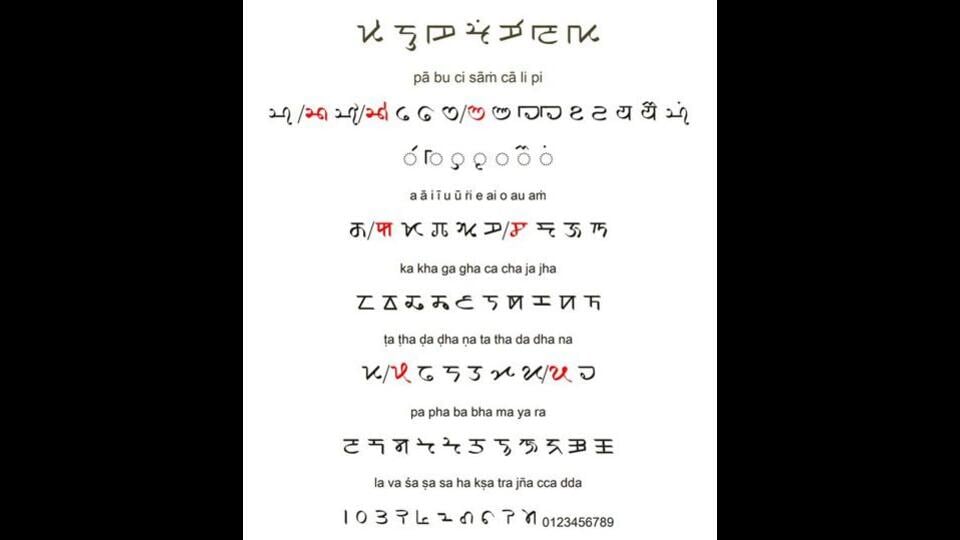
However, all is not lost yet and there is still a glimmer of hope as Kullu-based history buff has teamed up with a linguist from Port Blair and developed digital fonts for Pabuchi.
Yatin Pandit, 38, a self-taught historian who teaches Takri script, said he was always interested in the ancient scripts of Himachal.
When I heard of fonts developed for Takri script by Sambh, a Kangra-based group, the desire to preserve other vanishing scripts got stronger, said Pandit.
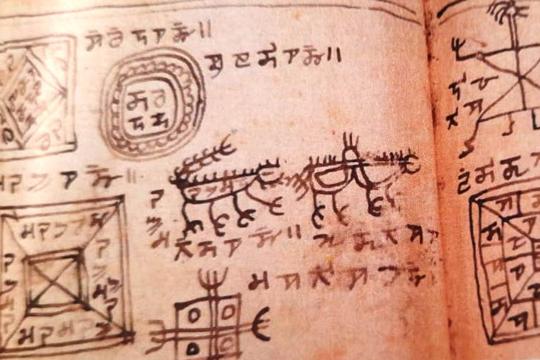
Pabuchi, which traces its roots to Kashmir, was primarily a script of Sancha Vidya — a combination of jyotish (astrology) and tantric knowledge. Pandit said he had shared some alphabets of the script on Twitter where he came in contact with Biswajit Mandal, a linguist from Andaman and Nicobar and they agreed upon developing a font for the script.
A teacher by profession, Mandal is a font creator, and linguistic content supplier for Omniglot (an online encyclopedia focused on languages and writing systems) and the Endangered Alphabets (a group preserving endangered cultures by using their writing systems to create artwork and educational materials).
“I provided him some literature available with me while Mandal developed rest of the research and developed the font,” he said, adding that font has yet not released as verification of alphabets is under progress by both of them.
He said the major problem they were facing was lack of manuscripts in Pabuchi. He said once the Covid pandemic is over, they intend to team up for preservation of other scripts of Sancha Vidhya, including Bhatakshri, Pandavani and Chandvani.
He said if these scripts vanish, a culture will be lost.
Pabuchi: Origin, evolution and fall
In remote parts of Shimla, Kullu, Mandi and Kinnaur districts, people consult oracles, mostly associated with local deities, when a calamity strikes or someone falls ill or even for an auspicious occasion. This practice has been passed on through generations as oral tradition. However, in Chopal and Sirmaur, it is preserved in a documented form, written in rare scripts like Pabuchi.
Pabuchi is used by Pabuch Brahmin families of Khadkanh village in Sirmaur . Pabuchi, the abugida (an alphabetic writing system) of Brahmic family, is believed to have originated in 10th or 11th century from Sharda script and travelled to Himachal from Kashmir via Jaisalmer.
Historians believe that an heirless king from Sirmaur married a princess from Jaisalmer, who brought with her Pabuch scholars brilliant in astrology, astronomy and tantric knowledge.
Another story has a different version. Whatsoever, the Pabuch brought with them their knowledge. Their divination involved Sancha, or astrological charts and diagrams, so this style is called Sancha Vidhya.
Later, a branch of Pabhuch Brahmins settled in Dhar Chanana of Chopal and who transliterated their knowledge into the local languages and the script thus became Chandvani. Similarly, the script used by Panda clan came to be known as Pandavani while that by Bhatt Brahmins as Bhatakshri.
However, over the period of time, younger generation gave up Sancha practice. Since, Sancha texts were in unknown scripts, they are used by descendants of the particular clan. They were not shared with outsiders for the fear of losing their powers.
Quick facts about Pabuchi
Origin: 10th or 11th Century
Mother script: Sharda
Place of origin: Kashmir
Use: Used to write texts of Sancha Vidhya, a combination of jyotish (astrology) and tantric knowledge.
Extent: Sirmaur, Chopal (Shimla) and Jaunsar-Bawar of Uttarakhand


