
 E-Paper



4 effluent treatment plants failed to meet norms in Feb
This also comes after Pink froth seen over the Okhla barrage of the Yamuna, sparking concerns about chemicals, dyes and untreated industrial effluents

 Prefer HTon Google


The Delhi Pollution Control Committee (DPCC)’s monthly assessment of the Common Effluent Treatment Plants (CETPs) in Delhi’s industrial areas has found that four of the total 13 plants failed to meet the water treatment standards for the month of February, while reports for two others were not available. This comes even as the Delhi government has initiated the administrative takeover of the Okhla CETP after an inspection found multiple operational deficiencies at the facility.
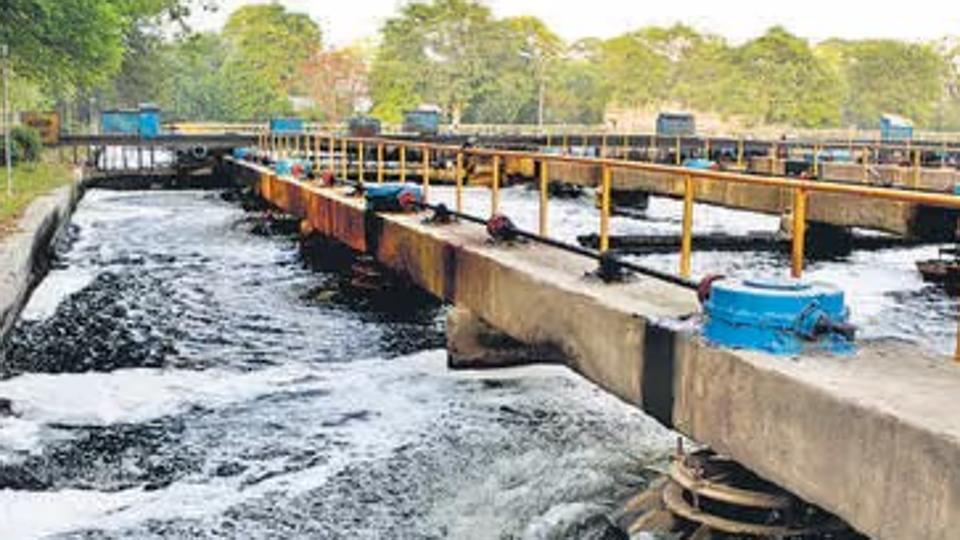
This also comes after Pink froth seen over the Okhla barrage of the Yamuna, sparking concerns about chemicals, dyes and untreated industrial effluents ending up in the river.
Of the 28 approved industrial areas in the national capital, only 17 are connected to the 13 CETPs that collect and treat industrial wastewater to meet environmental standards. The remaining areas, as well as 26 unplanned industrial areas, dispose of their waste into stormwater drains, which eventually flow into the Yamuna River, significantly contributing to its pollution.
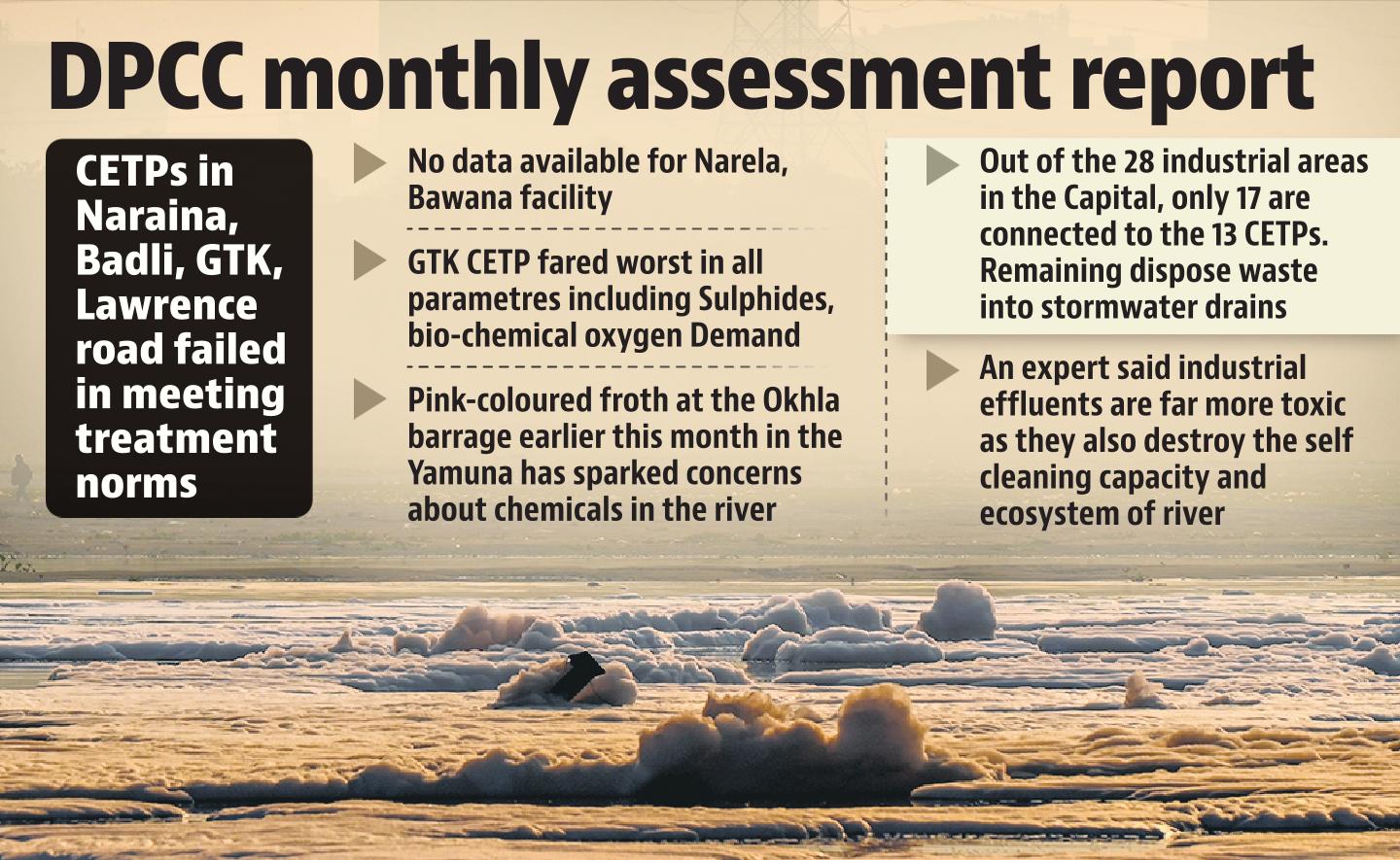
DPCC’s assessment report for the month of February shows that CETPs in Naraina, Badli, GTK and Lawrence road industrial area failed the treatment norms, while no data was available for Narela and Bawana facility. It was not clear why the data was not available.
The GTK CETP fared the worst with outlet water failing on multiple parameters, including Sulphides, Bio-chemical Oxygen Demand (BOD), and Total Suspended Solids (TSS). The Naraina and Lawrence road facility failed on treatment of Sulphides while the Badli CETP on BOD.
According to the report, against the maximum permissible BOD level of outlet water of 30mg/L, the GTK CETP recorded a BOD of 40mg/L; TSS level of 120 mg/L against the standard of 100 mg/L and Sulphide level of 3.6mg/L against the desired limit of less the 2mg/L. The Suphide levels at the Lawrence road CETP were at 2.2mg/L and the Badli CETP recorded at BOD level of 37mg/L.
The CETPs in other areas were found to be compliant
While the report, dated March 6, said that Okhla CETP met the treatment norms. However, resampling was carried out at the facility following a video widely circulating online that purportedly showed dark and untreated discharge into a nearby drain. Days later, on March 20, citing operational deficiencies, DPCC asked the industries department “to take over operation and maintenance of Okhla CETP within 30 days”.
Under the 1996 “MC Mehta vs Union of India & others” case regarding pollution in Delhi, Supreme Court had approved Delhi government’s scheme to construct the CETPs through Delhi State Industrial And Infrastructure Development Corporation (DSIIDC) in Industrial Estates of Delhi, for the treatment of industrial effluent generated by the industries. The cost was to be shared by the government and the industries on ‘Polluters pays Principle’. After the CETPs were built, in 2005, they were handed over to the respective CETP Society under the provisions of the Delhi Common Effluent Treatment Plant Act, 2000, and Rules, 2001. DPCC and the industries department supervises their operations.
A Delhi government report on the industrial pollution submitted to the Union water ministry last year said that there are 28 approved industrial areas in Delhi which have 29,823 industrial units. Of these, the effluents from 17 areas are being diverted to the 13 CETPs while the remaining 11 industrial areas with 3,419 units do not have a CETP. The report notes that the overall capacity of the 13 CETPs is 212.3 MLD (million liters per day), however, the utilisation is extremely poor.
For instance, DPCC February report are notes the poor utilisation, with none of 11 CETPs operating as per capacity. For instance, the flow at Naraina CETP was 5.3 MLD against capacity of 21.6 MLD; Mayapuri CETP had flow of 4MLD against 12 MLD; Okhla at 2.17MLD against 24 MLD capacity; Badli had 1.6 MLD against 12 MLD. Lawrence road, SMA and Nangloi CETPs each have to treat 12 MLD waste water but they reported flow of just 1.3 MLD, 2.09 MLD and 2.9 MLD respectively.
Besides the 28 approved Industrial Areas, there are 26 unplanned industrial areas which are non-conforming clusters of industries earmarked by the Delhi government for redevelopment. These areas which lack CETPs despite their dense industrial activity include Anand Parbat, Shahdara, Libaspur, Peeragarhi, Khyala, Shalimar Village, Nawada, Rithala, Karawal Nagar, Mundka and Mundka Udyog Nagar, Tikri Kalan, among others.
A government official on condition of anonymity said large number of industries in the non-conforming areas not water polluting industries. “We are in process of creating redevelopment plans of these areas. As far as CETPs flouting norms are concerned, penalties worth more than ₹20 crore have been imposed on the operators from time to time. Some of these operators have approached courts against these fines,” official said.
The DPCC did not respond to HT’s requests for comment.
Bhim Singh Rawat, Yamuna activist and member of the South Asia Network on Dams, Rivers and People (SANDRP), said that industrial effluents are far more toxic for the river health as compared to sewage as they also destroy the self cleaning capacity and ecosystem of the river and Delhi has completely failed to tackle this governance issue.

Stay updated with all top Cities including, Bengaluru, Delhi, Mumbai and more across India. Stay informed on the latest happenings in World News along with Delhi Election 2025 and Delhi Election Result 2025 Live, New Delhi Election Result Live, Kalkaji Election Result Live at Hindustan Times.


