With the fire at Bhalswa landfill continuing to rage, even 24 hours after it started on Tuesday evening, Delhi’s air quality took a hit on Wednesday, as the air quality index reading worsened to the higher ranges of the ”poor” category, logging a reading of 287, according to the Central Pollution Control Board’s (CPCB) daily 4pm bulletin.
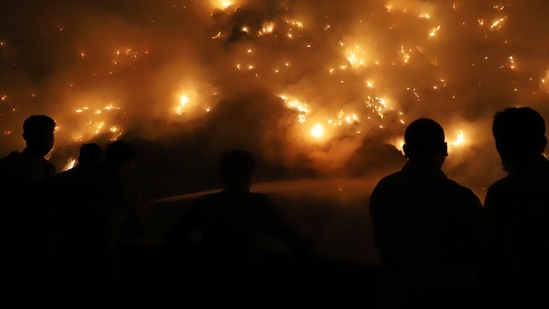
The reading is up from Tuesday’s figure of 209, also in the poor category, the CPCB figures showed. The air quality data maintained by another government body, Safar, painted an even more grim picture — the air quality went from ”moderate” on Tuesday to ”very poor” on Wednesday, a change that was attributed largely to the landfill fire.
The Safar bulletin said, “The air quality index is in the lower end of the “very poor” category with dominance of coarse particles due to the prevailing dry weather. Emissions from landfill fire that began on Tuesday has degraded the AQI from ”moderate” to ”very poor” and is likely to stay in this range for the next three days, owing to low wind speed.”
Gufran Beig, founder project director of Safar, said normally, landfill fires do not have such an impact on the air quality, unless the fire is prolonged and widespread. “The (Bhalswa) fire has been raging for over 24 hours and the lead pollutant, which is generally PM10 (particulate matter with a diameter of 10 micrometres) at this time of the year, has shifted to PM 2.5 (particulate matter with a diameter less than 2.5 micrometres) . While PM10 is generally due to dust, PM2.5 comes from combustion and fossil fuels and this fire is the only major addition to combustion in Delhi,” said Beig, adding that Safar’s nearest air quality station in Dhirpur was recording ”severe” AQI readings (500+) on Wednesday.
{{/usCountry}}Gufran Beig, founder project director of Safar, said normally, landfill fires do not have such an impact on the air quality, unless the fire is prolonged and widespread. “The (Bhalswa) fire has been raging for over 24 hours and the lead pollutant, which is generally PM10 (particulate matter with a diameter of 10 micrometres) at this time of the year, has shifted to PM 2.5 (particulate matter with a diameter less than 2.5 micrometres) . While PM10 is generally due to dust, PM2.5 comes from combustion and fossil fuels and this fire is the only major addition to combustion in Delhi,” said Beig, adding that Safar’s nearest air quality station in Dhirpur was recording ”severe” AQI readings (500+) on Wednesday.
{{/usCountry}}This spike is also reflected in the data maintained by the Delhi Pollution Control Committee (DPCC).
The Jahangirpuri air quality station, the DPCC station just 5km away from the site, showed spikes in the hourly PM2.5 and PM10 readings and they were nine to 10 times above the safe limits -- 60μg/m3 for PM2.5 and 100μg/m3 for PM10 -- early on Wednesday.