Which is Delhi’s greatest monument? Grandeur alone won’t do. Age also matters. When you look at a truly old monument, you’re looking at all the centuries it has stood there and the history that has seeped into its stones. To qualify, a monument should predate British-built New Delhi and retain much of its original structure. The hardest test is how much a monument belongs to the city’s everyday life. Tughlaqabad Fort and Purana Qila can feel a world away from the street. The tombs in Lodhi Garden come closer. For those who walk in the park every morning, the tombs are part of the round.
Or take Qutub Minar. You can see it across south Delhi, even from the rooftops of South Extension. The tower tapers as it shoots skyward, and seems to belong entirely to itself.
The dome of Humayun’s Tomb is a prized view from the rooftops of Nizamuddin East. But buy a ticket, cross the garden and climb to the tomb, and the city recedes. At Hauz Khas, local villagers can enter without a ticket. A boy who lives beside the monument goes there daily to play on the lawn. But apart from Feroze Shah Tughlaq’s tomb, much of the complex survives in fragments.
Some of the Red Fort’s old buildings did survive the British demolitions. But from the street, you mostly see the red ramparts. At the gateway, visitors take selfies with the fort behind them.
And then there is Jama Masjid, which Shah Jahan built atop a hillock in his new capital. For all its height, it is a long way from the ivory tower of monuments. All day, citizens and occasional tourists sit on its stone steps, getting their ears cleaned by red-capped ear cleaners or simply watching the bustle of the bazaar across the way. The street has come up to the steps of Jama Masjid.
{{/usCountry}}And then there is Jama Masjid, which Shah Jahan built atop a hillock in his new capital. For all its height, it is a long way from the ivory tower of monuments. All day, citizens and occasional tourists sit on its stone steps, getting their ears cleaned by red-capped ear cleaners or simply watching the bustle of the bazaar across the way. The street has come up to the steps of Jama Masjid.
{{/usCountry}}Over the centuries, Jama Masjid, too, has come down into the streets. It has as much presence in Old Delhi’s galis as the groceries, tea stalls and houses. From one lane you catch half a dome, from another the top of a minaret. Go upstairs in one of those houses and there it is again, framed by a kitchen window, or seen past the clothes drying on the roof.
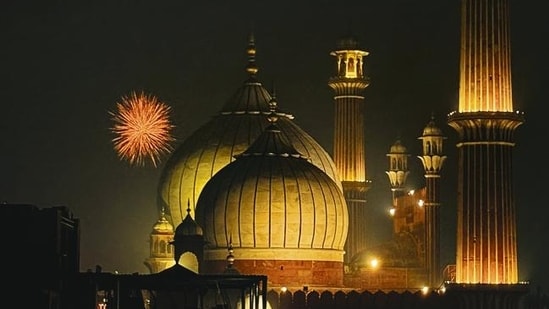
On Chhoti Diwali last Saturday night, fireworks were going up from one of the streets, bursting into sparks right beside the mosque’s central dome. See photo.
Jama Masjid is still a place of prayer for one of Dilli’s many faiths, and it is impossible to imagine the lanes and rooftops of Purani Dilli without it. But perhaps Delhi is too large and too various for any one monument to stand for it all. Our city is greater than its great monuments.