
 E-Paper



DTCP defends jurisdiction at DLF Phase 1–5 hearing on violations
Property owners argued municipal laws apply, while DTCP said licensed colonies fall under state law and violations attract action by the Director only.

 Prefer HTon Google


The department of town and country planning on Monday held a public hearing for property owners in DLF Phase 1 to Phase 5 who have been issued notices for violations of sanctioned building plans, illegal commercial activities and other related issues. During the hearing, the department reiterated that it has full legal jurisdiction to act in licensed private colonies even if they fall within municipal limits.

The hearing was conducted by Amit Madholia, district town planner, enforcement, following directions issued by the Supreme Court. The apex court had asked the Punjab and Haryana High Court to ensure that property owners were given an opportunity to be heard after residents challenged the notices issued by the department.
Over the past year, the department of town and country planning has issued notices to around 4,500 property owners in DLF Phase 1 to Phase 5 for various violations. Residents subsequently approached the Supreme Court seeking relief, arguing that the department lacked jurisdiction, as the area falls under the Municipal Corporation of Gurugram.
Addressing these objections, Madholia clarified that the department operates under the Haryana Development and Regulation of Urban Areas Act, 1975, not the 1963 Act. He stated that licensed colonies such as DLF Phase 1 to Phase 5 are governed by the 1975 Act, under which the department grants licences for residential development and approves zoning layout plans.
“The jurisdiction of the DTCP is applicable in a licensed colony even if the area falls in municipal areas. The colonies that have come up in DLF Phase-1 to Phase-5 are a licensed area. All violations found here are related to the Haryana Urban Development Act of 1975 and the licence conditions. Therefore, the Town and Country Planning Department has complete jurisdiction in this area, and the action taken by the department is completely valid according to the law,” observed Madholia.
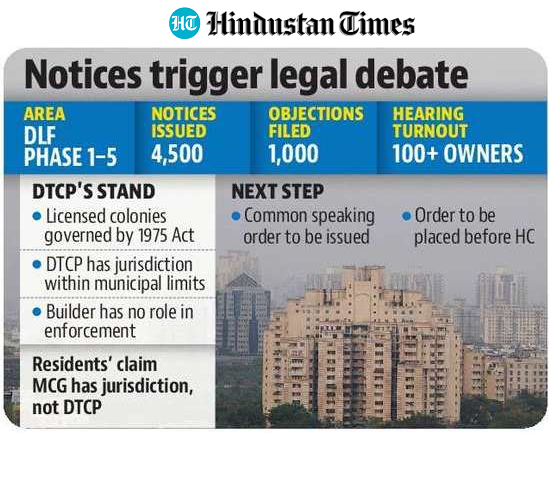
According to DTCP officials, around 4,500 notices have been issued to property owners in DLF Phase 1 to Phase 5 for various violations. “Around 1,000 property owners have filed objections and replies to these notices, and over 100 owners were present during the hearing. Enforcement action in licensed plotted colonies, including DLF Phase 1 to Phase 5, is carried out solely by the department, and the builder has no role in the process,” said a senior DTCP official.
According to DTCP officials, more than 100 property owners attended the hearing at the department’s office on Monday. Most objectors argued that since DLF areas are under the municipal corporation, the Town and Country Planning Act, 1963, does not apply and the department has no authority to take action. They further submitted that building plans and occupancy certificates are issued under the 1963 Act, placing jurisdiction solely with the municipal corporation.
Department officials further explained that violations in building plans or occupancy certificates would be treated as direct violations of the 1975 Act. In such cases, action under Section 3-B can only be taken by the Director, Town and Country Planning Department, or an authorised officer.
The department also cited judicial precedents, including the case of Shiva Ice Factory vs. Government of Haryana, where the Punjab and Haryana High Court upheld the department’s authority in licensed colonies within municipal limits. The Supreme Court dismissed the appeal against that judgment. A similar position was upheld in Exotica Condominium Owners Association vs. R.S. Business Solutions Private Limited.
“All the property owners were given an opportunity of hearing on Monday. Several property owners have filed their objections and these were clarified. We will now pass a common speaking order and share it with all owners who had filed objections. A copy of the same will be submitted to the Punjab and Haryana High Court,” said Madholia.
Advocate Anuj Saxena, a Supreme Court advocate representing the affected residents, said the hearing on jurisdiction was important, particularly after the Supreme Court set aside an earlier High Court order passed without hearing residents. “There are conflicting High Court rulings on whether the Municipal Corporation of Gurugram or the department of town and country planning has jurisdiction in licensed colonies, and the issue would be placed before the High Court for clarity,” he added.

Stay updated with all the Breaking News and Latest News from Mumbai. Click here for comprehensive coverage of top Cities including Bengaluru, Delhi, Hyderabad, and more across India along with Stay informed on the latest happenings in World News.


