With Diwali less than a week away, Gurugram’s air quality deteriorated further on Monday, with the air quality index (AQI) reaching 246 at 4pm, its highest reading this pollution season, according to the Central Pollution Control Board’s (CPCB) Sameer app. The city remained in the ‘poor’ air quality category.
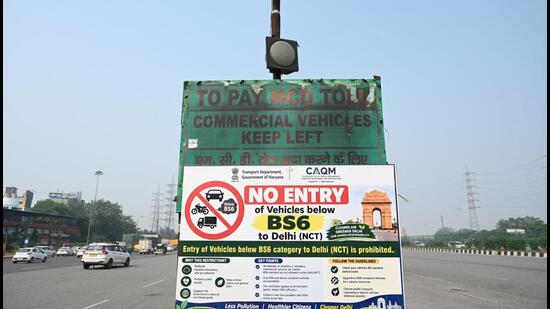
Meanwhile, the Commission for Air Quality Management (CAQM) invoked Stage 2 of the Graded Response Action Plan (GRAP) across Delhi-NCR as Delhi’s air quality deteriorated to the ‘very poor’ category and pollution levels worsened across the region.
Under Stage 2, authorities are required to intensify pollution-control measures, including increasing parking charges to discourage private vehicle use, augmenting public transport services and staggering office timings to reduce traffic congestion. These measures supplement existing restrictions, including mechanical road sweeping, water sprinkling and stricter enforcement of dust-control norms at construction sites.
Of Gurugram’s four AQI monitoring stations, Gwal Pahari recorded the highest reading at 291, followed by Sector 51 at 248 and Teri Gram at 247, all in the ‘poor’ category. Vikas Sadan recorded the cleanest air, with an AQI of 197 (‘moderate’).
According to the Sameer app, Gurugram’s AQI stood at 69 (‘satisfactory’) on Friday, 88 (‘satisfactory’) on Saturday and 183 (‘moderate’) on Sunday, before rising sharply to 246 on Monday.
{{/usCountry}}According to the Sameer app, Gurugram’s AQI stood at 69 (‘satisfactory’) on Friday, 88 (‘satisfactory’) on Saturday and 183 (‘moderate’) on Sunday, before rising sharply to 246 on Monday.
{{/usCountry}}The city recorded six days of ‘poor’ air quality in October, with the monthly peak reaching 240 on October 29. In September, the AQI peaked at 242 on September 22, while four days fell in the ‘poor’ category.
PM10 was the dominant pollutant across all four monitoring stations on Monday, indicating elevated concentrations of coarse particulate matter. PM10 refers to inhalable particles measuring 10 micrometres or less in diameter, commonly associated with road dust, construction activities, vehicular emissions and other sources.
Air quality remained poor across much of the National Capital Region (NCR). According to the CPCB’s Sameer app, Delhi recorded an AQI of 325 and Noida 334, both in the ‘very poor’ category. Ghaziabad and Greater Noida recorded 291 each (‘poor’), while Faridabad fared relatively better at 114 (‘moderate’).
Gurugram was the fourth most polluted city in Haryana on Monday. Kaithal recorded the highest AQI at 318 (‘very poor’), followed by Ambala at 285 and Kurukshetra at 260, both in the ‘poor’ category.
Despite the recent deterioration, Gurugram recorded its cleanest October air quality since monitoring began in 2016, with the monthly average AQI dropping to 162. The improvement was aided by intermittent rainfall during the month, although pollution levels have risen sharply since the rains subsided.
Stay updated with all the Breaking News and Latest News from Mumbai. Click here for comprehensive coverage of top Cities including Bengaluru, Delhi, Hyderabad, and more across India along with Stay informed on the latest happenings in World News.
Stay updated with all the Breaking News and Latest News from Mumbai. Click here for comprehensive coverage of top Cities including Bengaluru, Delhi, Hyderabad, and more across India along with Stay informed on the latest happenings in World News.