Chandra Shekhar Azad’s emergence as the declared chief ministerial face of the All India Majlis-e-Ittehadul Muslimeen- Azad Samaj Party (Kanshi Ram) alliance for the 2027 Uttar Pradesh assembly elections is widely seen as a calculated attempt to fill the leadership vacuum left by the Bahujan Samaj Party’s prolonged decline even as the new front faces the challenge of countering the perception created by other Opposition parties that it is the “B team” of the BJP in a largely bipolar BJP-SP electoral landscape.
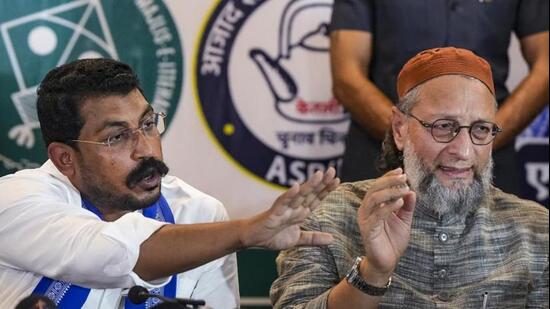
By joining hands with Asaduddin Owaisi’s AIMIM, Azad is also seeking to widen his appeal beyond core Dalit voters to Muslim communities, potentially creating a new combination that could cut into the support bases of both the SP and the BSP.
Nevertheless, the gap between ambition and electoral reality is stark. In the 2022 Uttar Pradesh assembly elections, AIMIM contested nearly 95-100 seats but won none, finishing with a vote share of around 0.49 per cent. Azad’s ASP fielded candidates on over 100 seats and secured only about 0.13% of the vote. Azad himself contested against chief minister Yogi Adityanath in Gorakhpur Urban where he polled just 7,640 votes and lost his deposit.
Both the AIMIM and ASP’s influence remains concentrated primarily in a handful of districts in western Uttar Pradesh — Saharanpur, Bijnor, Moradabad, Muzaffarnagar and adjoining areas — where significant Dalit and Muslim populations offer a natural base.
Expanding beyond these pockets into a genuine statewide force has so far proved elusive.
{{/usCountry}}Expanding beyond these pockets into a genuine statewide force has so far proved elusive.
{{/usCountry}}Overcoming the “B team” perception, while converting limited regional strength into a credible challenge across Uttar Pradesh, will be the central test of their claim to serious opposition status.
Whether Azad is accepted as a serious contender for the top job will depend on his ability to turn visibility into a durable organisational network and a meaningful vote share. Winning the Nagina Lok Sabha seat without allies in 2024 demonstrated potential, creating ripples in political circles. Projecting himself as a chief ministerial face raises the stakes considerably.
Azad first drew sustained national attention through activism and his breakthrough electoral win. Congress leader Priyanka Gandhi’s visit to him in hospital further underlined the notice he had begun to attract across party lines. Earlier efforts to align with the Samajwadi Party did not succeed; thereafter Azad focused on building an independent identity centred on Dalit assertion and broader social justice themes.
Political reactions have so far remained measured.
Samajwadi Party spokesperson Udayveer Singh, responding to the joint press conference by Owaisi and Azad in Lucknow, said: “Certainly, it is election time, so all parties are forming alliances according to their convenience and understanding. This party is also forming one; they are welcome, and they will form their own alliance. We are also in our own alliance, and our objective is to uproot and throw out the Bharatiya Janata Party government. So, certainly, the people of the state have to decide who is fighting the Bharatiya Janata Party and how at this time.”
Congress MP Imran Masood acknowledged that everyone has the right to do politics in their own way, wished the alliance well, and stressed that Congress would continue on its independent path. Changing the government in Uttar Pradesh is not easy, he observed, and the contest remains tough. Masood added that Congress already has faces representing different communities, but politics is ultimately about delivery and a clear vision rather than empty promises or mere community representation.
Political analyst and former head of the Political Science Department at Lucknow University, SK Dwivedi, described the CM-face declaration as ambitious and premature.
“Both parties should start working to strengthen their ground force for now,” he said.
Dwivedi noted that Muslim voters of the SP and Dalit voters of the BSP might be influenced by the alliance to some extent, which could ultimately help the BJP. He credited Azad with taking advantage of the vacuum created by BSP leadership, pointing out that the ASP chief remains accessible, holds meetings and stays in touch with people, in contrast to Mayawati’s relatively low-profile, social-media-centric approach.
The coming months will reveal whether this move is a strategic masterstroke that forces other parties to recalibrate, or an overreach that remains largely symbolic. For now, Azad has ensured that the conversation about Dalit leadership and alternative fronts in Uttar Pradesh can no longer ignore him.