
 E-Paper



High-beam menace: As glare on roads grows, RTO concedes no mechanism to curb it
High-beam headlights are blinding drivers at night, making roads unsafe. Authorities lack enforcement tools, leading to increased health risks and accidents.

 Prefer HTon Google


Headlights switched to high-beam - blinding drivers - have turned night driving into an ordeal for motorists, yet transport authorities admit they lack both the tools and the system to act against the menace.
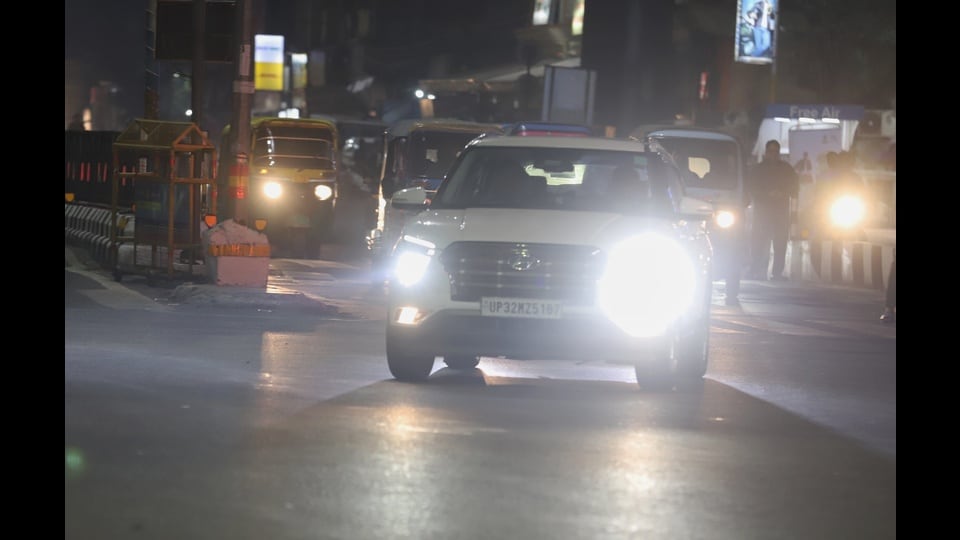
Enforcement agencies concede that there is no practical mechanism to check or penalise the use of illegal or excessively bright headlights.
For 59-year-old advocate Ramesh Mishra, the problem has already altered his life. He has stopped driving at night altogether. “When a high-intensity headlamp hits my eyes, I am blinded for a few seconds. That itself can cause an accident,” he said, adding that unchecked use of headlights on high beam and illegal modifications have made city roads unsafe.
“I hardly drive at night now, not even within the city. The glare from high beams is unbearable,” said Gyanendra Tiwari, a 54-year-old businessman.
And it’s not just the middle-aged. The problem cuts across age groups. Suryansh Gupta, 26, said he continues to drive at night but does so with constant anxiety. “Many people in luxury cars use high beams recklessly. The person facing the high beam headlight cannot see anything,” he said.
Gupta’s experience at an aftermarket modification shop underlines the regulatory vacuum. “When I asked the shopkeeper what the standard was and how much wattage was allowed, he said there was no standard. He even suggested fitting a 300-watt light,” he said.
Rules exist, enforcement missing
Dr Rohit Baluja, member of the United Nations Road Safety Collaboration and president of the Institute of Road Traffic Education (IRTE), said the law is clear but enforcement is missing. “There are two issues, the headlamp itself and its usage. Central Motor Vehicle Rules 105 and 106 clearly specify the height, alignment and standards of headlamps. The law also states that no vehicle should blind a person coming from the front. Headlights must be deflective,” he said.
According to Baluja, while manufacturers get their headlamps tested and approved by the Automotive Research Association of India (ARAI), Pune, the real problem begins with aftermarket modifications. “Vehicle owners get headlights fitted from local markets - yellow, blue, hard white lights, powerful fog lamps, without any clarity on whether they meet standards. A common police officer has no way to check this on the road,” he said.
Baluja said the responsibility squarely lies with the transport department. “They must create a system or at least a manual that helps identify standard and non-standard lights. Today, night travel has become hazardous because people misuse high beams and fog lamps, often just to deck up their cars,” he said, adding that such violations should be treated as dangerous driving.
On the use of ‘Lux meters’ to measure headlight brightness, Baluja said, “As of now, there is no such system. There is no enforcement and hardly any awareness,” he said.
What is Lux Meter
A lux meter is a handheld device used to measure the intensity of light falling on a surface, expressed in lux. In the context of vehicle headlights, it can objectively assess how bright a headlamp is at a fixed distance and angle, helping authorities determine whether the light is within permissible limits or a hazard to oncoming traffic.
RTO admits lack of tools
Transport authorities themselves acknowledge their helplessness. Sanjay Tiwari, RTO officer, said headlights manufactured and approved by ARAI are permissible, including white lights. “As far as high-beam and low-beam usage is concerned, enforcement is limited to awareness. We advise people to drive on low beam, but no punitive or enforcement action is actually possible in such cases.” he said.
Tiwari admitted that stopping vehicles and taking action against high beam users is “not practically possible”. This can only be rectified through awareness and improved civic sense,” he said.
When asked specifically about lux meters or any device to measure whether LED headlights exceed legal brightness, Tiwari said the department has none. “We do not have any specific tool or meter to check the legality of these headlamps. There is no action that can be taken by us,” he said.
Standards without enforcement
Under AIS-010 and Central Motor Vehicles Rules, headlights must not blind a person standing eight metres away, must follow an asymmetrical beam pattern, cannot be mounted above 1.5 metres and are limited in number. However, with unregulated aftermarket sales and no equipment or system on the ground, these standards remain largely on paper.
Health risks and rising complaints
Medical experts warn that the issue goes beyond inconvenience. Senior eye specialist Dr Ramesh Chandra said repeated exposure to extremely bright headlights can damage the retina if the glare directly strikes the eyes. “If this happens frequently, it can have long-term consequences for vision,” he said.


