BARABANKI Visitors arriving in ‘Pure Barwan’, a quiet Awadhi village 86 km from Lucknow, would normally expect a warm ‘Ram-Ram’ or ‘Namaste’. Instead, they are greeted with an enthusiastic “Hola! Mi nombre es Sejal Sahu” (Hello, my name is Sejal Sahu) by 14-year-old Sejal and her friends — an unexpected Spanish welcome in the heart of rural Barabanki.
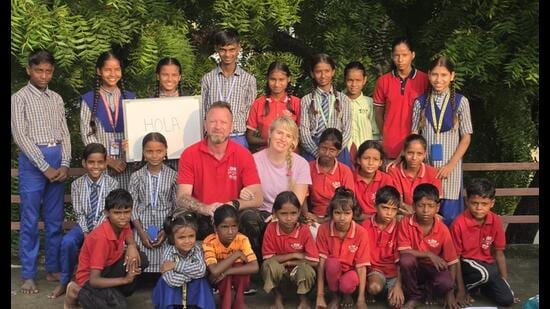
In this corner of Barabanki’s Haidergarh tehsil, Spanish has found an unlikely home. Around 50 to 60 children, some as young as five, attend ‘Our Language School’, where they fluently count into the hundreds and rattle off the months of the year. They strike up conversations with foreign tourists and act as tour guides for international visitors. The students have even traded traditional games like Gilli Danda for Lotería, a classic Spanish card game gifted by a visitor.
The linguistic revolution began during the Covid pandemic with brothers Rizwan and Mohammad Imran Khan.
While Rizwan, who founded the initiative, primarily manages rural and urban tourism and is a registered India Tourism Guide, Imran continues teaching Spanish and stays in the village. HT visited this village recently too see how this place is different from the other villages.
The journey began with Rizwan’s interest in languages and his desire to build an online platform during Covid lockdown. An LLB graduate, he initially wanted to build a career around Hindi.
{{/usCountry}}The journey began with Rizwan’s interest in languages and his desire to build an online platform during Covid lockdown. An LLB graduate, he initially wanted to build a career around Hindi.
{{/usCountry}}“While exploring online teaching resources, I noticed a gap in the availability of Spanish lessons for Hindi speakers. I also saw a lot of Spanish people who wanted to learn Hindi. So, in order to teach them Hindi, I first had to know Spanish as they don’t know English. I began learning Spanish online before deciding to teach it. The initiative took an unexpected turn during the pandemic, when I started teaching children outdoors with a laptop. Curious about the unfamiliar language, children gradually began gathering around me,” he told HT.
What started as an informal learning exercise slowly developed into a regular classroom, with children returning after school to learn Spanish.
Behind this unusual linguistic transformation are two brothers, Rizwan Khan and Mohammad Imran Khan. While Rizwan, who founded the initiative, primarily manages rural and urban tourism and is a registered India Tourism Guide, Imran continues teaching Spanish and stays in the village. HT visited this village recently too see how this place is different from the other villages.
The journey began with Rizwan’s interest in languages and his desire to build an online platform during Covid lockdown. An LLB graduate, he initially wanted to build a career around Hindi.
“While exploring online teaching resources, I noticed a gap in the availability of Spanish lessons for Hindi speakers. I also saw a lot of Spanish people who wanted to learn Hindi. So, in order to teach them Hindi, I first had to know Spanish as they don’t know English. I began learning Spanish online before deciding to teach it. The initiative took an unexpected turn during the pandemic, when I started teaching children outdoors with a laptop. Curious about the unfamiliar language, children gradually began gathering around me,” he told HT.
Today, Imran has taken on the responsibility of keeping those lessons going while Rizwan focuses on bringing visitors to the village.
The language classes have also become an unexpected bridge between the children and international tourists. Visitors from more than 20 countries have travelled to the village since the initiative began, most of them from Spanish-speaking countries. “Every year, 10 to 20 tourists visit us. Since we started, people from more than 20 countries have already come here. Most of the tourists are from Spanish-speaking countries,” Rizwan said.
For the children, the foreign language has unlocked new horizons.
Sejal, who aspires to become a teacher, told HT: “When I grow up, I want to be a teacher like Rizwan Sir, because he teaches so well. People from abroad visit our village, and when we speak to them in Spanish, they are truly delighted.”
Abhishek, 15, said: “I want to earn well by learning a foreign language and want to live in a big city.”
“It’s fun to speak this language and take foreigners around in our village. It’s a proud moment for villagers and our parents too,” said Vandana, 14.
Shivanshi, 13, also an avid Spanish learner, said: “Everyone gets happy when I speak Spanish. I even take tourists to my home and introduce everyone to them in Spanish!”
No Gulli Danda, they play Lotería
For the children, these encounters offer an opportunity to use what they learn beyond the classroom. They get to interact with people whose language they have been practising, often to the delight of visitors who do not necessarily speak English.
One such interaction brought an unexpected addition to their games. “A tourist gifted the children a set of Lotería cards and taught them how to play. The traditional game, popular in Spanish-speaking countries, has since become part of their recreational activities, giving them another way to engage with the language and its culture,” said Imran.
Rizwan’s ambitions, however, extend beyond language lessons. He has been promoting rural tourism by showcasing the village’s weddings, food, customs and everyday life to international audiences through online videos.