E-Paper



Kakori FIR copy: Priceless page from the past
After the train action incident, the British lodged an FIR two days later at Kakori police station. Its original FIR was written in Urdu. Later, it was also translated in Hindi. The copy of this FIR is still kept safe in a photo frame in Kakori police station. “However, it is not a complete copy, only one page has been preserved. We do not know where the original copy is,” said SHO Kakori Nawab Ahmad.

 Prefer HTon Google


LUCKNOW: It is a 100-year-old piece of paper, yellowed with age and print faded, yet it is priceless. This page is from the copy of the FIR lodged in the 1925 Kakori Train Action case, a throwback into the sepia-tinted years when a handful of revolutionaries braved all odds to fight the British and fearlessly marched to the gallows .
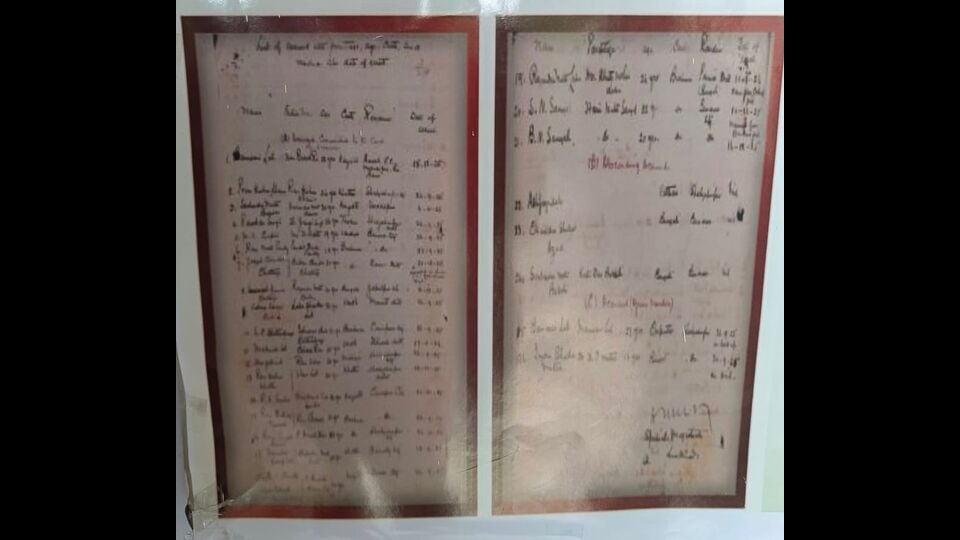
After the train action incident, the British lodged an FIR two days later at Kakori police station. Its original FIR was written in Urdu. Later, it was also translated in Hindi. The copy of this FIR is still kept safe in a photo frame in Kakori police station.
“However, it is not a complete copy, only one page has been preserved. We do not know where the original copy is,” said SHO Kakori Nawab Ahmad.
The Kakori police station was established in 1903, 22 years before the train hold-up took place.
HT had tried to access the copy of the FIR from Kakori police station a few years back when the cops posted there found it after hours of reshuffling old files and took out the 1925 register that was in bad shape. With the papers turning yellow and torn, the FIRs, written in Urdu at that time, were also fading . Finally, they found the FIR of the train incident and its Hindi translation attached to it, the copy of which HT has.
The translation does not mention the FIR number, as it has faded in the original FIR, but has mentioned every possible detail that was readable.
It was lodged on August 11, 1925, two days after the incident, by the government through the EEO of the railways. The amount of loot was mentioned as 4601 rupees, 15 anna and 6 pie.
The Hindi translation of the FIR (originally written in Urdu) stated that 20-25 unidentified people robbed the amount. The robbery took place when the number eight down train carrying British government money was passing near Kakori railway station on the evening of August 9, 1925. The FIR also said that the first information about the robbery was sent to the police station from a moving train through a communication device installed in it. The record did not have any mention of the final result of the case investigation.
Udai Khatri, son of Ram Krishna Khatri, one of the revolutionaries, had mentioned that the investigation records and judgement in the case were preserved in the State Archives.
ACCUSED IN FIR
The mastermind of the train action was Ramprasad Bismil and he along with nine others executed the plan. The others included Ashfaqulla Khan, Rajendra Lahiri, Chandrashekhar Azad, Sachindra Bakshi, Keshab Chakravarthy, Manmathnath Gupta, Murari Sharma (fake name of Murari Lal Gupta), Mukundi Lal (Mukundi Lal Gupta) and Banwari Lal. They pulled the chain and stopped the train. They looted the money belonging to the government and deposited it in the guard’s carriage.
Except that one passenger was killed by an accidental shot, there was no bloodshed.
At least 21 people were accused in the case and 19 were convicted, including Ramaprasad Bismil, Ashfaqullah Khan, Roshan Singh and Rajendra Lahiri. All four were sentenced to death while 15 others were given prison sentences .
Details of the FIR
Date of incident: August 9, 1925
Date of information to the police: August 11, 1925
Information: The government, through the EEO of the Railways regarding the train loot
Amount looted: 4601 rupees, 15 anna and 6 pie
Number of accused: 20-25
Section: 396 of the IPC