The contractor’s claim that parts of the newly inaugurated Lucknow-Kanpur Expressway witnessed repeated road settlements, cracks and surface failures due to heavy rain has come under the scanner as the districts concerned—Lucknow and Unnao—received deficient rainfall this monsoon.
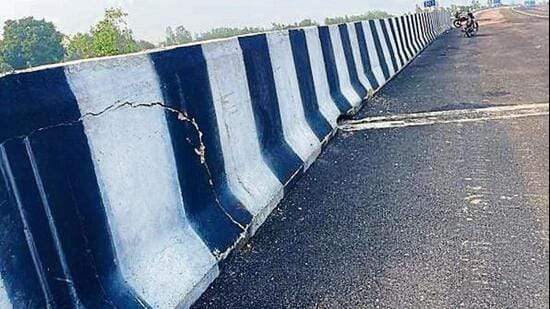
This key question has arisen even as an IIT Kharagpur team led by K Sudhakar Reddy collected around 50 samples from seven different locations in a 45-km greenfield stretch of the expressway, which was inaugurated on July 13 and opened to motorists a day later.
Data for the expressway corridor indicates that the area has received around 29% to 43% less rainfall than normal, raising a question mark on the contractor PNC Infratech’s “heavy rain” explanation as well as the quality of construction and drainage.
From June 1 to August 10, Lucknow received only 269 mm of rain against its normal 380 mm, a deficit of 29%. In Unnao, through which a substantial stretch of the expressway passes, the deficit was even higher: 206.3 mm against the normal 360.4 mm, or 43% below average, according to data available with the Indian Meteorological Department.
If a road built to withstand the monsoon is struggling under rainfall that is substantially below normal, the bigger concern is what could happen in a year when the region receives its full share of rain, people familiar with the matter said.
{{/usCountry}}If a road built to withstand the monsoon is struggling under rainfall that is substantially below normal, the bigger concern is what could happen in a year when the region receives its full share of rain, people familiar with the matter said.
{{/usCountry}}Gautam Vishal, chief regional officer of UP NHAI, said, “The IIT Kharagpur team led by K Sudhakar Reddy has collected around 50 samples from seven different locations in the 45 km Greenfield stretch. Apart from examining the damaged locations, the experts are looking at drainage capacity, whether rainwater was adequately carried away from the pavement and water ingress, whether water penetrated the pavement layers and weakened the subgrade, whether the thickness and composition of the road conform to the approved design.”
Officials say the team has sought records of rainfall to correlate the locations of failures with rainfall records, drainage arrangements and construction details before arriving at a conclusion.
Experts are looking into whether the underlying soil was properly treated and compacted, whether the material used met the specified standards, whether the required density was achieved in the various layers, whether repeated patching has merely treated the symptoms rather than the underlying defect.
In its clarification to the stock exchange, PNC Infratech has maintained that the road damage was associated with heavy rain.
An official of PNC Infratech, who did not wish to be named, said that the quality of the road is excellent but in some parts the upper crust of the road gave way because water on its shoulders seeped inside.
The rainfall figures could therefore become an important point for the IIT Kharagpur team examining the causes of the expressway’s repeated failures, particularly its drainage, embankment, pavement and soil-strengthening systems, NHAI officials agree in private conversation.
NHAI has already taken action over the damage, including suspension of toll collection and proceedings against those held responsible for the defects.
Even as the IIT investigation will have to determine whether rainfall was the cause or merely the trigger that exposed an underlying weakness, the crucial question is: Did the rain damage the road—or did the rain expose a road that was already vulnerable?
Gautam Vishal said traffic has started from both sides but repair work at some stretches is still on. The toll collection will remain suspended till the expressway is totally ready to operate traffic from both sides.