
Larsen & Toubro (L&T) is preparing the detailed project report (DPR) of Ayodhya to convert the temple town into a solar city. The completed project will fulfil the city’s maximum electricity requirement, including that of the Shriram Temple Complex, through the green power, to be generated by rooftop solar panels, people dealing with the issue said.
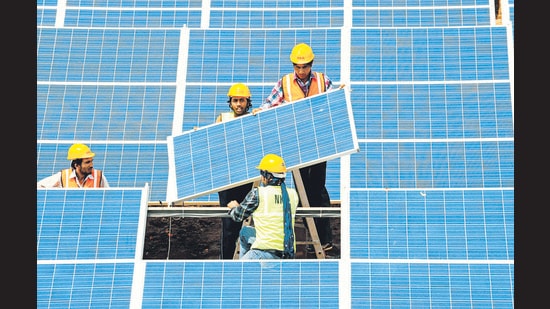
According to them, the government is also considering changes in the Solar Policy, 2017 to provide more incentives to people who opt for rooftop solar panels, so that the Ayodhya model may be replicated in more cities, especially those of religious importance.
“L&T is almost ready with the Ayodhya DPR, detailing the plan to convert the town into a solar city by installing solar panels on roofs of houses, government buildings, commercial and industrial establishments etc. This will be on a pilot basis in the first phase after which some other cities will also be identified for the same purpose,” Bhawani Singh Khangarot, director, Uttar Pradesh New and Renewable Energy Development Agency (UPNEDA) said.
An L&T survey found Ayodhya’s (3.40 lakh population) annual electricity consumption to be 281 million units by 0.81 lakh households.
“The NEDA is basically working on four things in Ayodhya, that is, solar generation from ground-mounted utility scale and solar plants, arranging solar cooking for community kitchens for devotees, fulfilling energy requirement of the Shriram Temple Complex from solar and other renewable sources,” he said.
{{/usCountry}}“The NEDA is basically working on four things in Ayodhya, that is, solar generation from ground-mounted utility scale and solar plants, arranging solar cooking for community kitchens for devotees, fulfilling energy requirement of the Shriram Temple Complex from solar and other renewable sources,” he said.
{{/usCountry}}Simultaneously, the NEDA has also proposed changes to the solar policy, seeking more incentives to people and government, semi-government and commercial bodies to install rooftop panels on houses/buildings.
The NEDA has proposed enhancement of state subsidy on installation of rooftop solar panels by residents in the cities identified to be declared as solar cities. Ajay Kumar, another NEDA official said that the enhanced state-subsidy would be in addition to the subsidy already provided by the Central government.
“We have also proposed net metering facility for government and semi-government buildings and commercial and industrial establishments that use grid-connected rooftop solar panels to generate power in solar cities. The net metering will enable them to sell excess electricity to the UP Power Corporation Ltd (UPPCL) through net meters,” he added.
Domestic and agriculture consumers already have the net metering facility. The UP Electricity Regulatory Commission (UPERC) did away with this facility for government buildings and commercial/industrial establishments in 2019.
The third proposal mooted by the NEDA seeks to solarise Nagar Nigams of cities identified as solar ones. “According to the proposal, the Nagar Nigam will meet its energy needs for street lighting, water works etc from the renewable power through the ‘Open Access’,” Kumar said.
The amendment proposals, he said, have been sent to the government which was likely to take a call on the issue soon.
ABOUT THE AUTHOR
Brajendra K Parashar is a Senior Journalist with the Hindustan Times, based in Lucknow, with nearly three decades of experience covering governance, public policy, politics and development in Uttar Pradesh. Over the years, he has reported extensively on key sectors, including energy and renewable power, mobility and transport, road safety, agriculture and allied sectors and issues related to farmers, rural development, taxation under the Goods and Services Tax (GST) and public administration. A seasoned political correspondent, Parashar closely tracks the Bharatiya Janata Party (BJP) and has covered every major election in Uttar Pradesh right from three-tier panchayat elections and urban local body polls to Assembly and Lok Sabha elections. He also reports regularly on the proceedings of the Uttar Pradesh Legislature, bureaucracy, governance, policy decisions and administrative developments with focus on their impact on public life. His reporting is known for its strong analytical approach, extensive use of official data. His areas of interests include investigative journalism, long-form political and policy analysis, data-driven reporting, elections and institutional reforms. Parashar holds a postgraduate degree in Political Science with First Division from Aligarh Muslim University (AMU), followed by a Diploma in Journalism and Mass Communication from the same university. His inclination towards journalism began during his student days, when he regularly contributed letters to editors and articles to newspapers and magazines. In the mid-1990S, his essay, “Should India Switch Over to the Presidential Form Of Government?”, published in Politics India magazine edited by noted constitutional expert Subhash C Kashyap, was adjudged the best entry in a national competition. His work has received professional recognition, including the Hindustan Times Journalist of the Month Award for an impactful series on drinking water issues during the 2010 Lok Sabha election campaign. Originally from Kasganj in western Uttar Pradesh, Parashar is currently based in Lucknow where continues to report on politics, governance and public policy.