THANE: Kalyan Phata, a seemingly impossible challenge for motorists to navigate, has acquired a nickname. The daily crawl at this junction, which connects Thane, Navi Mumbai and the Kalyan-Dombivali belt, has inspired reel-makers to cheekily dub it their own ‘Strait of Hormuz’, drawing a parallel with the blockade of the strategic West Asian waterway amid the US-Iran conflict.
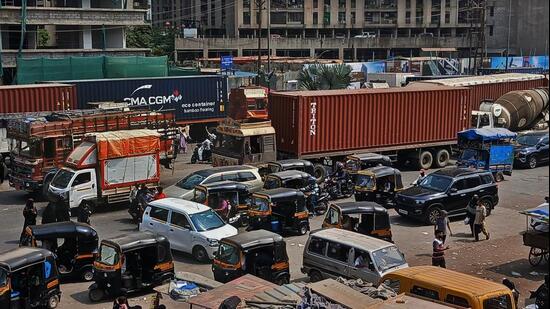
“Challenges at work don’t scare me as much as crossing this stretch does,” says Rahul Kumar, who spends between two to four hours in his car daily, driving from his home on the Katai-Badlapur Road, to Airoli, 21 km away. Much of this time is spent stalled in traffic that has backed up, he says.
Kalyan Phata has been a traffic nightmare in the making for a quarter of a century but town planners either didn’t see it coming or, worse, didn’t care. The area, now dotted with sprawling housing complexes, was surrounded by paddy fields, rivulets and the Parsik Hills until the early 2000s. As real estate prices soared in Mumbai and Thane, huge residential complexes rose in Kalyan, Dombivali and Shil Phata, catering to middle and upper-middle class residents. But road infrastructure remained largely unchanged.
Moreover, apart from being the point where the Kalyan-Shil Road, Thane-Panvel Road and Shil-Mahape Road converge, the intersection is also a connector for heavy vehicles travelling northwards from the Jawaharlal Nehru Authority (JNPA) in Uran to Nashik, Gujarat and beyond.
{{/usCountry}}Moreover, apart from being the point where the Kalyan-Shil Road, Thane-Panvel Road and Shil-Mahape Road converge, the intersection is also a connector for heavy vehicles travelling northwards from the Jawaharlal Nehru Authority (JNPA) in Uran to Nashik, Gujarat and beyond.
{{/usCountry}}During peak hours, traffic backs up 6 km, to Katai Naka in Dombivali, to the Mumbra Reti Bunder, and Dahisar-Mori in the Panvel direction. Motorists heading towards Navi Mumbai also have to cross the Mahape pipeline, an elevated, hilly stretch of around 1 km on the way to Mahape. This extends their commute by up to 40 minutes.
“It takes me two to four hours to cover the 4-km stretch from Kalyan Phata to Palava City during peak morning and evening hours. Trucks and trailers should be banned from this stretch during these hours,” says Yogesh Patil, who lives in Palava City in Dombivli.
Kalyan Phata;s infamous gridlock has spared no one. With no alternative roads to take, school and college students, the elderly, even the sick trying to make it to a hospital have suffered the same fate as daily office-goers.
Nagendra Faujdar, a BJP leader from Dombivli, says a developer has announced plans to house 1 million more people into the area in a couple of years. “Imagine what will happen when 10 lakh more people fight for road space that is already exhausted,” he says.
Residents also point to incomplete land acquisition and ongoing metro work that have narrowed the four-lane road to two lanes in several places. Add to that, heavy vehicles and it’s a mess. Last month, the Maharashtra Navnirman Sena (MNS) organised a protest rally at Kalyan Phata. Hundreds of residents joined in to demand urgent action to ease the chronic congestion. MNS leader and former Kalyan Rural MLA Raju Patil demanded that the traffic police stop heavy vehicles from using the road during morning and evening peak hours.
Pankaj Shirsat, deputy commissioner of police, traffic, Thane, said, “Kalyan Phata and the Shil-Kalyan, Shil-Panvel stretch is more than a traffic issue. It’s a vicious circle that involves public transport, hawkers, road conditions and streamlined engineering. It requires multiple-agency collaboration and coordination. Since traffic policemen are visible to people, they blame the traffic police for the gridlock here. This is not fair.”
Shirsat said they have booked 124 violators and filed FIRs against them in the last couple of months, and seized a number of vehicles, mostly two-wheelers, that violated traffic rules. Much of the time, two-wheeler riders ride on the wrong side of the road, stirring further traffic chaos here. He said that to ease congestion along the arterial roads that fan out from Kalyan Phata, it would require improved public transport, pothole repairs, and get motorists to observe traffic rules.
Rohit Dixit, Joint Secretary, CREDAI-Maharashtra Chamber of Housing and Industry (MCHI) Kalyan-Dombivli, said, “Traffic congestion is a major pain point in this area due to several infrastructure projects being undertaken simultaneously, These include the Bullet train, metro, new flyovers, and road-widening and freeway projects. The movement of heavy vehicles transporting construction materials has added to the traffic woes.”
But there’s a ray of hope. Projects such as the metro and Palava flyover are expected to be completed in less than a year, which should ease traffic congestion. Additionally, once the JNPA-Delhi expressway stretch is completed, heavy vehicles travelling from JNPA and Panvel will no longer need to enter Thane city and will instead use the expressway. The Virar-Alibaug Multimodal Corridor will also divert vehicles travelling from Gujarat towards JNPA, Taloja, and the MIDC industrial areas of Badlapur and Ambernath, further reducing traffic congestion.
Stay updated with all the Breaking News and Latest News from Mumbai. Click here for comprehensive coverage of top Cities including Bengaluru, Delhi, Hyderabad, and more across India along with Stay informed on the latest happenings in World News.
Stay updated with all the Breaking News and Latest News from Mumbai. Click here for comprehensive coverage of top Cities including Bengaluru, Delhi, Hyderabad, and more across India along with Stay informed on the latest happenings in World News.