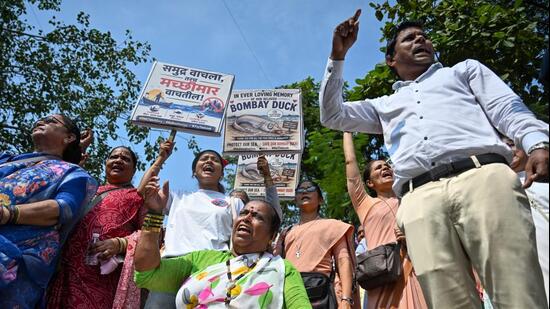
MUMBAI: Traditional fishing communities on Monday demanded an immediate halt to construction of the proposed 400-million-litres-per-day (MLD) desalination plant at Manori and cancellation of the ₹3,000-crore project, alleging that the Brihanmumbai Municipal Corporation (BMC) and district administration had failed to address concerns over livelihoods, environmental damage and land approvals.
A delegation led by Congress MLC Bhai Jagtap met Mumbai suburban district collector Saurabh Katiyar, submitting a representation seeking a review of land approvals, a formal hearing on their objections and a stay on construction until the issues are resolved.
The delegation expressed dissatisfaction with Katiyar’s reported response that he could only forward their demands to the state government, questioning whether the collector was empowered to redress public grievances or was merely acting as a postman passing them on to the authorities.
The fishermen demanded that construction on revenue department land be stopped until a proposed meeting with chief minister Devendra Fadnavis takes place. They also questioned how work could continue when, according to the delegation, the fisheries department had not issued a no-objection certificate (NOC) for the project.
The Akhil Maharashtra Machhimar Kruti Samiti (AMKS), which submitted the representation along with local residents, has sought details of the approvals granted for the use of government land at Manori. Referring to a land-related order issued by the collector’s office on December 8, 2025, it sought clarification on the legal and procedural basis for the transfer or change of use of the land, and questioned whether traditional fishermen, residents, farmers and other affected communities had been consulted.
{{/usCountry}}The Akhil Maharashtra Machhimar Kruti Samiti (AMKS), which submitted the representation along with local residents, has sought details of the approvals granted for the use of government land at Manori. Referring to a land-related order issued by the collector’s office on December 8, 2025, it sought clarification on the legal and procedural basis for the transfer or change of use of the land, and questioned whether traditional fishermen, residents, farmers and other affected communities had been consulted.
{{/usCountry}}The delegation also criticised the BMC for sending junior-level officials instead of senior officers empowered to take decisions on a project of this scale, saying their absence reinforced the community’s perception that its concerns were not being taken seriously.
Devendra Damodar Tandel, president of AMKS, demanded that the collector exercise his authority to suspend construction until the objections are examined.
“The committee has said that if the collector’s office cannot issue a stay, it should urgently refer the matter to the competent authority. It has also sought a joint meeting of the departments concerned under the collector’s chairmanship, followed by a written order addressing the objections,” Tandel told HT.
Brine discharge raises alarm
The fishermen have flagged the project’s potential environmental impact, citing the BMC’s updated Environmental Impact Assessment (EIA) report of February 2026. According to the report, the first phase will involve drawing 500 MLD of seawater and discharging 300 MLD of brine, or concentrated saltwater, into the sea. In the second phase, seawater intake and brine discharge are expected to rise to 1,000 MLD and 600 MLD, respectively.
The committee has demanded an independent assessment of the effects of seawater extraction and brine discharge on marine biodiversity, fish populations and traditional fishing activities. It has called for consultations involving the fisheries department, marine research institutions and environmental authorities, with representatives of local fishing communities.
“A presentation of the project cannot be treated as a public hearing or as a resolution of objections,” the representation stated, maintaining that the concerns raised by affected communities had not been satisfactorily addressed.
Kiran Koli, a fishing community leader, warned that hypersaline brine could damage marine ecosystems and fish populations, threatening livelihoods sustained by generations of fishing families. Leo Colaso, president of the Maharashtra Machhimar Kruti Samiti (MMKS), said the Koli community would continue opposing the project until it was stopped.
Sweety Henriques, president of the Gorai Village Welfare Association, sought clarity on reports of prehistoric tools being discovered in the project area, questioning whether their archaeological significance had been investigated and protected.
Fishermen question project’s economics
The delegation also challenged the project’s economic rationale. Ramkrishna Tandel, president of the National Fishworkers Forum, said water leakages and non-revenue water losses in Mumbai had not been accounted for.
“Mumbai’s water leakages and non-revenue water losses are not accounted for, and that better management could potentially save around 845 MLD,” he said.
He questioned the viability of a project costing more than ₹3,000 crore, with estimated annual electricity expenditure of around ₹147 crore.
Bernard D’Mello, working president of AMKS, said unchecked construction and population growth were placing mounting pressure on the city’s water, land and air resources. He argued that the BMC should address water management and unsustainable urban expansion before undertaking another major coastal infrastructure project.
The fishermen also raised concerns about reports of another desalination plant being planned at Versova, warning against expanding such projects along Mumbai’s coastline without thoroughly examining their environmental consequences and alternatives.
Jagtap backed the demand for an immediate suspension of construction until an amicable resolution is reached. The committee said the administration must examine the validity of land-related decisions, statutory approvals and environmental concerns before allowing work to proceed.
The protest was further fuelled by allegations that police stopped more than 15 buses carrying demonstrators to the agitation on Monday morning. Protesters alleged that drivers were detained and bus keys seized, questioning the legal basis for the action and demanding the release of the drivers and buses.
Despite the reported obstruction, fishing community members, including women, participated in the protest, asserting their right to defend traditional livelihoods and the coastal environment.
The committee warned that it could launch further democratic protests if the administration failed to take a timely decision. It demanded a written response to its representation, insisting that a proposed meeting with the chief minister could not substitute for immediate action.
The fishermen maintained that development could not come at the cost of traditional fishing livelihoods, marine biodiversity and the rights of communities that had depended on the coastline for generations.
Katiyar remained unavailable for comment despite attempts to reach out to him.
Stay updated with all the Breaking News and Latest News from Mumbai. Click here for comprehensive coverage of top Cities including Bengaluru, Delhi, Hyderabad, and more across India along with Stay informed on the latest happenings in World News.
Stay updated with all the Breaking News and Latest News from Mumbai. Click here for comprehensive coverage of top Cities including Bengaluru, Delhi, Hyderabad, and more across India along with Stay informed on the latest happenings in World News.