
 E-Paper



Rail welding begins for Mumbai-Ahmedabad bullet train project in Gujarat
The project utilises 25-metre rails imported from Japan, which are joined using advanced fusion welding machines to create 200-metre rail panels

 Prefer HTon Google


Mumbai: The National High Speed Rail Corporation Limited (NHSRCL) has commenced the critical phase of rail welding for the Mumbai-Ahmedabad bullet train project in Gujarat, marking the final stage before track laying for the 508-kilometre route designed for speeds of 320 kilometres per hour.
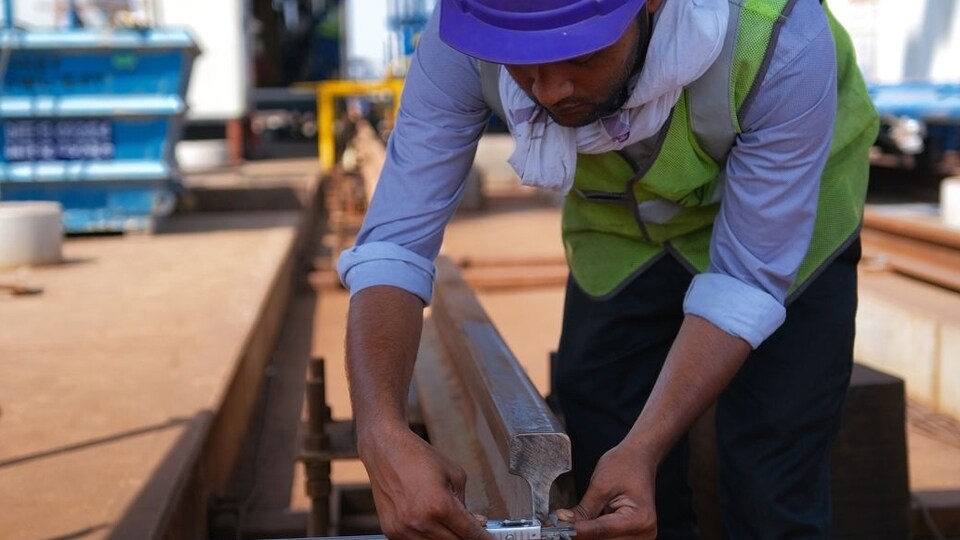
"The track construction work for the Gujarat portion of the bullet train project is progressing swiftly with the commencement of welding of rails on the viaduct in Gujarat," an NHSRCL spokesperson said.
The project utilises specialised 25-metre rails imported from Japan, which are joined using advanced fusion welding machines to create 200-metre rail panels. The operation has already produced 298 panels, equivalent to approximately 60 kilometres of track.
The welding process begins with grinding the rail ends for surface preparation. "Once the rails are perfectly aligned, they are joined together using flash butt welding technology. The weld is inspected by using magnetic particle and ultrasonic testing for detection of flaw and if any flaw is detected in the weld the same is replaced by new weld," the spokesperson explained.
Following the welding, rail alignment undergoes verification using specialised Japanese rail tread measuring equipment. A purpose-built rail feeder car distributes the 200-metre panels along the route for track laying. The rails are then secured to the track slab using fasteners for the final installation.
The project currently operates four track construction bases in Gujarat: two between Surat and Bilimora, and two between Vadodara and Anand. Construction teams have completed 64 kilometres of reinforced concrete track bed, with more than 23,000 track slabs cast at facilities in Kim (near Surat) and Anand, covering 118 track kilometres.
The bullet train route, which is 90 per cent elevated, will serve 12 stations: Mumbai, Thane, Virar, Boisar, Vapi, Bilimora, Surat, Bharuch, Vadodara, Anand, Ahmedabad and Sabarmati. Mumbai's station at Bandra Kurla Complex will be the sole underground facility.
Launched in 2017 with an estimated cost of ₹1,08,000 crore and an initial completion target of December 2023, the project has faced delays due to land acquisition challenges in Maharashtra and the Covid-19 pandemic.
NHSRCL now aims to inaugurate the complete 508-kilometre route in the latter half of 2028, though officials suggest the Gujarat section might open in 2027. Once operational, the high-speed rail service will reduce the journey time between Mumbai and Ahmedabad to approximately three hours, significantly faster than the current fastest option, the Vande Bharat Express, which takes about five and a half hours.


