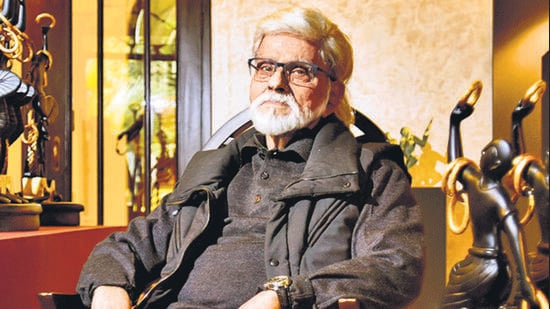
MUMBAI: Artist Satish Gujral (1925–2020) was the OG multi-hyphenate. He painted, sculpted, made murals and designed buildings. His 100-year retrospective, ‘The Modernist Returns: Satish Gujral 100,’ at the National Gallery of Modern Art (NGMA), Mumbai, will offer a glimpse into the prolific career of one of the most dynamic modernists of India.
His early paintings illustrate the horrors of the Partition, The Emergency features in his works of the 1970s and the anti-Sikh riots influenced his sculptures in 1984. He also made a series on cricket.
Gujral must also be credited for several public murals, including the towering tile murals in Shastri Bhawan, New Delhi, and an alphabet-based relief mural for Delhi High Court. Among the self-taught architect’s revered buildings are the embassy building of Belgium in New Delhi, Ambedkar Sthal in Lucknow and Goa University, Taleigao. “It is important to remember that Gujral actually broke a lot of boundaries,” says Pramod Kumar KG, curator of the exhibition.
He charted his own path and on his own terms. At age eight, he lost his ability to hear post a swimming accident in Kashmir. In 1998, underwent a cochlear implant surgery in Australia to restore his hearing, but had the implant removed two years after. He chose silence over chaos and poetry became his music. KG fondly remembers how Gujral would commence and end all his meetings with an Urdu poetry. “I never saw him as somebody who was guided by silence. Poetry guided his life and most of his art,” says KG. One can see a more direct reference to this in his paintings with Sufi figures in the 2000s.
Carving his own path
{{/usCountry}}Carving his own path
{{/usCountry}}Gujral didn’t follow other modernists such as SH Raza or Akbar Padamsee in studying or working in a Western countries. He went to Mexico in 1952 to study at the Palacio de Bellas Artes, working alongside Diego Rivera and David Alfaro Siqueiros. The two were the leaders of the Mexican Muralist movement. Gujral’s time there profoundly influenced his approach to murals, materials and public art. “He created his own vocabulary of how he was going to depict modernism,” says KG. “He went further west than other artists, saw and learnt another style and brought that to us,” adds KG.
One of his most remarkable paintings is the portrait of Pandit Jawaharlal Nehru. Gujrals and Nehrus were family friends. The portrait’s background is sombre, and the signature rose is given a place of prominence. But what’s most noteworthy is the perspective in which Gujral places his subject. The figure is enlarged portraying the larger-than-life Nehru, depicting the way the world saw India’s first prime minister then. “The other works that really haunt me are his Partition paintings,” says KG.
Gujral discontinued his studies at Mumbai’s JJ School of Art in 1947 to return to his hometown in Jhelum, now in Pakistan. As his family helped women to travel to either side, the young Gujral saw violence up close. These subjects, however, made it to his canvas only on his return from Mexico. KG refers to a powerful work in which Gujral portrays a group of faceless, veiled women clad in dupattas –no one can tell if they are Hindu or Muslim, as their anguish is writ large on the canvas. “The painting can only be a mirror of what he actually saw in those harrowing days of what you always believed to be your home,” adds KG. In yet another abstract painting of dark blue and maroon fields, two or three shadowy figures in black and white appear like the demon -- a myth of the past that Gujral was carrying.
Forward march
KG believes that up until the ’70s, Gujral was looking back at the past. But after the Delhi riots of 1984, his works changed. That’s when he starts making sculptures out of brunt wood. The twisted forms recall the horror of rubber tires thrown at Sikhs to set them on fire. “Gujral lived through it and decided to not let humanity forget its horrors. That really is the mark of a master artist. He just doesn’t create beautiful memories but also powerful, important ones that are sealed in the history of one’s country,” adds KG.
Gujral’s works illustrate these in great detail, which makes his retrospective an important show of our times, brought to the city by the Gujral Foundation and Sangita Jindal’s JSW Foundation. “Satish ji stood apart by his fearlessness and a creative instinct, constantly questioning, experimenting and finding new forms of expression,” says Jindal.
Gujral’s son, Mohit, an architect, explains that for his father, painting, sculpture and architecture were never separate disciplines as he believed that art was to be experienced and inhabited. “Bringing his centenary exhibition to Mumbai therefore feels like a return to where an important part of that journey began,” says Mohit.
(‘The Modernist Returns: Satish Gujral 100,’ will be shown at the NGMA, Mumbai from October 9 to November 20.)
Stay updated with all the Breaking News and Latest News from Mumbai. Click here for comprehensive coverage of top Cities including Bengaluru, Delhi, Hyderabad, and more across India along with Stay informed on the latest happenings in World News.
Stay updated with all the Breaking News and Latest News from Mumbai. Click here for comprehensive coverage of top Cities including Bengaluru, Delhi, Hyderabad, and more across India along with Stay informed on the latest happenings in World News.