To facilitate smooth implementation of critical state and central projects requiring diversion of forests, the state government has decided to create a compensatory afforestation land bank of 10,000 hectare.
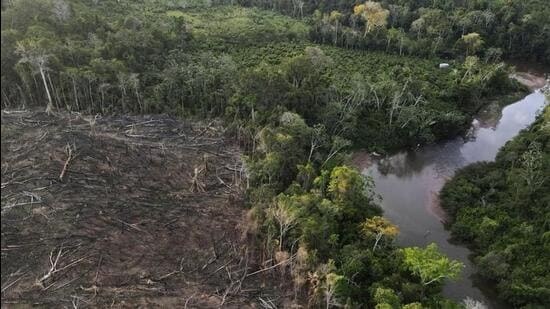
A resolution of Revenue and Disaster Management department said the ‘Compensatory Afforestation Land Bank’ will be created in each district of the state by including degraded revenue forest lands.
However, the land should not have been notified as forest under the Indian Forest Act, 1927 or any other law nor managed as forest by the forest department.
The lands included in the said land bank will be provided only for projects undertaken by central government and state government requiring land for compensatory afforestation.
Also Read:In Argentina’s remote Chaco forests, deforestation uproots natural rhythms
“While the lands included in the land bank will be provided to state government departments on free of all charges, the central government ministries/departments will be required to pay the cost of the land as would be fixed by the collector of the district concerned,” the resolution stated.
According to the guidelines, identified land should be a compact patch of minimum 25 hectares. However, if the land is in continuity of a land declared or notified as forest under the Indian Forest Act, 1927 or under any other law for time being in force, Protected Area, Tiger Reserve or within a designated or identified tiger or wildlife corridor, there will be no restriction on size of the land. The land should be free from encroachment and encumbrances.
{{/usCountry}}According to the guidelines, identified land should be a compact patch of minimum 25 hectares. However, if the land is in continuity of a land declared or notified as forest under the Indian Forest Act, 1927 or under any other law for time being in force, Protected Area, Tiger Reserve or within a designated or identified tiger or wildlife corridor, there will be no restriction on size of the land. The land should be free from encroachment and encumbrances.
{{/usCountry}}Officials said the decision as compensatory afforestation land bank was taken as Centre has made it mandatory while approving proposals for de-reservation or diversion of forest land for non-forest uses under the provisions of the Forest (Conservation) Act, 1980.
“The situation with regard to availability of land is getting worse with passage of time. It is difficult to find government land for implementation of projects even for development purposes funded by the state exchequer. On many occasions, land reserved for specific purposes in record of rights are now required to be de-reserved for other public purposes,” said an official of the state forest department.
Till March 31, 2022, about 59,359.9 hectares of forestland have been diverted for developmental projects in Odisha.
In 2021-22, 1193.9 hectare of forest area was diverted for 18 projects.
The largest share of total forestland was diverted for mining-related development activities (50%) followed by irrigation-related activities (17.9%).
Following the Supreme Court judgement in 2002 in TN Godhavarman Vs Union of India case, CAMPA was established in 2004 to manage the Compensatory Afforestation Fund. However, low utilisation of CAMPA funds has been an issue since its inception in 2002.
Among the states, Odisha received the highest cumulative share of CAMPA funds between 2019-20 and January 2023.
However, Odisha has managed to utilise just about one third of the total CAMPA funds allocated to it.