New Delhi: The implementation of the Delhi government’s ‘No PUC, No Fuel’ rule on Thursday triggered a sharp surge in demand for Pollution Under Control Certificates (PUCCs), leading to overcrowding and confusion at fuel stations across the capital, officials and motorists said.
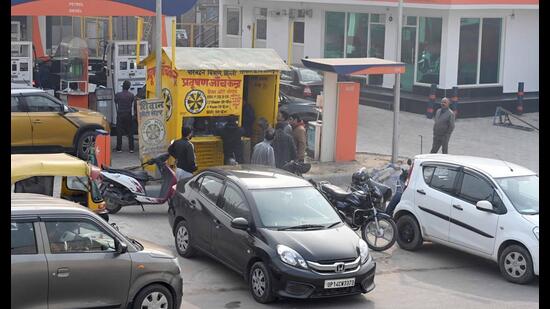
While officials said the drive was successful at ensuring compliance with pollution norms, motorists alleged chaos and confusion at fuel stations, claiming the government directives were “ambiguous.”
According to the transport department’s data, 29,938 PUCCs were issued on December 17, followed by another 31,974 certificates by 5pm on December 18, taking the total to more than 61,000 in just two days. This marks nearly a twofold increase over the daily average of 16,000–17,000 PUCCs issued in the previous week. At several fuel stations, queues for PUC testing were reported to be even longer than those for refuelling.
Environment minister Manjinder Singh Sirsa said: “The fact that over 60,000 people have renewed or obtained their PUCC within two days shows that citizens can comply with strict measures when they are convinced it is for the larger public good.”
According to officials, 3,746 motorists were penalised for lacking a valid PUCC in the past 24 hours. On the first day of enhanced action, joint teams of the Delhi Traffic Police and the transport department checked vehicles at border entry points and turned away 568 non-compliant or non-destined vehicles.
{{/usCountry}}According to officials, 3,746 motorists were penalised for lacking a valid PUCC in the past 24 hours. On the first day of enhanced action, joint teams of the Delhi Traffic Police and the transport department checked vehicles at border entry points and turned away 568 non-compliant or non-destined vehicles.
{{/usCountry}}Sirsa said there was a visible reduction in the entry of outside vehicles at city borders and credited coordinated action by Haryana and Uttar Pradesh for setting up parallel checkpoints.
However, transporters and motorists flagged confusion at fuel stations over how compliance was being verified.
The All India Motor and Goods Transport Association (AIMGTA) claimed that petrol pump staff were insisting on physical PUCCs despite the government’s stated position that checks would be conducted through the automatic number plate recognition (ANPR) system.
AIMGTA president Rajendra Kapoor cited instances where fuel was denied to vehicles, including a 2024-manufactured private car, allegedly due to the absence of a physical certificate.
“The lack of clear written instructions led to arbitrary checks, long queues and inconvenience, particularly for truck operators. We urge the transport department to issue clear directions to petrol pump operators to avoid manual verification where ANPR systems are functional,” Kapoor said.
Meanwhile, fuel station staff reported heated exchanges with customers. At a fuel station on Mathura Road, attendants said several motorists argued when initially denied fuel. “They kept asking us to recheck the rules. Eventually, most of them went for the PUC test,” an attendant said.
At multiple stations, vehicles queued up as documents were being verified, while motorists without valid certificates were turned away, underscoring both the impact and the teething troubles of the new enforcement drive.