LUCKNOW Vehicular emissions have been identified as the primary contributors to the alarming rise in air pollution levels along the city’s roadsides, according to a scientist at the CSIR-Indian Institute of Toxicology Research (IITR).
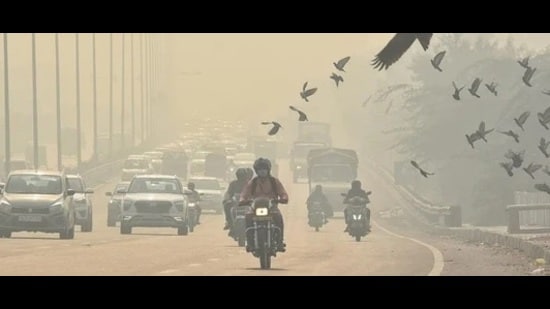
While additional factors such as residential garbage burning and ongoing construction projects also play a role in exacerbating the city’s Air Quality Index (AQI), vehicular combustion remains the predominant cause.
On Wednesday, the city once again recorded a ‘poor’ AQI of 202, marking the second time in six months after it recorded a ‘moderate’ level on Tuesday. The previous day, the city registered a ‘poor’ AQI with a reading of 203, marking the end of a six-month respite from deteriorating air quality, as reported by the Central Pollution Control Board.
Experts at the CSIR-IITR pointed out that pollution sources vary depending on the locality within the city. They explained, “In areas near roads, the main contributor to pollution is vehicular combustion, while in residential zones, factors such as garbage burning, sweeping activities, and construction projects are prominent causes.”
Data retrieved from a study titled ‘Assessment of Ambient Air Quality of Lucknow City’ in the pre-monsoon report-2023, published in June by its Environment Monitoring Division, revealed a 6.3% increase in the number of registered vehicles between 2022-2023 till June in Lucknow. The total number of vehicles counted as of June 1, 2023, was 2,816,291, up from 2,650,286 between 2021-2022, according to the report.
{{/usCountry}}Data retrieved from a study titled ‘Assessment of Ambient Air Quality of Lucknow City’ in the pre-monsoon report-2023, published in June by its Environment Monitoring Division, revealed a 6.3% increase in the number of registered vehicles between 2022-2023 till June in Lucknow. The total number of vehicles counted as of June 1, 2023, was 2,816,291, up from 2,650,286 between 2021-2022, according to the report.
{{/usCountry}}According to the Regional Transport Office (RTO), there are nearly 4 lakh vehicles excluding electric vehicles (EVs) running on the streets of Lucknow. “There are a total of 3,86,963 vehicles minus EVs on Lucknow streets as of,” said Sandeep Pankaj, Assistant Regional Transport Officer.
‘Air Quality Likely to Plummet Further as Diwali and Winter Approach’
The approaching winter season and the impending Diwali festival are anticipated to further worsen air quality in Lucknow. “Winter conditions lead to lower atmospheric pressure, which traps suspended particulate matter such as PM2.5 and PM10 in the lower layers of the atmosphere,” said UC Shukla, Regional Officer of the U.P. Pollution Control Board in Lucknow.
‘Vehicular Inspection for Pollution Control’
To combat the escalating pollution problem, a senior scientist at CSIR-IITR’s Environmental Toxicology department, who requested anonymity, offered several recommendations. These include permitting only BS-V compliant vehicles on the city’s streets due to their lower emissions and promoting the adoption of electric vehicles. Regular inspections and enforcement by the relevant authorities are seen as critical to mitigating pollution.
The scientist also emphasised the importance of practical measures, stating, “Regular sprinkling of water and wet sweeping, coupled with reduced construction activity following a proper Standard Operating Procedure (SOP), can effectively help control the AQI.” The CSIR-IITR is also set to release its post-monsoon air quality report on November 4, providing a comprehensive assessment of the city’s air quality and recommendations for action.
SC seeks affidavits on air pollution from U.P, 4 other states
LUCKNOW The Supreme Court on Tuesday asked for affidavits from the governments of Delhi, Uttar Pradesh, Haryana, Punjab, and Rajasthan regarding the measures taken to control air pollution in the national capital.
A bench consisting of Justice Sanjay Kishan Kaul and Justices Sudhanshu Dhulia and PK Mishra directed the chief secretaries of these states to submit their affidavits within a week, providing their response on the matter.
The bench scheduled further hearings on the matter for November 7.
The Supreme Court stated, “The concerned states should file an affidavit outlining the steps they have taken to address the situation. We call upon the states of Delhi, Punjab, Haryana, Uttar Pradesh, and Rajasthan to submit an affidavit within a week.”
The SC was addressing a series of MC Mehta cases related to environmental issues. HTC