Four engineering students of the Hindustan Engineering College in Coimbatore, under the guidance of Dr KR Kaimal, director of Sarabhai Institute of Science and Technology in Thiruvananthapuram, have developed a new technology that they claim can help avert accidents at tabletop airports, HT has learnt.
With the help of artificial intelligence and specially prepared gadgets, they said, such accidents can be avoided.
“If the touchdown is a little in front of the exact line, the pilot may not be able to stop the flight at the end by applying the permissible deceleration. If the deceleration is more, there is a possibility of slipping away from the track. In such a situation, the pilot may go beyond the endpoint,” explained Dr KR Kaimal who retired from the Indian Space Research Organisation (ISRO) after 33 years of service. At ISRO, he worked under former President late APJ Abdul Kalam and owns five other patents.
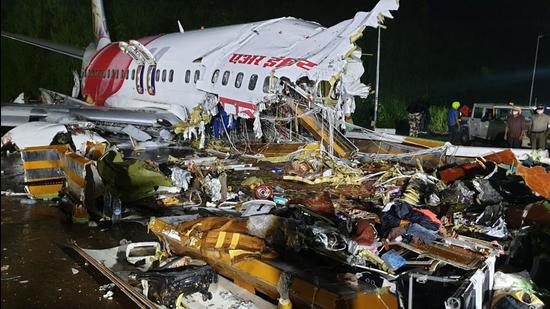
Tabletop airports are a nightmare for pilots and many accidents occurred in the country, including the last year’s mishap in Kozhikode international airport that claimed 22 lives.
Innovators said many airports and pilots have expressed interest and they applied for a patent. One of the young scientists has already joined the French aircraft giant Airbus Industrie. They said several reasons usually attribute to accidents in tabletop airports, such as climate conditions, lighting arrangements, carelessness on the part of the pilot and misjudgement.
{{/usCountry}}Innovators said many airports and pilots have expressed interest and they applied for a patent. One of the young scientists has already joined the French aircraft giant Airbus Industrie. They said several reasons usually attribute to accidents in tabletop airports, such as climate conditions, lighting arrangements, carelessness on the part of the pilot and misjudgement.
{{/usCountry}}Dr KR Kaimal said the newly-developed programme gives a warning to the pilot so that he can increase the speed and take off again and land in a nearby airport or the same airport after obtaining permission. He said the process has been demonstrated at the Hindustan Aeronautical Limited and Kozhikode airport and many pilots have shown keen interest in it.
“Accident statistics indicate that descent, approach and landing are most dangerous phases of flight and often lead to 61% of accidents. We studied all existing and upcoming landing guidance system and came to a conclusion that even with the existing instrument of landing system installed on runways, pilots continue to make errors during approach and landing that lead to many accidents,” explained Keerthi K Radhakrishan, one of the innovators.
She said their product consists of an integrated system indicating safe landing on the runway. The system includes an array of transmitters emitting unique frequency signals installed on both sides of the runway touchdown zone. The rays emitted are sensed by the corresponding sensors set up on the aircraft. She said this process clearly defines the runway to the pilot.
“If the airplane makes a proper landing on the touchdown zone, the sensors installed on the flight are activated and the system will indicate to the pilot that a safe landing has been made. If the landing was incorrect, the sensors will not be activated and the system would alert the pilot with an audio and a visual warning. This includes triggering the pilot’s attention to abort the landing and initiate a go-around,” she said.
Kaimal said the second part of the innovation is more important. “In critical situations, lakhs of neurons which are developed from fear and anxiety of pilots are picked up by brain jelly sensor and then amplified electro-magnetically. Thus, flight mode can be changed to autopiloting,” he said, adding that because of the unavailability of the jelly sensor and its high cost, the second part of the experiment was lagging.
He said the new project can help pilots get a good assessment of the landing and automatic takeoff using brain jelly sensors in critical conditions. He said after the patent is received, the technology will be transferred to firms and airports that show an interest.