
Despite spending around ₹1,600 crore on its ambitious 24x7 equitable water supply project, the Pune Municipal Corporation (PMC) continues to lose nearly 32% of the city’s water through leakages. Nearly eight years after implementation began, leakage-control measures have reportedly been completed in only seven to eight of the city’s 141 distribution zones, raising questions about the pace of execution, utilisation of funds and accountability of officials and contractors.
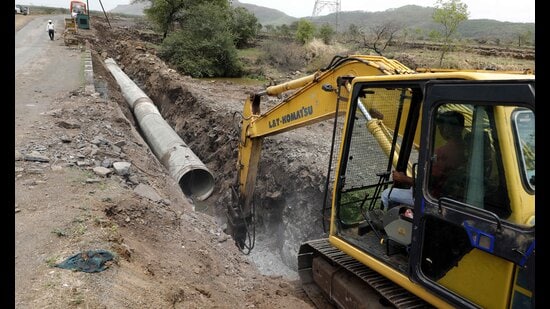
Ongoing water losses have drawn sharp scrutiny as the civic administration enforces weekly Thursday water cuts across Pune. Civic activists and political representatives have questioned the rationale for restricting supply to residents when an estimated 522 million litres of water are lost every day due to leaks, amounting to over six thousand million cubic feet (TMC) annually.
Approved in May 2015, the project began ground-level implementation in 2018 and was conceived with a 30-year perspective. With an estimated total cost of ₹2,818.46 crore, it aimed to provide equitable and round-the-clock water supply while reducing leakages from around 40% to 15%.
Corporator Amol Balwadkar said, “The BJP, which has decided to impose water cuts in Pune, must first explain what it has done to stop water leakages. Despite spending ₹1,600 crore on the 24x7 water supply project, around 32% of the water is still being lost. What benefit have Pune residents received from this project? Who is accountable for its planning, implementation and expenditure?”
He demanded an independent technical audit of the city’s water distribution network, a detailed account of the ₹1,600 crore spent and ward-wise disclosure of the estimated daily water loss of 522 million litres. He also sought a time-bound action plan to plug leakages and fix responsibility on the officials and contractors concerned.
{{/usCountry}}He demanded an independent technical audit of the city’s water distribution network, a detailed account of the ₹1,600 crore spent and ward-wise disclosure of the estimated daily water loss of 522 million litres. He also sought a time-bound action plan to plug leakages and fix responsibility on the officials and contractors concerned.
{{/usCountry}}Civic activist Vivek Velankar said the objective of the project was to bring down leakage levels from 40% to 15%, but the current estimate of 32% suggested that the intended outcome remained elusive.
“Water leakage of around 15% is considered acceptable. But if 20% of the water remains unaccounted for, the question is where the money has been spent. The unfortunate part is that no one is being held accountable,” Velankar said.
Advocate Satya Muley questioned the absence of an independent assessment of the leakage figures as well as the expenditure incurred under the project. He said the lack of a third-party audit had made it difficult to establish whether the money spent had translated into measurable improvements in the distribution network.
“The expenditure on reducing water leakages raises serious questions. There has been no third-party audit to assess the actual leakage percentage, financial transactions and technical performance. There are no tangible results on the ground. Residents in several parts of the city still do not receive adequate water through their taps and have to depend on tankers,” he said.
Defending the expenditure, Nandkishore Jagtap, head of the PMC’s water supply department, said the 24x7 project was much wider in scope than merely plugging leakages.
“The objective of the project is not just to reduce water leakages. The major task was to ensure water supply to areas that had poor or no supply. The expenditure also includes construction of storage tanks and transmission lines, among other works. Much of this infrastructure work has been completed,” Jagtap said.
He said water supply-related problems had been addressed in Baner-Balewadi, Mohammadwadi, Mahawadi, Hadapsar and Shivajinagar’s Apte Road.