The Pune Metropolitan Region Development Authority (PMRDA) has said that the delay in construction of a key culvert on the part of the Maharashtra Industrial Development Corporation (MIDC) led to waterlogging in Hinjewadi Information Technology (IT) Park on June 7 despite below-average rainfall thus far in June. According to the PMRDA, the MIDC ignored the former’s repeated follow-ups over the past one year.
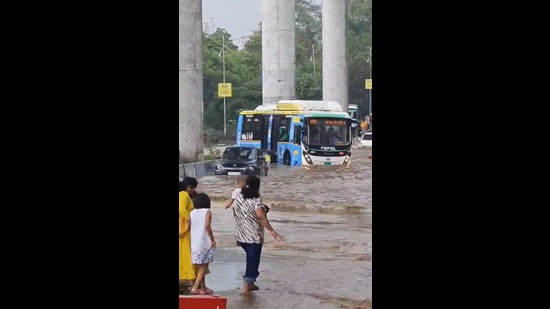
Rinaj Pathan, chief superintendent engineer, PMRDA, said, “Water from the surrounding hills flows heavily into Hinjewadi, and MIDC was supposed to build a culvert as part of interim flood management during the metro construction. Despite year-long follow-ups, the work was not completed, which directly led to the recent flooding.”
The flash flooding in Hinjewadi IT Park was triggered by just a short spell of rain and brought traffic to a standstill apart from damaging vehicles as roads in the tech hub turned into water channels. The Rajiv Gandhi Infotech Park in Hinjewadi, which houses over 400 IT firms and supports nearly a million jobs directly and indirectly, remains vulnerable year after year despite repeated warnings from civic groups and citizens.
Below-average rain, above-average damage
{{/usCountry}}Below-average rain, above-average damage
{{/usCountry}}According to Zomato’s private Automatic Weather Station (AWS) network—often relied upon due to the absence of an India Meteorological Department (IMD) station in Hinjewadi—phase 1 has recorded just 25.8 mm of rain so far this month and phase 2 only 19.2 mm; both well below the monthly average of 46.2 mm. According to experts, the scale of flooding given such low rainfall is alarming.
The Forum for IT Employees (FITE) posted on social media: “Drains are clogged with debris, silt, and construction waste from the metro project. In some areas, drains are broken or missing entirely.” The group has called for a complete audit and cleaning of drainage systems across the IT park. An FITE member, speaking anonymously, said, “Flooding during short showers has become the norm. Employees waste hours in traffic. If permanent solutions aren’t implemented, companies may need to consider remote work again.”
Reactions
The incident has drawn strong criticism from industry bodies, political leaders and citizens.
Prashant Girbane, director-general of the Maratha Chamber of Commerce, Industries and Agriculture (MCCIA) called the situation ‘terrible’. “This isn’t just about local inconvenience—it damages India’s global reputation. Many international clients rely on Hinjewadi firms for mission-critical tasks. Roads must be cleared immediately, and a long-term drainage overhaul is essential,” Girbane said.
Whereas Nationalist Congress Party (SP) MP Supriya Sule posted on X: “Water accumulation near Ryan International School and across phase 2 clearly points to the absence of basic drainage systems. MIDC must act urgently and implement sustainable flood control measures.”
Former Congress MLA and party deputy chief of the state unit Mohan Joshi blamed the Maharashtra Bharatiya Janata Party (BJP) government for neglecting civic responsibilities in the area. “Flooding after a single shower is unacceptable. Infrastructure projects have stalled or are progressing at a snail’s pace. In contrast, earlier Congress-led governments pushed for IT growth with matching civic upgrades,” Joshi said.
Prajakta Luthade, employee, Hinjewadi phase 3, said, “I have been working at a multinational corporation (MNC) in the Hinjewadi area for the past five years. The stretch of road between Wipro Square and Grand High Street is in extremely poor condition, and the traffic situation is deteriorating every day. The presence of large potholes, metro construction debris, open wiring and scattered material has made commuting dangerous. These issues pose a serious safety risk, especially due to the size and number of potholes. There is definitely potential for road widening and improvement, but unfortunately it seems that the concerned authorities are neglecting the matter.”
Pratik Pampattiwar, a resident of Hinjewadi, said, “The area faces severe waterlogging. The road has narrowed due to ongoing metro construction, and heavy truck traffic has worsened road conditions. Covering just seven to eight kilometres can take two to three hours. The hybrid work culture has added to the congestion, and multiple bottlenecks have formed due to construction activities, further aggravating the situation.”
Hinjewadi – once Pune’s poster child for tech-led urban development – now finds its future tied to how swiftly and seriously civic agencies respond given that it continues to battle not just flooding but traffic congestion, inadequate public transport, and unregulated construction.