Due to the growing leopard population in Junnar, it may have breached its leopard carrying capacity due to which we are witnessing cases of human-leopard conflict outside Junnar in the past two to three years as spillover, according to a wildlife expert from the Wildlife Institute of India.
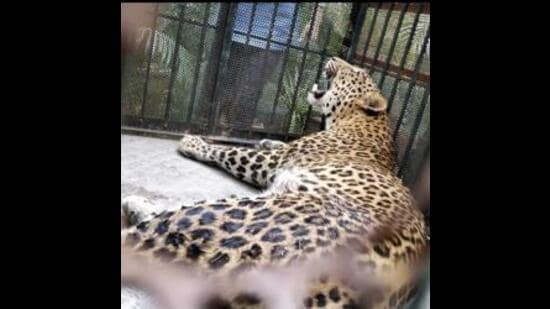
Ankit Kumar, scientist, Wildlife Institute of India, said, “The leopard population is growing and possibly, has breached the carrying capacity in Junnar. Hence, leopards might be expanding their territory to other areas, especially areas with higher sugarcane cultivation. Hence, human-leopard encounters are increasing in other areas as well.”
According to the information shared by the forest department, Raksha Nigam, 4, from Pimpalsuti village, Shirur tehsil, Pune district, was playing in front of her house with her mother sitting nearby when a leopard suddenly attacked the little girl, dragging her inside the sugarcane field. A search was initiated and after two hours, the search team found Raksha’s body in a nearby sugarcane field with the head severed from the rest of the body. Seeing this, the parents went numb with shock even as Raksha’s body was sent to the rural hospital in Shirur for a post-mortem. Raksha’s is the 10th human death in Pune district due to a leopard attack. Another suspected death took place in Daund on December 8 wherein the forest department is waiting for the forensic report to confirm whether or not the death was caused by a leopard. Before this in 2002-03, a record 11 people died in leopard attacks in Pune district.
Recalling the incident, Amol Satpute, deputy conservator of forests, Junnar forest department, said, “Forest officials visited the spot, interacted with the villagers, and told them about the action being taken by the forest department. To capture the leopard, a search was carried out with the help of a drone camera. Also, 10 cages and 10 camera traps were set up in the area. This unfortunate instance took place at around 7 pm on December 24 when the electricity supply was temporarily cut off and Raksha was playing outside her house when the leopard hiding nearby suddenly attacked her.”
{{/usCountry}}Recalling the incident, Amol Satpute, deputy conservator of forests, Junnar forest department, said, “Forest officials visited the spot, interacted with the villagers, and told them about the action being taken by the forest department. To capture the leopard, a search was carried out with the help of a drone camera. Also, 10 cages and 10 camera traps were set up in the area. This unfortunate instance took place at around 7 pm on December 24 when the electricity supply was temporarily cut off and Raksha was playing outside her house when the leopard hiding nearby suddenly attacked her.”
{{/usCountry}}Earlier, leopard attacks were limited to the Junnar and Ambegaon tehsils but with the growing population of leopards and the expansion of sugarcane fields, the human-leopard conflict has reached areas outside of Junnar such as Shirur and Daund and even Baramati and Indapur to some extent. Leave aside Pune district, the human-leopard conflict has reached other parts of the state due to which the state forest department is taking all possible efforts to mitigate the growing human-leopard conflict. Vivek Khandekar, chief wildlife warden, Maharashtra forest department, said, “The human-leopard conflict is probably increasing because of the direction and orientation of development. For instance, the increase in sugarcane cultivation has provided a new habitat for the leopard where it can live, breed and survive easily. The cub movement also coincides with the sugarcane cutting season leading to greater interaction with humans.”
Khandekar said that the forest department has introduced some short-term measures such as the use of artificial intelligence (AI) to mitigate the conflict. “We will be replicating these systems on a larger scale. The proposal of sterilisation is still in consideration with the ministry of environment, forests and climate change (MoEFCC), and we are expecting to hear about it soon. We need to ensure that we have long-term measures to keep leopards within the carrying capacity of the land,” Khandekar said.