There seems to be a protest for almost every major government proposal in Maharashtra these days. If it is not an AI data centre, it is a hydropower project. If it is not a port or a highway, it is a recruitment examination. The issues are different, the locations are scattered, and the participants are varied. But the frequency of agitations has made protest an increasingly familiar feature of the state’s political and administrative life.
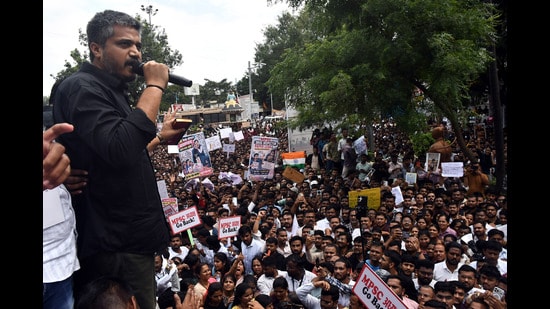
Consider the developments of the past few weeks. At Ujani, NCP (SP) MLA Rohit Pawar, MP Dhairyasheel Mohite-Patil and other opposition leaders led a road blockade against a proposed AI data centre and energy projects. In Karjat, the proposed felling of more than 32,000 trees for Torrent Power’s 3,000-MW pumped-storage hydropower project triggered protests, initially involving villagers from affected areas, and later joined by environmentalists and opposition leaders. In Palghar, the latest agitation against the Vadhavan port saw Congress, Shiv Sena (UBT) and CPM leaders rally behind residents and fishing communities.
The proposed Nagpur-Goa Shaktipeeth highway has been facing sustained opposition from farmers and political leaders, particularly in western Maharashtra, over land acquisition, the route and its implications for agricultural livelihoods.
The protests have not been limited to development projects. Pune’s 11-day agitation by Maharashtra Public Service Commission (MPSC) aspirants over examination irregularities, recruitment and accountability became a major political issue, with NCP (SP) MLA Rohit Pawar among those leading the campaign. The agitation ended after the government agreed to a time-bound inquiry and other concessions.
{{/usCountry}}The protests have not been limited to development projects. Pune’s 11-day agitation by Maharashtra Public Service Commission (MPSC) aspirants over examination irregularities, recruitment and accountability became a major political issue, with NCP (SP) MLA Rohit Pawar among those leading the campaign. The agitation ended after the government agreed to a time-bound inquiry and other concessions.
{{/usCountry}}In Thane, Shiv Sena (UBT) leader Aaditya Thackeray opposed the proposed hyperscale Amazon data centre, citing its power and water requirements. In Nashik, environmental groups and citizens have raised objections to tree felling for preparations for the upcoming Kumbh Mela. Farmers have protested over loan-waiver eligibility and crop-related issues, while the proposed Pune-Nashik direct railway alignment has also seen road blockades and demonstrations.
Taken together, these developments suggest that Maharashtra is passing through a season of protests. But what is interesting is not merely the number of agitations. It is the growing role of political parties, opposition leaders and activist groups in mobilising around projects and policy decisions, often with the participation and support of affected communities.
The distinction matters as in several cases, residents have genuine concerns about land, livelihood, water and the environment. In Karjat, for instance, villagers were alarmed when tree felling began in forests they depend on. At Vadhavan, fishing communities have repeatedly expressed apprehensions about the impact on their traditional livelihoods. Farmers along the proposed Shaktipeeth route have their own reasons to question land acquisition. These concerns do not become less relevant simply because political leaders subsequently take up the cause.
At the same time, political mobilisation has its own considerations as the opposition parties are naturally inclined to question government decisions, particularly when projects are announced or implemented without sufficient public engagement. Activist groups often bring technical, environmental and procedural issues into the public domain that may otherwise receive limited attention. Their intervention can help widen the debate. But it can also turn a discussion about the merits of a project into a political contest between the ruling establishment and its opponents.
The Ujani controversy offers an illustration. While opposition leaders have questioned the proposed projects’ water and power requirements and their implications for farmers and fishermen, the district administration has disputed several of their claims, particularly the projected water consumption, with the government saying agricultural allocations will not be affected and has argued that the investment will generate jobs and improve the region’s economic prospects. The issue, therefore, needs more than competing claims at a protest site. It requires transparent data, independent scrutiny and an informed public discussion.
There is also a political angle to the timing and spread of these agitations. With several large projects moving through different stages of approval, land acquisition and implementation, the opposition has found multiple opportunities to challenge the government’s development narrative. The ruling establishment, in turn, has often characterised such opposition as politically motivated or an attempt to obstruct investment.
Yet, it would be unfair to dismiss every protest as an opposition-sponsored exercise. Equally, the presence of residents at a demonstration does not automatically establish that an entire region is opposed to a project. The extent of local support and opposition, the nature of objections and the project’s potential benefits need to be assessed independently in each case.
For the government, the challenge is to ensure that consultation does not become a formality after decisions have effectively been taken. Public hearings, environmental assessments, land surveys and compensation discussions must be credible and accessible. Project details, including water requirements, employment projections, ecological costs and rehabilitation plans, should be placed in the public domain. Equally, it will be interesting to see if those opposing projects are prepared to engage with facts and alternative solutions rather than rely solely on mobilisation.