
Pune’s battle against encroachments has largely been fought on its roads and footpaths. Pavements are cleared, handcarts removed and roadside stalls dismantled, only to return after a few days or weeks.
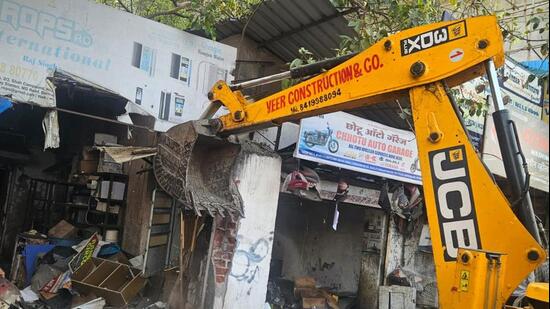
But the Pune Municipal Corporation’s (PMC) latest campaign has the potential to address a more fundamental problem that has long escaped sustained enforcement: the illegal occupation of front and side margins of commercial buildings.
The distinction is important. While the removal of roadside encroachments creates immediate space for pedestrians, reclaiming front margins could have a much wider impact on the city’s traffic management, parking discipline, emergency access and even the quality of its urban environment.
Front margins in commercial buildings are not leftover spaces meant for owners to use as they please. Building regulations provide for these open spaces, with a substantial portion earmarked for visitors’ parking. Yet, across Pune, they have gradually become extensions of commercial establishments. Restaurants and hotels put up tables and chairs, shopkeepers display merchandise, food vendors occupy the space and temporary structures become permanent fixtures. What was meant to serve a public purpose is effectively converted into private commercial space.
The consequences spill onto the road. A customer visiting a restaurant or shop has little choice but to park on the carriageway when the designated visitor parking space is occupied by tables, counters or merchandise. In many commercial stretches, vehicles parked by customers end up occupying an entire traffic lane. This reduces the effective road width, creates bottlenecks and adds to congestion, particularly during peak hours. The irony is that a road may have adequate physical width, but its usable capacity is reduced because the adjoining private premises have encroached upon their own mandatory open spaces.
{{/usCountry}}The consequences spill onto the road. A customer visiting a restaurant or shop has little choice but to park on the carriageway when the designated visitor parking space is occupied by tables, counters or merchandise. In many commercial stretches, vehicles parked by customers end up occupying an entire traffic lane. This reduces the effective road width, creates bottlenecks and adds to congestion, particularly during peak hours. The irony is that a road may have adequate physical width, but its usable capacity is reduced because the adjoining private premises have encroached upon their own mandatory open spaces.
{{/usCountry}}This is why the PMC’s focus on front margins is significant. Rather than merely removing an obstruction from the road, the administration is attempting to restore the original purpose of spaces that were supposed to keep roads functional. If visitors can park within commercial premises instead of on the carriageway, the impact on traffic could be considerable. It may not solve Pune’s traffic problem overnight, but it addresses one of its recurring and largely overlooked causes.
There are other reasons why these spaces must remain open. Front margins provide room for vehicles to enter, turn and manoeuvre within premises. In an emergency, a fire engine or ambulance may need unobstructed access close to a building.
Open margins also serve an environmental and urban-design purpose. They allow light and air to reach buildings and adjoining spaces. When these areas are covered with permanent or temporary structures, the sense of openness around buildings disappears. In a city where buildings are increasingly packed together, preserving such spaces is essential.
There is also an interesting planning dimension. During road widening, front margins can be adjusted against additional floor space index (FSI) benefits available to developers, subject to applicable development regulations. In other words, these spaces are part of a larger planning framework and cannot simply be treated as private extensions of commercial establishments.
The current drive, therefore, has implications beyond the immediate removal of encroachments. Its success could determine whether Pune begins enforcing building regulations as consistently as it enforces restrictions on public roads.
Commissioner Naval Kishore Ram deserves credit for taking on an issue that successive administrations have struggled to address. The campaign has not been without resistance. The recent action on Laxmi Road, for instance, had to be halted within half an hour after traders protested against the removal of shop name boards and signboards. Earlier, BJP corporators had protested inside the general body meeting over the civic administration’s anti-encroachment action. That political resistance, however, appears to have provided the commissioner an opportunity to underline the need for a sustained campaign rather than selective enforcement. He has also attracted considerable support from citizens, both online and on the ground.
His Sunday social media post taking an unusually sharp swipe at an unnamed retired senior civic official is another development worth noting. The former officer has frequently criticised the civic administration, including the very system in which he once held a senior position. Ram questioned his record and the outcomes of the measures taken during his tenure. While public disagreements between serving and retired bureaucrats rarely help institutional credibility, the larger question raised by the commissioner is legitimate: why were these longstanding problems allowed to persist for so long?
Ultimately, the test of this campaign will not be the number of sheds demolished or square feet of space reclaimed on a particular day. The real measure will be whether the reclaimed spaces remain free of encroachments, whether commercial establishments are made to provide the parking they are supposed to, and whether roads become more usable as a result. Selective drives and temporary clearances will achieve little if enforcement stops once the machinery moves away.
Pune does not lack regulations. It lacks consistent enforcement. Reclaiming front margins may seem like a small administrative exercise, but it could be one of the more meaningful interventions in addressing the city’s everyday traffic disorder. The administration must now ensure that this opportunity does not become another short-lived anti-encroachment campaign.
ABOUT THE AUTHOR
Yogesh Joshi is the Metro Editor with the Pune edition of Hindustan Times, where he has been working since 2005. He oversees coverage of the city and western Maharashtra and writes on urban governance, civic administration, infrastructure, public policy and politics, often exploring how these issues intersect.