Pune:
For Nana Patekar, the journey from the screen to the fields of drought-hit Maharashtra was not a publicity exercise or an extension of his celebrity. It became a deeply personal commitment that eventually led him, along with actor Makarand Anaspure, to establish the NAAM Foundation in 2015 to work with farmers and villages struggling with drought, water scarcity and farmer suicides.
Patekar’s association with the farmers grew after he began visiting drought-hit areas and meeting families devastated by agrarian distress. He often spoke about how these encounters changed his understanding of life and pushed him towards rural Maharashtra. In 2026, recalling his work at a water conservation conference in Nagpur, he said that a televised interview with a farmer’s widow had prompted him to take up the cause of water conservation.
Patekar’s approach was not limited to financial assistance. NAAM worked on water conservation, restoration of rivers and streams, groundwater recharge and revival of abandoned water projects, while also helping the families of farmers who had died by suicide. The foundation claims that between 2015 and 2025, its water conservation initiatives helped restore 2,246 water sources and rejuvenate 178 rivers.
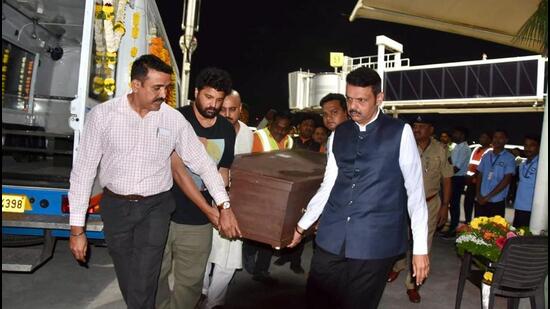
Nationalist Congress Party/NCP (Sharadchandra Pawar/SP) chief Sharad Pawar while paying his last respects to Patekar, recalled the actor’s contribution during a drought in Maharashtra. “I remember when there was a drought in Maharashtra, Nana and Makarand established the Naam Foundation and helped farmers,” Pawar said. He added that Patekar had a strong desire to help people in distress, and had made significant contributions beyond cinema.
{{/usCountry}}Nationalist Congress Party/NCP (Sharadchandra Pawar/SP) chief Sharad Pawar while paying his last respects to Patekar, recalled the actor’s contribution during a drought in Maharashtra. “I remember when there was a drought in Maharashtra, Nana and Makarand established the Naam Foundation and helped farmers,” Pawar said. He added that Patekar had a strong desire to help people in distress, and had made significant contributions beyond cinema.
{{/usCountry}}Union minister Nitin Gadkari too recalled Patekar’s work in water conservation and watershed management through NAAM, as well as the assistance extended to the families of farmers who had died by suicide. Maharashtra Congress president Harshvardhan Sapkal said that Patekar had taken the initiative in water conservation and helped many farmers, while former chief minister Prithviraj Chavan said that Maharashtra will not forget his service-oriented work in drought-hit areas.
Patekar himself saw the work not as charity but as something that gave him a sense of fulfilment. Speaking at a NAAM Foundation programme in May this year, he said, “The kind of satisfaction I drew while acting in plays like Purush, the same satisfaction was experienced during the work for NAAM. When one sees that there are lush green fields in a village because of the work done by NAAM, that experience is unparalleled.”
His message to farmers was also different from the usual political discourse around agrarian distress. In 2020, he said that farmers do not need to be treated as beneficiaries dependent only on loan waivers. “Farmers don’t need loan waivers; we need to give them emotional support and comfort them. We need to talk to them. Loan waivers alone will not help; farmers are not beggars,” he said.
In May this year, the actor made an emotional appeal to distressed farmers at a water conservation conference in Nagpur, urging those battling suicidal thoughts to reach out rather than take an irreversible step. He recalled his visits to Beed and the sight of young widows and children left behind by farmer suicides. “Visits to places like Beed changed me,” he said, adding that such experiences made him realise that immediate intervention is necessary.
He also spoke of a growing disconnect from urban life and a stronger emotional bond with villages. “I feel more alive in villages,” he said earlier this year, expressing a desire to spend more time working directly with rural communities on water conservation and sustainable development.
For an actor remembered for some of Indian cinema’s most intense characters, Patekar’s work with NAAM created another, quieter legacy — of standing beside drought-hit farmers, helping villages secure water, and attempting to restore dignity to families shattered by agrarian distress.