Pune: A visit to a friend’s home in August 2020 planted the idea for ‘Pustakwale’ in the minds of 39-year-old Rutica Walambe, a commercial artist, and 41-year-old Ashay Walambe, a B.tech and MBA. Pandemic restrictions were beginning to ease, and the couple had brought a book for their friend’s five-year-old son. The conversation that followed revealed a problem: there was no bookstore nearby, and travelling to buy books was difficult.
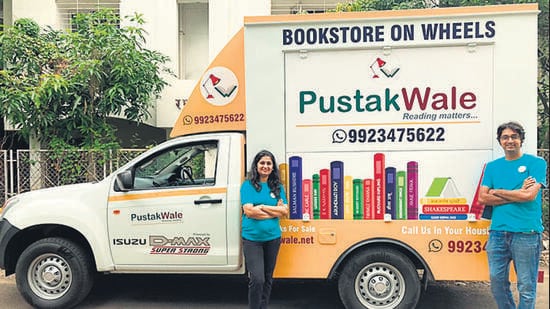
For the Pune-based husband-wife team, this raised a question: If families could not easily reach a bookstore, could the bookstore come to them?
With this thought in mind, they organised their first bookstall at their friend’s housing society in Baner. Children could browse alongside parents, grandparents and friends, recreating the pleasure of discovering books without leaving their residential community.
An idea takes shape
“Our first sales came from taking books directly to customers rather than waiting for customers to come to a traditional bookstore,” the couple said.
On the first day, half their inventory sold. That response became the starting point for a business built around access, discovery and personal interaction - aptly named ‘Pustakwale’.
Pustakwale’s founders believed the gap extended beyond the availability of books. Online shopping offered convenience, but some children and older readers were less comfortable choosing books digitally. Physical browsing allowed customers to examine a title, ask questions and discover something they had not intended to buy.
Investment of a different kind
{{/usCountry}}Investment of a different kind
{{/usCountry}}Rather than immediately investing in a technology platform, the couple began learning through exhibitions and customer conversations. They watched which books attracted attention, what readers requested, and what persuaded families to return.
“We started small and learned directly from customers rather than beginning with a large technology platform,” they said.
Housing societies became the first route to market. Schools, corporate engagements and exhibitions followed, supported by recommendations, direct customer relationships and books supplied on demand.
The venture’s network now includes over 1,000 housing communities in Pune, over 75 schools and upwards of 50 corporates. Since its inception in August 2020, it has sold over one lakh books to 50,000 families, generating cumulative revenue exceeding ₹1.5 crore.
The exhibition model keeps the entry barrier simple. Hosts invite Pustakwale and provide space; the venture does not charge an exhibition fee. Revenue comes primarily from the books customers purchase.
“We don’t charge anything from our customers. Our exhibition is free of cost. Just invite us and provide space for the exhibition,” the duo said.
Building this network has required sustained work with housing communities, schools, companies, publishers and readers. The founders describe it as a business shaped more by people and relationships than by heavy technology investment.
Novel operations model
Operations draw on a network of over 100 Gen Z book lovers participating in its ‘Earn and Learn’ initiative. The team has developed around exhibitions, sales, customer engagement and community activities, while keeping the operating structure lean.
Early financial support came from five backers who contributed ₹5 lakh each. The resulting ₹25 lakh was structured as debt, rather than equity. Cultural sponsorship from a couple of banks also helped during the early stages.
The founders did not specify their own financial investment. According to them, their continuing involvement and the operating revenue have supported the venture’s development.
‘2 Pages a Day’
Pustakwale now seeks ₹50 lakh in stages for its next phase. The proposed investment covers inventory and working capital, institutional business development, community activities, people, operations and systems.
The task is to strengthen earnings beyond book sales. The team wants to add institutional reading programmes and paid services around reading experiences and community engagement.
Its next initiative, ‘2 Pages A Day’, takes that ambition into everyday behaviour. Planned to begin on Children’s Day, it asks whether a modest daily commitment can help people establish a lasting reading habit.
For Pustakwale, the intended connection is straightforward: regular reading encourages discovery, which can lead to further purchases and deeper participation by families and institutions.
Over the coming year, the venture plans to strengthen school and corporate sales, develop recurring revenue through programmes and partnerships, and improve inventory management and customer relationship systems.
It also wants a more sustainable working arrangement for its founders and team. The immediate objective, they say, is to establish a stronger business model before pursuing scale.
Five years plan
The five-year ambition is to become a company associated with reading culture, connecting families, communities, schools, corporates, authors and publishers.
The founders are confident that technology and artificial intelligence (AI) could support personalised recommendations, discovery and engagement as that network grows. However, the central proposition would remain rooted in the physical experience: finding a book, opening it and making time to read.
“Our belief is simple: Technology can make life faster. Books can help us make some moments slower,” they said.
For a venture that began with a children’s book and a neighbourhood stall, the next chapter depends on turning occasional purchases into daily habits.
“Pune can be our laboratory. India can be the opportunity,” the couple summed up.