Pune: Bubonic plague strikes Bombay in August 1896. Medical surveillance began at the Poona railway station on September 30, 1896, but the first local plague cases were not recorded until December 1896. The colonial government imposed military searches and compulsory sanitary measures. After the Epidemic Diseases Act (Act III of 1897) received the Governor-General’s assent on February 4, 1897, the Governor of Bombay appointed Indian Civil Service officer Walter Charles Rand chairman of the Poona Plague Committee by notification on March 9. Systematic operations commenced on March 13, 1897.
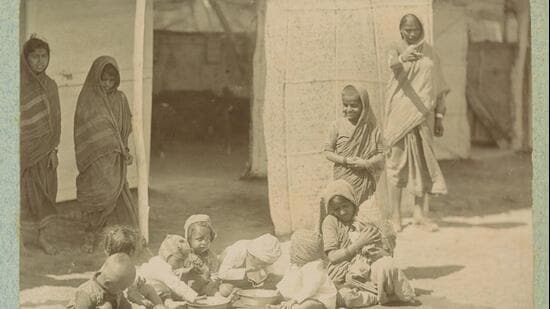
Rand oversaw an intervention that included house-to-house inspections, the removal of suspected patients to hospitals or segregation facilities, disinfection, and restrictions on movement. These measures reflected late nineteenth-century epidemic control, but in colonial Poona they encountered distrust and fears of intrusion into domestic, religious, and caste practices.
Official accounts of these operations appear in several municipal and provincial publications, including the Report of the Municipal Commissioner on the Plague in Bombay, ME Couchman’s Supplement to the Account of Plague Administration in the Bombay Presidency from September 1896 to May 1897, the medical reports of Surgeon-Captain WW Beveridge, and Robert Nathan’s four-volume survey, The Plague in India, 1896–1897.
These records identify no separate, central, public kitchen managed by the government during the pandemic. Cooking, rations and food supply were addressed instead within segregation camps and hospitals.
The main site of confinement in Poona was the General Segregation Camp on Shankarshet Road, while similar smaller camps were established at Wanowrie and Kondhwa. Official food policy at the Shankarshet Road camp shifted across different phases of the epidemic. Rand’s report in the Couchman volume states that, before compulsory segregation, the authorities offered one free meal a day to attract people to the camp. They could leave during the day to pursue their usual occupations in the city, but few accepted the offer.
{{/usCountry}}The main site of confinement in Poona was the General Segregation Camp on Shankarshet Road, while similar smaller camps were established at Wanowrie and Kondhwa. Official food policy at the Shankarshet Road camp shifted across different phases of the epidemic. Rand’s report in the Couchman volume states that, before compulsory segregation, the authorities offered one free meal a day to attract people to the camp. They could leave during the day to pursue their usual occupations in the city, but few accepted the offer.
{{/usCountry}}For the period of compulsory detention, published regulations governing the General Segregation Camp set out specific maintenance rules. They allowed segregated persons of the labouring classes two annas a day to purchase food and fuel. Those above the labouring class ordinarily received no allowance, though the inspecting medical officer could authorise one in individual cases. Food and fuel were available for purchase inside the camp. Inmates ordinarily cooked their own meals; those unable to do so could request food prepared by the camp cook.
The Shankarshet Road camp had dedicated cooking facilities. Rand’s report records that fifteen cook-rooms made of corrugated iron were provided for the inhabitants. Residential huts stood in small blocks to limit losses in the event of fire. The report does not specify the cook-rooms’ precise location or allocation, nor whether they were assigned by caste.
Evictions into the camp disrupted household food routines. The official report acknowledges the speed of removal, recording that residents were sometimes given only thirty minutes to collect bedding, clothing, and cooking utensils before being taken to camp.
Outside the camps, house searches brought military search parties into private living spaces. Rules governing entry into homes appear in the standing directions issued to search parties. In the instructions drawn up for the military divisions, Rule 7 ordered that searchers were not to enter a cook-room or a god-room unless there was reason to suspect a person was concealed inside, and then only after allowing the householder or an accompanying native gentleman to search the room and report. The written instructions for plague searches in the Poona Suburban Municipal District also explicitly directed officials to use persuasion and gentleness, disturb women’s privacy as little as possible, employ women to inspect women, and show consideration for caste and religious practices.
Contemporary criticism suggests that soldiers did not always follow these directions. Editorials in the “Mahratta” (March 28 and April 4, 1897) and “Kesari” (April 6 and 20, 1897) reported resentment over British soldiers entering cooking apartments and prayer rooms with boots on, handling cooking pots, and defiling stored food. Such intrusions violated more than domestic privacy. Where caste and ritual observances governed the preparation and handling of food and water, soldiers’ entry into cooking spaces and contact with utensils and provisions could violate the boundaries of purity and pollution, rendering the space itself and its contents ritually impure.
In the Bombay Legislative Council proceedings of August 5, 1897, non-official members submitted itemised petitions detailing instances where soldiers entered domestic cook-rooms and ruined water supplies. Similar complaints regarding domestic intrusions appear in the evidence collected by the Indian Plague Commission in 1898, such as the testimony of witness Rao Bahadur Vishnu Moreshwar Mahajani in the second volume of the Minutes of Evidence.
This popular resentment over intrusive search methods formed the backdrop to violence against the plague administration. On the night of June 22, 1897, as guests were departing the Government House reception at Ganeshkhind, the Chapekar brothers carried out attacks along Ganeshkhind Road. Lieutenant Charles Ayerst was shot and killed while travelling ahead in his carriage. Rand was shot shortly afterwards along the same road. He was taken to the Sassoon Hospital, where he died of his wounds on July 3, 1897.
Food and customary practice also shaped the administration of plague hospitals. At the government General Plague Hospital at the Sangam, Section 10 of Rand’s official report in the Couchman volume records that the administration made specific efforts to respect caste rules. The hospital had separate shed wards for Brahmins and other so-called “high-caste” Hindus, with Brahmin and other caste cooks employed to prepare their meals.
Hospital regulations also permitted relatives of patients to visit freely and bring food, milk, and water directly from home to the bedside. Despite these concessions, fear of institutional removal persisted, prompting the Plague Committee to sanction separate community-managed facilities. The Poona Hindu Plague Hospital, the Parsi Hospital, and the Mahomedan Plague Hospital were maintained by private subscriptions and managed under the supervision of committees representing those communities, which arranged for their own attendants and food supply.
The Poona plague of 1896–97 brought imperial priorities into conflict with domestic practices. For British administrators, the epidemic threatened imperial commerce and public order. The state treated residents as vectors of contagion to be isolated by force, while limiting relief.
Sanitary authority rested on coercion rather than consent. The conflict raised a fundamental question about a government that claimed to protect its subjects while denying them control over their domestic lives.
Chinmay Damle is a research scientist and food enthusiast. He writes here on Pune’s food culture. He can be contacted at chinmay.damle@gmail.com