
As the first crisp chill settles over the Deccan plateau, Pune’s peri-urban fringe prepares for its annual winter ritual. Roads leading out toward Saswad, Uruli Kanchan, Baramati, and Shirwal fill with weekend motorists bound for rustic farm outings centred on “hurda”, tender, unripe sorghum ears roasted over glowing embers and rubbed free of their husks between the palms.
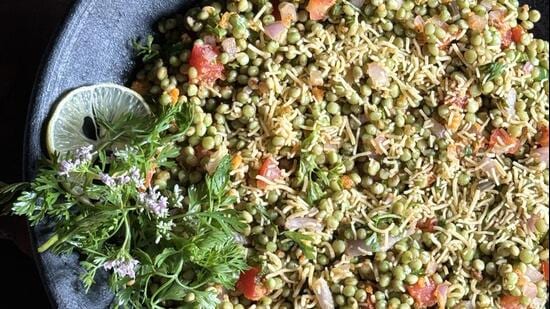
Hurda also refers to unripe green bajri (pearl millet) or maize grains, though jowar is the more widespread variety across Maharashtra. Over the past few decades, hurda has been packaged as a nostalgic agro-tourism escape, complete with buffet spreads and bullock cart rides. However, long before it became an urban, upper-class leisure activity, roasted green hurda featured in accounts of Maratha military campaigns and formed part of the rural subsistence economy and agricultural life of the Poona Deccan.
Hurda finds mention in medieval Marathi texts like the “Dnyaneshwari” and “Leelacharitra”. Eighteenth-century Marathi visual culture linked roasted green grain to the austerity and speed of Maratha cavalry campaigns. In his biography of Peshwa Bajirao I, Nageshrao Vinayak Bapat Waikar wrote that when the Peshwa began leading military campaigns, he would subsist for days on roasted chickpeas and hurda. As James Campbell recorded in the 1885 Gazetteer of the Bombay Presidency for Poona, “Maratha pictures represent Peshwa Bajirao I eating fried jvari ears or hurda as he rides at the head of a troop of Maratha soldiers.”
For a cavalry column on the move, hurda was a convenient ration. During the Panipat campaign in late 1760, as recorded in “Bhausahebanchi Kaifiyat”, a light Maratha reconnaissance detachment under Baji Hari dismounted in dense woods near the Afghan lines to roast and eat hurda, assuming the enemy was nowhere in sight, only to be ambushed by an Afghan patrol that killed four men and sent the rest back to camp stripped of their horses and weapons.
{{/usCountry}}For a cavalry column on the move, hurda was a convenient ration. During the Panipat campaign in late 1760, as recorded in “Bhausahebanchi Kaifiyat”, a light Maratha reconnaissance detachment under Baji Hari dismounted in dense woods near the Afghan lines to roast and eat hurda, assuming the enemy was nowhere in sight, only to be ambushed by an Afghan patrol that killed four men and sent the rest back to camp stripped of their horses and weapons.
{{/usCountry}}In the dryland tracts of the Deccan stretching eastward from Poona through Haveli, Shirur, Bhimthadi, and Indapur, winter sorghum matured between December and February. By the late nineteenth century, British revenue surveys documented jowar as the foundational cereal of Poona District. In 1881–82, the crop covered 588,502 acres across the district. Hurda provided an important source of food for the rural working poor in the weeks immediately preceding the main harvest. “When in season the parched unripe jvari heads form a chief item of food with the labouring classes and are called hurda,” noted the 1885 Poona Gazetteer.
JA Abbott, writing about agricultural customs in the Deccan in “The Keys of Power” (1932), described hurda as a communal feast. In the chapter “The Rituals of Agriculture”, he wrote that people were invited to eat the roasted unripe grain with coconut and garlic, after five ears had first been offered to the village deity. He noted that this was a widespread custom and described the hurda feast as one of the familiar sights of the countryside. The feast was also associated with acts of charity, with farmers distributing produce from their fields in the belief that generosity would bring a more abundant harvest.
Newspaper reports, fiction, and autobiographies document hurda parties in the twentieth century. The “Maharashtra Vaksampradaya Kosh” recorded the expression “Bamani hurda”, referring to grain that had become overripe and tough. Because farmers (Kunbis) knew best which hurda was ideal for eating, they plucked the tenderest, sweetest cobs for themselves. Assuming that urban folks or Brahmins could not tell the difference, they ended up serving them the tough, overripe grains instead.
Authors Vyankatesh Madgulkar and Gopal Neelkanth Dandekar described the hurda parties arranged by farmers for friends in Pune and southern Maharashtra. On February 1, 1934, Sakharam Viththal Hudagikar hosted a hurda party at his farm near Solapur for the District Collector and other officials; the Marathi newspaper “Dnyanaprakash” noted that nearly a hundred guests were in attendance.
Around the same period, winter hurda parties became a regular fixture at Maharshi Dhondo Keshav Karve’s Mahilashram at Hingne, where students, teachers, and patrons gathered in the open fields on the city’s outskirts to eat roasted tender jowar. In 1931, the Local School Board of Poona considered organising hurda parties for schoolchildren. The proposal was abandoned because of the expense involved.
Hurda was made from varieties grown specifically for their tender, sweet grain. While standard winter varieties like Shalu and Maldandi were grown for bhakri flour and cattle fodder, farmers maintained small plots of specialised sweet-grained landraces, traditionally grouped under the Vani sorghums and celebrated in the Marathi proverb “Vanyacha hurda”.
In 1919, GL Kottur of the Department of Agriculture, Bombay Presidency, published “Classification and Description of the Jowars of the Bombay and Karnataka (Bulletin No. 92)”, one of the earliest colonial classifications of regional sorghum varieties based on grain structure and culinary use. Decades later, germplasm research at ICRISAT by KE Prasada Rao and DS Murty (”Sorghum for Special Uses,” 1981) identified the genetic characteristics behind these cultivars.
Unlike standard grain sorghum, Vani landraces possess a sweet, sugary endosperm at the soft-dough stage, roughly 95 to 97 days after sowing. Their high soluble sugar content causes the grain to lose moisture rapidly as it dries and develop visible dimples at maturity. This makes it unsuitable for long-term storage or milling into bhakri flour. Since these varieties could not be stored through the year, they had to be eaten fresh from the fire. Around Deccan and southern Maharashtra, farmers guarded heirloom landraces such as Gulbhendi, Surti, Dudhmogra, and Sakri-Mukri specifically for this short winter season.
For most of the twentieth century, hurda production remained largely local. A report published in 1953 by the Agriculture College, Pune, noted that traditional landraces like Gulbhendi yielded around 2,082 kilograms of tender grain per hectare, but their tightly attached glumes made grain separation difficult.
It was only at the turn of the twenty-first century that agricultural scientists at Mahatma Phule Krishi Vidyapeeth, Rahuri, crossed the traditional Gulbhendi landrace to breed commercial hurda cultivars such as Phule Uttara (2005) and Phule Madhur (2015). By retaining Gulbhendi’s sweetness, increasing tender-grain yields to nearly 3,400 kilograms per hectare, and achieving grain separation rates above 95 per cent, the scientists made commercial hurda cultivation more viable.
When Punekars gather around farm pits this winter to roast and eat hurda, they are continuing a tradition that appealed to Chakradhar Swami, sustained Maratha cavalry campaigns, and formed part of the rural subsistence economy of the Deccan. The brief winter season still gives this old food its place in the lives of farmers and city-dwellers alike.