PUNE: After the end of a pilot project that used artificial intelligence (AI) to detect traffic violations on September 15, 2026, double-parking and unauthorised stopping of vehicles have resurfaced on Fergusson College (F C) Road, much to the disappointment of residents.
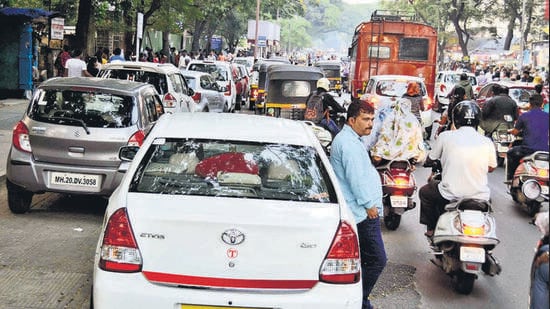
“We have seen a rise in double-parking and unauthorised stopping of vehicles on F C Road after the pilot ended. Vehicles parked along the road reduce the carriageway available to moving traffic, leading to congestion and inconvenience for commuters,” said Pranali Deshmukh, a resident of Erandwane.
The pilot was implemented from May 28 to September 15 this year by the Pune city traffic police in collaboration with SenSen Networks Ltd. It used AI-enabled cameras to detect violations, including no-parking, double-parking, triple-seat riding, driving in the wrong direction, and obstruction of traffic along a 200-metre stretch of F C Road; automatically generating challans for the detected offences.
The pilot’s weekly data showed that the average number of daily violations declined from 140 in the first week to 142 in the second, before falling to 126 in the third week, and 114 in the fourth. The count subsequently fluctuated between 104 and 118 in the weeks five to seven, before dropping to 90 in the eighth week. Violations continued to decline in the following weeks, reaching 84 in weeks nine and 10; 78 in week 11; 70 in week 12; 66 in weeks 13 and 14; and 56 in week 15. The figure rose slightly to 58 in the final week.
Data from the 16-week trial showed a substantial decline in violations, from an average 140 violations per day in the first week to 58 in the final week. As such, violations fell by nearly 59% over the said period, indicating improved compliance as motorists became aware that violations would be detected and penalised.
{{/usCountry}}Data from the 16-week trial showed a substantial decline in violations, from an average 140 violations per day in the first week to 58 in the final week. As such, violations fell by nearly 59% over the said period, indicating improved compliance as motorists became aware that violations would be detected and penalised.
{{/usCountry}}Vijay Khuspe, director, SenSen Networks Ltd., said that the trial demonstrated the effectiveness of technology-driven enforcement.
“We have successfully completed the pilot project on F C Road and the results are there to see. When the project was operational, violations decreased,” Khuspe said. The pilot data also showed a sharp decline in repeat violations, with repeat challans slapped on less than 1% offenders during the trial period.
Meanwhile, Pune city traffic police said that the project has not been abandoned but is being incorporated into the broader Intelligent Traffic Management System (ITMS) under which, AI-enabled cameras have been proposed at more than 400 locations across the city.
Manoj Patil, additional commissioner of police (traffic), said, “Basically, it was a pilot project. During the period, over 5,250 challans were issued, and interestingly, there were no grievances because human interference was minimised.”
“After getting good results from this project, we have decided to incorporate this under our ITMS initiative and install more such cameras at over 400 locations across the city. The proposal has already been made and sent, and it is at the stage of approval,” he said.
The pilot also appeared to have influenced parking behaviour in the area. According to traffic police officials, municipal corporation-run parking facilities in the locality were operating at full capacity during the trial period, indicating increased demand for designated parking spaces. Two to three individuals even approached the traffic police, seeking permission to introduce valet parking services in the area. They were directed to the Pune Municipal Corporation (PMC) to obtain the necessary permissions; officials said.