“It’s is difficult to believe that life could actually change so much in just two-three years. But that is how my experience has been since I took over this work in 2018 after becoming a member of the women self-help group (SHG) in 2015,” says Poonam Surin, who works as banking correspondent sakhi (BCS) in the tribal-dominated Tethaitangar block of Simdega district in Jharkhand.
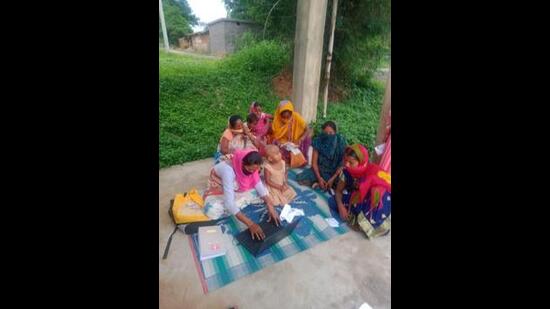
Surin, a graduate, says she was a homemaker till she joined the SHG, giving tuitions to children in her Gargarbahar village and earning around ₹1000-1500 every month. “On an average, I now earn around ₹10,000 per month. And there is scope to increase it further as my income is linked to the number of banking transactions done through me. We get a commission of 0.5% of each transaction value,” says Surin.
In November 2021, Surin did 795 banking transactions worth ₹31.95 lakh.
There are others who have travelled far, doing monthly transactions of over ₹1 crore. In the same month, Anita Kumari of Jayshree Mahila Kalyan Samuh in Chitarpur of Ramgarh district did transactions worth ₹1.2 crore. Similarly, Gudiya Kushwaha of Vikash Mahila Mandal in Bela in Hazaribag district logged transactions worth ₹1.09 crore.
Besides gender empowerment, SHG women like Surin are transforming banking in the rural areas, taking it to the doorsteps of the needy, especially the elderly and the divyang (handicapped), widening financial inclusion of rural populace like never before.
{{/usCountry}}Besides gender empowerment, SHG women like Surin are transforming banking in the rural areas, taking it to the doorsteps of the needy, especially the elderly and the divyang (handicapped), widening financial inclusion of rural populace like never before.
{{/usCountry}}These BCS are part of SHGs (Sakhi Mandals) formed under the Deendayal Antayodaya Yojana (DAY) under the National Rural Livelihood Mission (NRLM) of the central government.
In Jharkhand, the programme is run by Jharkhand State Livelihood Promotion Society (JSLPS), which works under the state’s rural development department. As per official estimates, the BC Sakhis are making 2.75 lakh transactions worth ₹120 crore every month.
“Currently, we have 4,691 women working as banking agents. Some of them are working in the same panchayats if they are big in geographical spread and demography. Out of them, 1,491 are working as BCS after proper training. The target is to have at least one BCS in all of the 4,370 gram panchayats in the state,” said Dheeraj Horo, state programme manager (financial inclusion), JSLPS.
These banking correspondents provide basic financial services such as customer identification, collection of information/applications, individual account opening, cash withdrawal, deposit, transfer, Aadhar seeding, pension services, scholarships to school children, wage payment under MGNREGA and fund withdrawal under PMAY etc.
“While the concept of banking correspondent is to take banking into rural pockets, associating women with it has far-reaching consequences. It has the potential of a silent social revolution wherein women become self-reliant. It also promotes them as role models among the local populace,” said Manish Ranjan, rural development secretary, Jharkhand.
JSLPS officials said women working as BC Sakhi also help SHGs in understanding the banking system and make credit linkages better. “If members from a SHG become banking agents, it boosts the confidence of other members of the SHG as most of them are illiterates. As per the state-level banking committee (SLBC) data, the credit linkage to women SHGs was only ₹27 crore in 2013. In 2021, it rose to ₹3,234 crore. It shows how confidence of SHGs has increased in seeking bank loans,” said Horo.
During Covid-19 and curbs, officials said, banking correspondents played a key role, providing banking services closer to people’s homes, taking all precautions as per the set protocols. “Besides banking services, these BCS and SHGs also helped in cooking and distribution of food during the lockdown period,” said Ranjan.
However, technical glitch, especially poor internet connectivity, is one of the major hindrances in functioning of the banking correspondents, besides safety issues for moving around with money for their job.
BCS Gudiya Kushwaha of Vikash Mahila Mandal in Bela in Hazaribag district, who logged transactions worth ₹1.09 crore, said poor internet connectivity forces them to restrict their functioning from their kiosk, which operates like a mini bank.
“We still try to reach out to the needy, especially the elderly and disabled. We try to organize a weekly visit to the villages to cater to the needs of the SHGs and their loan-related settlements. Even if the customers are required to visit our permanent centres, it is much more convenient for them. For example, people from our panchayat were required to visit the block headquarter Chouparan to avail of banking services, which is around six kilometres from here. But now they are required not beyond one to one-and-a-half kilometres,” said Kushwaha.
Ranjan, while conceding that internet connectivity was a concern, said his department has issued an order making it mandatory for the BCS to make regular visits to the villages. “It is especially required when the customers are senior citizens or divyangs,” said Ranjan.