As Ludhiana continues to grapple with the maximum number of Covid-19 cases and deaths in Punjab, the number of containment zones has also increased substantially across the length and breadth of the district, restricting around 15,000 residents within their streets.
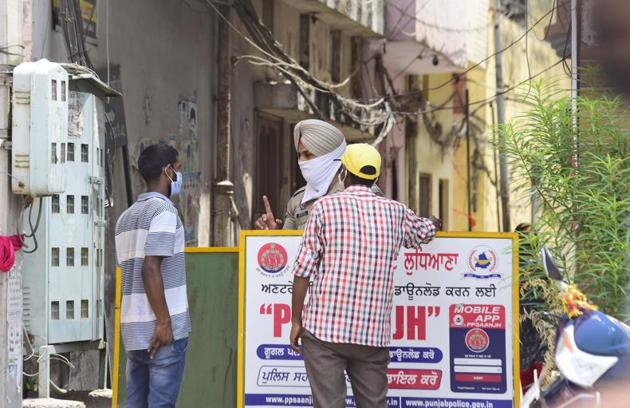
From old city areas to narrow lanes, rural areas to city markets, the pandemic has not spared even those living in posh localities of Ludhiana.
With 9,546 Covid-19 cases and 361 fatalities, the district has five containment zones and 34 micro-containment zones, and the number is expected to rise. Micro containment involves sealing only a certain locality in a large area.
When the cases were 3,935 and deaths 122 in the beginning of August, the administration had declared 10 areas as micro-containment zones, while a month ago, the district had just two containment zones.
As per officials, in Punjab, areas where positive cases exceed 15 are declared containment zones, while those with cases between five and 15 are declared micro-containment zones.
Among the areas to get the tag recently are tony city areas, such as B-block of BRS Nagar (25 positive cases, containment zone) and parts of Model Town Extension, Aggar Nagar Block A, Sector 32, Chandigarh Road and Atam Nagar (micro-containment zones).
{{/usCountry}}Among the areas to get the tag recently are tony city areas, such as B-block of BRS Nagar (25 positive cases, containment zone) and parts of Model Town Extension, Aggar Nagar Block A, Sector 32, Chandigarh Road and Atam Nagar (micro-containment zones).
{{/usCountry}}The highest positive cases at 39 are from the narrow lanes of Dhandari Kalan, a congested area, which was declared a containment zone on August 17.
In the rural parts of the district, confined areas near Heavenly Palace, Doraha, is a containment zone with 17 cases, while areas near Macchhiwara Sahib, Ram Nagar Jagraon, Kalakh Majra Dehlon, village Manakwal, village Akalgarh, among others have been declared micro-containment zones.
According to Ludhiana additional deputy commissioner (development) Sandeep Kumar, the residents of these zones are allowed access to only essential services within their area and movement is severely restricted.
“Boundaries are decided keeping in view the cases in that particular area. While the containment zone is initially declared for a minimum of 10 days, decision on whether to extend it is taken following analysis of the last positive case there,” he said.
Amid all these steps by the administration, managing a large population with blatant containment zone violations remains a challenge.
“People venture out several kilometres away from their house for all sorts of errands by pleading ‘emergencies’. Confining the public amid the sheer disregard towards the rising pandemic is a major challenge,” said a police official deputed at a containment zone.
RESISTANCE TO TESTING
District epidemiologist Dr Ramesh Kumar said their aim was to collect samples from 100% population of a contained area. “But, despite our best efforts, we face a lot of resistance from residents. Some even refuse to open doors out of fear that they will be declared positive. They do not cooperate with us.”