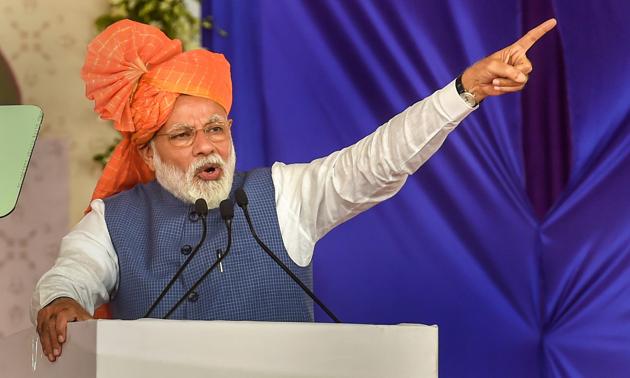
When Narendra Modi is on the campaign trail in his janmabhoomi (place of birth) of Gujarat, his rhetoric usually gets even more theatrical. No surprise then, that he chose a public rally in Ahmedabad last week to launch a ferocious attack on Pakistan. “Ghar mein ghuskar maarenge (will enter their homes and kill them)”, he thundered, while threatening more air strikes on Pak-based terror camps. The adoring crowd, which, until then, was relatively subdued, erupted into loud applause. This was the kind of talk for which they had been waiting.
The shrill anti-Pakistan tone is not new in Gujarat’s political landscape. In the state election campaign of 2002, against the backdrop of the Godhra train burning and alleged links of the suspects with Pakistan, Modi positioned Miyan Musharaff as his prime enemy. The miyan allusion to the Pakistani dictator was an obvious dog-whistle for demonising the Gujarati Muslim. In the 2017 Gujarat campaign, he went a step further, while suggesting that his predecessor, Manmohan Singh, was plotting with Pakistani officials against his government by attending an informal dinner with high-profile guests from across the border. Singh rightfully demanded an apology; he never got one. Another campaign was to spread the fake news that a retired Pakistani general was pushing for Congress leader and Sonia Gandhi’s political secretary, Miyan Ahmed Patel, to be made the next Gujarat chief minister.
The question is, will the fear-mongering around Pakistan’s terror militias and their alleged local links now acquire a national resonance in the 2019 general elections? Recall the Bihar 2015 assembly election campaign when Bharatiya Janata Party (BJP) president Amit Shah warned voters that if the opposition maha gatbandhan (grand alliance) won, crackers would be burst in Pakistan. The desperate attempt by the BJP leadership to prey on the fears of the Bihari Hindu voter failed against the sheer arithmetic of the wide caste coalition that was ranged against the party. Even in its previous Jan Sangh avatar, when the sangh parivar espoused the notion of an Akhand Bharat and an annihilation of Pakistan as its core agenda, the voter wasn’t particularly enthused. The post-Kargil war general election of 1999 also did not see any dramatic swell in voter support. Nor was the BJP able to stop Sheila Dikshit from completing a hat trick of wins in Delhi when the city-state went to the polls in 2008 within days of the horrific Mumbai 26/11 terror attack despite putting out full page ads on polling day blaming the Congress for the terror strike.
{{/usCountry}}The question is, will the fear-mongering around Pakistan’s terror militias and their alleged local links now acquire a national resonance in the 2019 general elections? Recall the Bihar 2015 assembly election campaign when Bharatiya Janata Party (BJP) president Amit Shah warned voters that if the opposition maha gatbandhan (grand alliance) won, crackers would be burst in Pakistan. The desperate attempt by the BJP leadership to prey on the fears of the Bihari Hindu voter failed against the sheer arithmetic of the wide caste coalition that was ranged against the party. Even in its previous Jan Sangh avatar, when the sangh parivar espoused the notion of an Akhand Bharat and an annihilation of Pakistan as its core agenda, the voter wasn’t particularly enthused. The post-Kargil war general election of 1999 also did not see any dramatic swell in voter support. Nor was the BJP able to stop Sheila Dikshit from completing a hat trick of wins in Delhi when the city-state went to the polls in 2008 within days of the horrific Mumbai 26/11 terror attack despite putting out full page ads on polling day blaming the Congress for the terror strike.
{{/usCountry}}And yet, if the BJP seems convinced that this time it can capture the election narrative by relentless Pakistan bashing, it is partly a weakened and divided opposition which has aided the process. With several opposition leaders demanding proof of the damage done by the air strikes, the opposition is in danger of falling into the carefully laid trap of the Modi-Shah machine. When rising unemployment and falling agriculture income figures should be the key talking point for the Congress-led opposition parties, far too many of their leaders seem to be spoiling for a fight over national security.
With a TRP-hungry high-decibel news television as an ever-willing echo chamber, muscular nationalism is the terrain which suits Team Modi , especially across the Hindi heartland where the 2019 elections will be won and lost. In the early 1990s, the BJP fashioned a Hindutva wave on the Ram Janmabhoomi issue with the sadhu-sant samaj as support cast. Now, it’s the men in uniform and TV studio warriors who are being used to create an emotional nationalist upsurge around the notion of a strong Hindu nation taking on an Islamist Pakistan with Modi as the mascot of this new majoritarian awakening. The millennial voter, impatient with the more traditional diplomatic methods of dealing with a rogue Pakistani army-terror machine, is a specific target of this muscle flexing, war mongering pitch.
Perhaps, a more engaged and ideologically robust opposition could offer a meaningful challenge to the Modi brand of Hindutva nationalist politics as it did in the 1990s when the “mandir wahin banayege (will build the temple at the same spot)” saffron army was stopped in its tracks in Uttar Pradesh. But while the Vajpayee-Advani generation of BJP leaders in the 1990s were conscious of a broad parliamentary etiquette, the Modi-Shah loyalists have little time for political correctness or constitutional niceties. Which might explain why, when questioned on the stark intelligence failure in Pulwama, the instant response of BJP spokespersons was to get aggressive and lampoon the critics as “anti-national Pakistanis”! When the battle lines are drawn between “desh bhakts (patriots)” and “desh-drohis (traitors)” in such crude terms, the political climate is bound to be further vitiated.
Post-script: The original trademark for Pakistan bashing as an instrument of domestic politics lies with the Shiv Sena chief, Bal Thackeray. In 1991, when Shiv Sainiks dug up a Mumbai cricket pitch to protest against an India-Pakistan cricket match, Thackeray was in a celebratory mood. “I am proud of my boys, they have taught Pakistan a lesson,” he said. Where Thackeray seemed content with grabbing the headlines after the pitch vandalism, Modi now hopes to gain electorally with the Balakot air strike.
Rajdeep Sardesai is a senior journalist and author
The views expressed are personal