Twenty years after Rahul Dravid and Virender Sehwag were among the defining figures of Indian batting, their sons found themselves together on an India scorecard on Friday. Anvay Dravid and Aryavir Sehwag featured for India U19 against Australia U19 in the opening unofficial ODI of the three-match series at the Nianjan Shah Stadium in Rajkot, with both offering intriguing glimpses of cricketers beginning to build identities of their own.
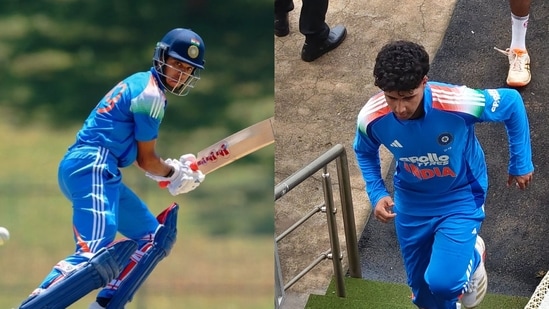
Aryavir, making his first appearance for India U19, opened the batting and scored 28 off 26 deliveries, while Anvay produced the more explosive innings lower down the order, smashing 38 from only 18 balls as India reached 182/6 in a rain-shortened contest reduced to 20 overs a side.
For Anvay, particularly, the nature of the innings made for an interesting contrast with the image most readily associated with his father. Rahul Dravid was hardly incapable of playing attacking cricket. He adapted successfully to the demands of limited-overs cricket and later demonstrated that he could be an effective T20 batter as well. But the overwhelming image of Dravid’s career remains that of “The Wall” - a batter whose game was founded upon patience, judgement outside off stump, technical discipline and the willingness to absorb pressure for prolonged periods.
Anvay’s innings on Friday belonged to an altogether different tempo. Walking in at No.6, the 17-year-old wicket-keeper batter struck two fours and three sixes during his 18-ball 38, scoring at a strike rate of 211.11. He combined with Yashbardhan Chauhan in a rapid 69-run partnership from only 34 deliveries, helping India accelerate after losing wickets through the middle of the innings. It was not the first indication that Anvay possesses a considerably more aggressive gear. During India’s U19 tour of Sri Lanka earlier this year, he followed a score of 14 on his Youth ODI debut with an 87 off 67 balls in Hambantota, an innings containing nine fours and a six.
{{/usCountry}}Anvay’s innings on Friday belonged to an altogether different tempo. Walking in at No.6, the 17-year-old wicket-keeper batter struck two fours and three sixes during his 18-ball 38, scoring at a strike rate of 211.11. He combined with Yashbardhan Chauhan in a rapid 69-run partnership from only 34 deliveries, helping India accelerate after losing wickets through the middle of the innings. It was not the first indication that Anvay possesses a considerably more aggressive gear. During India’s U19 tour of Sri Lanka earlier this year, he followed a score of 14 on his Youth ODI debut with an 87 off 67 balls in Hambantota, an innings containing nine fours and a six.
{{/usCountry}}Also Read: Yuvraj Singh ‘texted’ Abhishek Sharma, a day later he responded with record-breaking century
A familiar Sehwag name returns at the top
If Anvay’s innings offered a contrast to his father’s most famous batting identity, Aryavir's position at the top of the order inevitably carried echoes of Virender Sehwag. The younger Sehwag opened the innings on his India U10 debut and struck five boundaries during his 26-ball 28. He added 45 runs in 6.1 overs for the first wicket with captain Lakshya Rajesh Raichandandi, who contributed 15 from 15 balls.
There was no attempt at reproducing one of his father’s whirlwind assaults on this occasion, but Aryavir’s boundary-heavy contribution still carried traces of the attacking intent with which the Sehwag surname became synonymous at the top of an innings. The 18-year-old had already attracted considerable attention in the age-group cricket after producing a mammoth 297 for Delhi against Meghalaya in the Cooc Behar Trophy in 2024. That innings came from 309 deliveries and included 51 fours and three sixes, leaving him only three runs short of a triple century.
Friday, however, represented a different milestone: his first innings wearing India colours at the U19 level. For Anvay, it was another step in an international age-group journey that began against Sri Lanka in July. For Aryavir, it was the beginning of one. And while the surnames ensured immediate attention in Rajkot, the more interesting detail was the manner in which the two sons went about their cricket. One Dravid was clearing the ropes at more than runs a ball; one Sehwag was constructing an opening stand rather than detonating from ball one. The names may be inherited. Their cricket, increasingly, is becoming their own.