There’s no better way to understand Sachin Tendulkar’s cricketing journey than through his bats. Twenty-five of his prized willows, used in the most memorable stages of his career from 1978 to 2013, are in display at the Mumbai Cricket Association’s Sharad Pawar Cricket Museum, Wankhede Stadium.
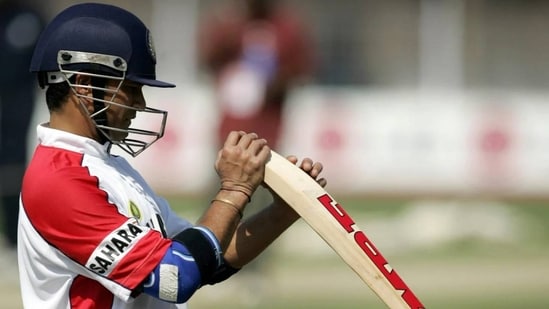
From his first bat, picked up as a five-year-old, to the one used in his final Test will adorn the one-of-a-kind section dedicated to Tendulkar.
Named ‘Batography’, the collection presents each bat as a chapter in the batting master’s career. It begins with the Kashmir willow bat gifted to him by his elder sister Savita in 1978, and culiminates with the bat with which he played his last Test innings at the Wankhede.
The collection includes the bat with which he scored his maiden Test century at Manchester’s Old Trafford in 1990, aged 17. The bat gifted to him by Don Bradman in 1998. The bat he used in the 2003 World Cup where he was declared player of the tournament. And the one with which he scored his 100th international century, against Bangladesh in Mirpur on March 16, 2012.
Tendulkar unveiled ‘Batography’ on Monday evening and then shared many interesting anecdotes about his bats, numbered 1 to 25.
{{/usCountry}}Tendulkar unveiled ‘Batography’ on Monday evening and then shared many interesting anecdotes about his bats, numbered 1 to 25.
{{/usCountry}}Bat number 20 is tagged as “The Superbat”. It is the one he used between 2009-11 and scored 175 against Australia at Hyderabad and the first ODI double century against South Africa by a male cricketer, at Gwalior.
Interestingly, the bat was not meant for Tendulkar.
“We were playing at Mohali and the bat manufacturer (Sumit Kohli) had brought a collection of bats for me to choose from. There was one bat which he kept aside and I casually asked him about it. He said it was not of my kind and quality, it was slightly long as well, and that it is for Sunil Joshi (ex-India spinner and lower order batter).
“Out of curiosity, I took it and when I hit (tapped the ball on the blade), the ball flew and touched the roof. I told him I will give two extra bats to Joshi, and asked him to give me the one meant for Sunil. Please cut it from the bottom and send it quickly to me. Next game we were playing in Hyderabad against Australia and the bat reached me just as the bus was leaving for the stadium. I went out to bat with a brand new bat.
“It became my favourite bat. I used to repair it myself, using various methods, putting glue, etc.”
Talking about the best way for youngsters to check a bat, the batter with record Test and ODI runs said: “The feel of the bat is the most important thing. If a 10-year-old has to choose a bat, one should check how it feels while playing the cut (in front of the square and late cut) and pull shots against fast bowlers,” he said, emphasising that “you can’t play those shots well if the balance of the bat is not good.”
One of the most intriguing aspects of Tendulkar’s bat history is that for two years at his peak, including the entire 1996 World Cup, he played without any sticker on the bat. Tendulkar said a lot of offers were there but he and his family members decided not to advertise tobacco and alcohol brands. Out of superstition, he even turned down the offer from a top international sports brand so as not to jinx his fine run.
“During the 1996 World Cup, I became the man of the match in the first two matches and was feeling good with a blank bat. During those days, people could walk into the dressing room if they knew someone from the team. We were playing against Australia, and batted second. I remember the MD of a foreign company who was earlier in talks with me coming into the dressing room and saying: “we accept all your terms and conditions, you please put our sticker on the bat right now and go out to bat”. But I said no, “I am slightly superstitious now, with the blank bat it was priceless to score all those runs. We will talk after the World Cup. I am going to play the whole World Cup with a blank bat. I didn’t want to disturb anything.”
Addressing the MCA officials, he said: “My bats are an extension of my body. They are so dear to me. I am giving you a part of my body, and please take care of it.”