Some young batters announce themselves through spectacle. The bat comes down hard, the ball disappears frequently, and their gifts are immediately obvious. Yashbardhan Singh Chauhan appears to be taking a more intriguing route. His appeal lies not merely in how forcefully he can strike the ball, but in how naturally he seems to understand the changing demands of an innings.
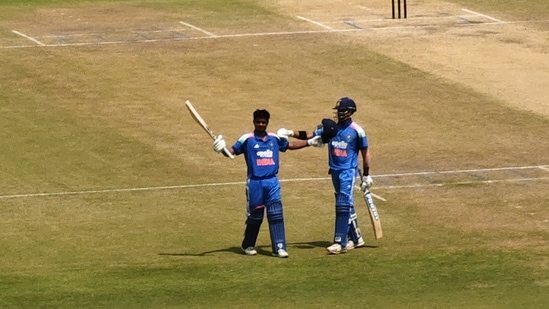
That was the most revealing aspect of his 122 against Australia Under-19 in Rajkot on Monday. Chauhan reached 53 from 53 balls before finishing with 122 from 100, meaning his final 69 runs arrived from only 47 deliveries. The innings was not played at one relentless tempo; it was consciously reshaped as the contest evolved.
India were already well placed when Chauhan arrived, but the situation still required judgment rather than abandonment. He and VK Vineeth built a substantial partnership without becoming hostage to urgency, allowing the innings to acquire both stability and depth before the acceleration began. Once that foundation had hardened, Chauhan changed gears without allowing his batting to lose structure.
Why Chauhan looks different
That ability to move through gears is what makes him particularly interesting. Plenty of gifted teenage batters can attack, and many can also defend. Far fewer show an early understanding of when each instinct should take precedence, or possess the composure to alter tempo without making the transition appear forced.
Any comparison with Virat Kohli or Shubman Gill must therefore be handled carefully. Chauhan is only 17 and remains several developmental stages removed from the demands of international cricket. Calling him the “next Kohli” would be premature, but there is a legitimate comparison to be made in terms of batting architecture.
{{/usCountry}}Any comparison with Virat Kohli or Shubman Gill must therefore be handled carefully. Chauhan is only 17 and remains several developmental stages removed from the demands of international cricket. Calling him the “next Kohli” would be premature, but there is a legitimate comparison to be made in terms of batting architecture.
{{/usCountry}}Kohli and Gill were never compelling merely because they could dominate attacks. Their appeal lay in their ability to take increasing ownership of an innings: first through control, then through accumulation, and finally through acceleration. Chauhan's early cricket is beginning to reveal traces of that same instinct.
His junior record strengthens the impression that occupying the crease is not something he merely tolerates. As a 13-year-old, he produced extraordinary scores of 425, 235 and 391 in Madhya Pradesh age-group cricket, innings that spoke as much about concentration and appetite as they did about technical superiority. He has since continued to produce substantial scores rather than relying on short, eye-catching cameos.
The opening match of the Australia series provided an equally useful contrast. With rain reducing the contest to 20 overs a side, Chauhan responded with 54 from 34 balls. Three days later, given a full one-day innings and an entirely different rhythm, he made 122 from 100. The significance lies not simply in scoring in both games, but in how differently he solved the two problems.
That adaptability may ultimately become the most valuable part of his batting. The climb through professional cricket is an exercise in adjustment: quicker pace, more intelligent fields, better spin and opponents who identify technical weaknesses rapidly. Players dependent on one method can look spectacular until that method is deciphered; the most enduring batters usually learn to inhabit several versions of themselves.
Chauhan has not yet faced those examinations often enough for sweeping conclusions. Age-group cricket has produced many prodigies whose dominance did not survive the transition into senior competition, and one hundred against Australia Under-19 cannot answer every question.
What Monday's innings did provide was another indication that Chauhan possesses something beyond precocious stroke-making. He appears willing to let an innings develop before imposing himself upon it, and secure enough in his own scoring range to resist manufacturing urgency before it is required.
That is where the Kohli-Gill comparison becomes meaningful — not as a prediction of greatness, but as a description of method. Chauhan is beginning to resemble a batter interested not merely in producing memorable innings, but in understanding them well enough to determine what they eventually become.