On November 22, 2022, India apparently moved on from one of their most prodigious swing bowlers. Bhuvneshwar Kumar played for the last time in the Indian Blues on that day against New Zealand at Napier. He bowled four overs, went wicketless, and soon disappeared from India’s plans. The numbers for him that year in T20Is were not particularly punishing either. In 32 matches, he picked up 37 wickets while averaging 19.56 and conceding runs at an economy rate of 6.98.
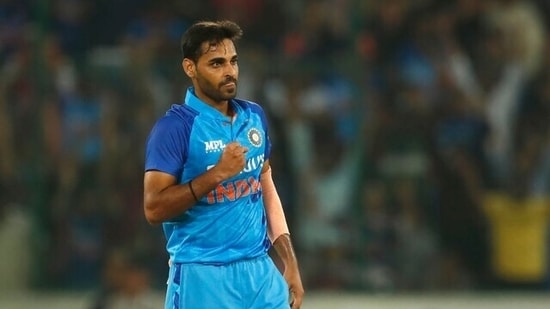
However, India began to look beyond, and after nearly four years, it has returned to him. The 36-year-old has been picked in the Indian squad for the five-match T20I series in New Zealand. The most interesting part of this dramatic comeback is not simply that he survived a long exile away from the national side; it is how he changed himself as a bowler during this period.
Bhuvneshwar returned to the domestic arena and did his best. He picked up 16 wickets at an average of 9.31 and an economy of 5.84 in the 2023 Syed Mushtaq Ali Trophy. He proved his mettle even in first-class cricket, picking up a career-best 8/41 for Uttar Pradesh against Bengal in early 2024.
Deep Dive
How did Bhuvneshwar Kumar adapt his bowling technique for his comeback in T20 cricket?
What role did selectors play in Bhuvneshwar Kumar's return to the Indian cricket team?
Why was Bhuvneshwar Kumar considered for the T20I squad against New Zealand?
His IPL performances were far less noticeable. In IPL 2024, Bhuvi managed only 11 wickets at an economy of 9.35, while in IPL 2025, he picked up 17 wickets at an economy of 9.29. These are hardly the kind of performances one wants to deliver in one of the world's premier T20 leagues while pushing for a comeback into the international arena.
{{/usCountry}}His IPL performances were far less noticeable. In IPL 2024, Bhuvi managed only 11 wickets at an economy of 9.35, while in IPL 2025, he picked up 17 wickets at an economy of 9.29. These are hardly the kind of performances one wants to deliver in one of the world's premier T20 leagues while pushing for a comeback into the international arena.
{{/usCountry}}Then came IPL 2026, and Bhuvneshwar Kumar showed exactly why he is still considered one of the best in Indian cricket. Playing for RCB, he picked up 28 wickets at an average of 17.89 while conceding 7.95 runs an over. More importantly, Bhuvneshwar delivered in the phases where pacers are punished most brutally in the format. In the powerplay, he bowled 34 overs during IPL 2026 and picked up 17 wickets while maintaining an economy of 6.94. In the death overs, he scalped another nine wickets in 18 overs at an economy of 8.50.
The numbers, the performances and the change were there for all to see. Bhuvneshwar was showing signs that he could once again become a bowler capable of both starting and finishing an innings with the ball.
Bhuvneshwar Kumar evolved with the game
The easiest thing to assume from this comeback is that the swing returned for him and he started destroying batters with it again. But that is only partly true. The older version of Bhuvneshwar would give batters early hints through his seam position: one orientation for the outswinger and another for the ones coming back into the batter.
Over time, he evolved and introduced the wobble or scrambled seam delivery more prominently into his repertoire, denying the opposition that early information and making the movement much harder to predict.
The greatest evolution in his bowling was evident in his lengths. That is significant for a bowler who has relied so heavily on swing and on deceiving batters through movement. During his SRH days, Bhuvi picked up 81 of his 157 wickets while bowling around the 6-8 metre zone.
In IPL 2026, however, he dragged his length slightly backwards. He mixed his trademark 6-8 metre deliveries, where he picked up wickets at an average of 20.5 while having an economy of 7.6, with deliveries around the 8-10 metre mark, where he averaged 16.5 and conceded just 6.7 runs an over.
The yorkers in his arsenal were also repurposed. Bhuvneshwar started using them even with the new ball. In IPL 2026, his yorkers went for around five runs an over compared to nearly seven during his SRH days.
One of the major drawbacks in Bhuvi’s bowling towards the closing stages of his previous stint in the Indian blue was the lack of clarity over when to use which variation. His evolution did not come from constantly adding new deliveries, but from developing a much clearer thought process about how and where to use the variations he already possessed.
This could perhaps be one of the most important lessons for players trying to find a way back into the international arena. Bhuvneshwar Kumar did not try to make the selectors remember what he had been in the past. He went back to domestic cricket, put in the hard yards, and adjusted his bowling to the demands of modern T20 cricket.
The comeback, in this case, did not arrive by recreating the past; it arrived by making the people who mattered realise that the old bowler still had plenty of use left in him.