The third wave of the coronavirus pandemic has begun — the seven-day average of daily cases was 29,461 on January 4, a 343% increase from the corresponding figure of 6,656 on December 25 — and states and Union Territories (UTs) are scrambling to enforce curbs of the sort seen during the first and the second waves. Yet, this wave is different. At least in the metros, it is safe to assume that most cases are being caused by the Omicron variant of the Sars-CoV-2 virus, and what we know of this variant suggests fewer hospitalisations and deaths, relatively milder infections, and a short, but sharp spike in cases. This requires a change in testing protocol, quarantine regimes, and the kind of non-pharmaceutical interventions to be used. The Union health ministry or the Indian Council of Medical Research should take the lead on this.
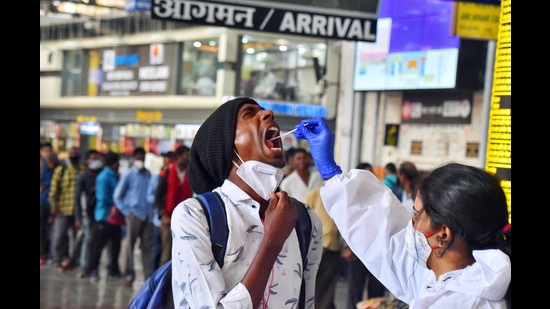
First, testing. Those with mild symptoms associated with the variant should take self-administered home tests (local governments should make these available) and, if they test positive, assume they have been infected by the variant and isolate at home (more on this shortly) along with their family. Those with moderate or strong symptoms should take RT-PCR tests and, if they test positive, be hospitalised. Body temperature and blood oxygen levels should be the only criteria to define mild, moderate, and strong symptoms. Second, isolation and quarantine. It makes no sense to insist that anyone infected with the Omicron variant be hospitalised. This is the quickest way to ensure the health capacity of a region is overwhelmed, and the health ministry’s guidelines issued on Wednesday that those testing positive can home quarantine (irrespective of the variant, HT learns) is welcome. Indeed, the samples of those with no symptoms or mild symptoms should not even be sequenced. Given the infectivity of this variant, cases are bound to spike, and half-baked measures aiming to block its spread are not just unlikely to work, but will also hurt the ongoing economic recovery and impact livelihoods.
Third, metrics. Governments should stop looking at positivity rates, and instead look at symptomatic positivity rates. Not too many states or UTs track this. On the rare days for which this data is available for Mumbai, for instance, the symptomatic positivity rate is a tenth of the positivity rate. In addition, governments should also track hospitalisation rates. Fourth, restrictions. Broadly, indoor activities of any kind should be allowed to carry on with an emphasis on masking, social distancing, capacity, and ventilation; outdoor ones should be allowed with an emphasis on masking and capacity. This means no night or weekend curfews and that almost all activities can go on, albeit with curbs on capacity. The virus has mutated; so should our response.
{{/usCountry}}Third, metrics. Governments should stop looking at positivity rates, and instead look at symptomatic positivity rates. Not too many states or UTs track this. On the rare days for which this data is available for Mumbai, for instance, the symptomatic positivity rate is a tenth of the positivity rate. In addition, governments should also track hospitalisation rates. Fourth, restrictions. Broadly, indoor activities of any kind should be allowed to carry on with an emphasis on masking, social distancing, capacity, and ventilation; outdoor ones should be allowed with an emphasis on masking and capacity. This means no night or weekend curfews and that almost all activities can go on, albeit with curbs on capacity. The virus has mutated; so should our response.
{{/usCountry}}