The nearly-200-km farmers’ Nashik-to-Mumbai march may have ended on Monday with the Maharashtra government offering a seemingly amicable resolution to the protestors, but there are some significant fallacies that policy makers must caution themselves against. The first is the perception that the current agrarian crisis facing the country’s most industrialised state is restricted to loan waivers; and second, that the state-wide resentment is monolithic.
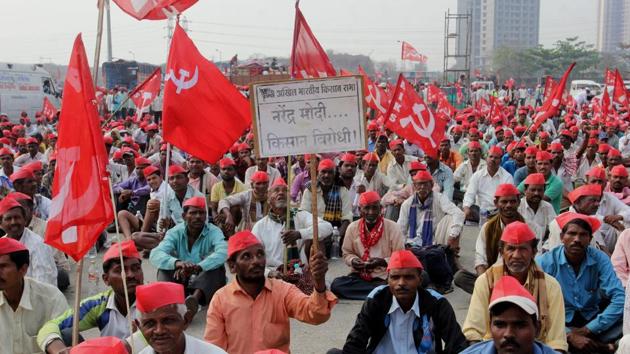
Thousands of farmers from Nashik in northern Maharashtra and the surrounding areas marched to the state’s legislative headquarters to demand fair allocation of forest land, a minimum support price (MSP) that is one and a half times that of the production cost, and the waiving of pending energy bills. However, the concerns of Nashik’s farmers are not the same as those from Vidarbha and Marathwada.
This is a problem not restricted to Maharashtra alone. The state’s farmers have voiced issues similar to those from the rest of the country; only the magnitude and the specifics differ. For instance, data released by the Census of India – and published by this paper in February this year – proves that Dalit farmers across the country are not likely to benefit from farm reforms announced by the government as the policies are aimed at owners of farm lands, rather than the agricultural labour force. More than 70% of agricultural labourers are in debt. Consequently, the suicide rate among them is higher as they do not have access to the formal loan economy, which land owners do.
Maharashtra has other problems, too: over-dependence on the monsoon for growing crops; the lack of empowered village-level redress mechanisms; a massive pest outbreak that has all but destroyed the cotton crop for this year and has left millions without income; and the inconsistencies in the disbursal of farm loan waivers. The debate over MSP is unlikely to end soon as there are several schools of thought on what the best formula should be.
{{/usCountry}}Maharashtra has other problems, too: over-dependence on the monsoon for growing crops; the lack of empowered village-level redress mechanisms; a massive pest outbreak that has all but destroyed the cotton crop for this year and has left millions without income; and the inconsistencies in the disbursal of farm loan waivers. The debate over MSP is unlikely to end soon as there are several schools of thought on what the best formula should be.
{{/usCountry}}It is for all these reasons that no state government in India can think only of loan waivers with the aim of pacifying protesting farmers and winning easy votes in the bargain. Besides, huge loan waivers have a significant impact on a state’s economy as it adversely affects other infrastructure investments. This is exactly what happened to Maharashtra this year, when the state government presented a budget that has no new turnkey project despite the promises made over the last year.
The solution offered to farmers on Monday is welcome, but it is, like previous solutions, piecemeal. There is an urgent need for Maharashtra to address the looming emergency in the farm sector, and it is a crisis that won’t go away with knee-jerk and reactionary responses.