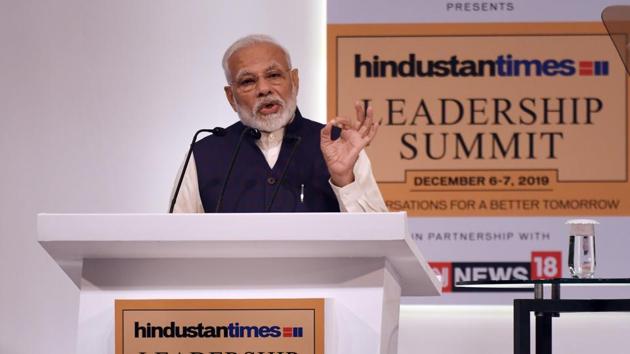
Delivering the inaugural address at the Hindustan Times Leadership Summit on Friday, Prime Minister Narendra Modi laid out the fundamentals of his governance philosophy. He also spoke, with great coherence and clarity, about the underlying reforms the government is undertaking, which, he believes, will lay the foundation for a better tomorrow.
In the run up to the 2014 elections, Mr Modi said he believed in minimum government, maximum governance. He has now built on that underlying philosophy, arguing that the poor must never feel the absence of government, and the citizen, the pressure of government. This is a positive goal. It also explains why the PM has been so focused on expanding welfare programmes, and improving its delivery. Critics may argue that the Indian State still exercises way too much power in regulating citizens. Many within this government’s broad ideological ecosystem too have sought to regulate people’s choices. But if Mr Modi can succeed in turning this around and deepening individual freedom, it will be liberating for citizens.
Within this broad framework, the PM spoke of three major areas of focus. The first, which has been under-reported, is in the realm of administration. This includes transparent appointments, lateral entry for professionals, more expert feedback, termination of the services of underperforming babus, and encouraging integration of all services to prevent them from working in silos. No one can deny the importance of this work, given India’s antiquated bureaucratic processes, which have often stalled progress. The second area is the emphasis on aspirational districts, which have lagged behind on development indicators. Focusing on these, through special plans, sharp implementation and constant monitoring, will indeed lift India’s human development index.
And the final area is the economy. The PM seems to believes that he has done the difficult part of dealing with legacy issues in the last five-and-a-half years. This involved taking steps to sort out the banking mess; initiating measures for relief in real estate; embarking on structural reforms in taxation, ease of doing business, labour laws, disinvestment. All these have led to what the government thinks are short-term adversities for stakeholders. But it has also cleared the basis for more sustained, cleaner growth. The PM now thinks that coupled with the government’s push on infrastructure, if Indian banks start taking decisions without fear, Indian capital begins to step up and invest, and Indian markets respond, there is a better tomorrow. This is once again a positive message. It is what bureaucrats, bankers, business and consumers want to hear in the current phase of slowdown. It is based on not treating mistakes as malfeasance, as the Nobel laureate Abhijit Banerjee suggested. What it needs to be backed with a sustained plan to ease supply constraints, and boost incomes and demand to revive the virtuous economic cycle. Mr Modi has shown he has the intent and has a plan. With his overwhelming personal popularity and political majority, it is time to build on these reforms.
{{/usCountry}}And the final area is the economy. The PM seems to believes that he has done the difficult part of dealing with legacy issues in the last five-and-a-half years. This involved taking steps to sort out the banking mess; initiating measures for relief in real estate; embarking on structural reforms in taxation, ease of doing business, labour laws, disinvestment. All these have led to what the government thinks are short-term adversities for stakeholders. But it has also cleared the basis for more sustained, cleaner growth. The PM now thinks that coupled with the government’s push on infrastructure, if Indian banks start taking decisions without fear, Indian capital begins to step up and invest, and Indian markets respond, there is a better tomorrow. This is once again a positive message. It is what bureaucrats, bankers, business and consumers want to hear in the current phase of slowdown. It is based on not treating mistakes as malfeasance, as the Nobel laureate Abhijit Banerjee suggested. What it needs to be backed with a sustained plan to ease supply constraints, and boost incomes and demand to revive the virtuous economic cycle. Mr Modi has shown he has the intent and has a plan. With his overwhelming personal popularity and political majority, it is time to build on these reforms.
{{/usCountry}}