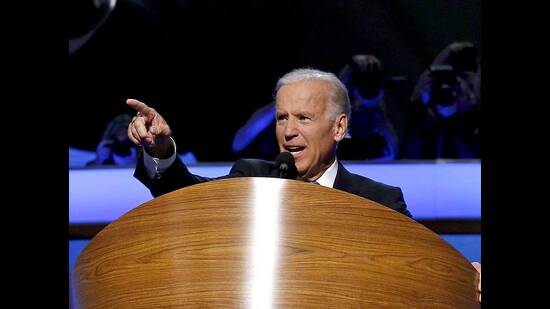
When Joe Biden took office as United States (US) president this week last year, there was a degree of uncertainty over the India-US relationship. Would the new president have the same strategic clarity about China that Donald Trump, for all his political misjudgments, had shown? How would Mr Biden’s emphasis on democratic values translate into the administration’s approach to India? Would Narendra Modi’s joint appearance with Donald Trump in Houston lead to a backlash from within the Democratic Party?
Take
When Joe Biden took office as United States (US) president this week last year, there was a degree of uncertainty over the India-US relationship. Would the new president have the same strategic clarity about China that Donald Trump, for all his political misjudgments, had shown? How would Mr Biden’s emphasis on democratic values translate into the administration’s approach to India? Would Narendra Modi’s joint appearance with Donald Trump in Houston lead to a backlash from within the Democratic Party?
Take each of these concerns. The Biden administration has not just remained strategically clear about China as a competitor — but crafted an approach that is more consistent and coherent than that of its predecessor. Mr Biden convened a meeting of Quad leaders, both virtually and in-person, over the year. And there was recognition that countering China needed an affirmative vision of what democracies could offer. This suited India just fine — as it engaged both bilaterally and within Quad on issues ranging from cooperation on vaccines to emerging technologies. This strategic convergence has, of course, also played a role in minimising the possible divergence on “values and principles”. To be sure, there is concern about India’s record today both in the White House and on the Hill, and India has to end up squandering precious diplomatic energy and political capital in warding off allegations about democratic backsliding. But the China challenge means that key power centres within the national security establishment in Washington DC know that Delhi must be cultivated. The fact that Indian diplomats have actively diversified their political relationships with leaders in the Congress, including those who may have been critical in the past, among Democrats, has also helped.
Two geopolitical issues, however, have added to the challenge. The first was the manner of the US withdrawal in Afghanistan, enabling a Taliban takeover. The current situation in Afghanistan is proof that it has not been as much of a win for Pakistan as Islamabad may have thought — but it has added to India’s security challenge and skepticism about America’s reliability, especially when it comes to the western flank. The second is the growing US-Russia confrontation. Irrespective of whether India gets a waiver on sanctions for its acquisition of the S-400 missile systems, it should be prepared to live with the reality that balancing ties between DC and Moscow will be more challenging in the years to come. Notwithstanding these challenges though, Mr Biden’s stint in office has shown again that the India-US relationship has a momentum of its own. After all, he is the fifth successive president under whom ties have deepened.
One Subscription.
Get 360° coverage—from daily headlines
to 100 year archives.
Archives
HT App & Website