The cheetah is the only large mammal India has lost since independence, and for most of its history in the subcontinent there are no bones or photographs to tell its story. What survives from the pre-modern era are cave paintings, Sanskrit lexicons, Persian chronicles and Mughal miniatures. Cheetah’s story is how a cat that once ranged from Punjab to the Deccan was hunted, tamed and captured out of existence.
A cat built for open country
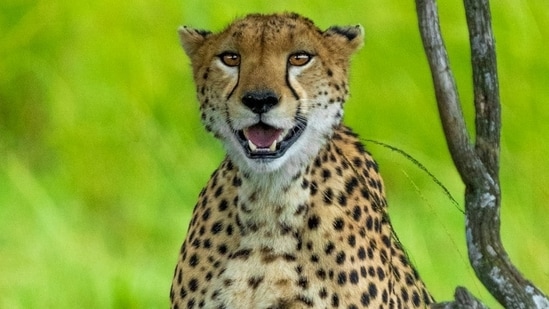
The cheetah is one of
The cheetah is the only large mammal India has lost since independence, and for most of its history in the subcontinent there are no bones or photographs to tell its story. What survives from the pre-modern era are cave paintings, Sanskrit lexicons, Persian chronicles and Mughal miniatures. Cheetah’s story is how a cat that once ranged from Punjab to the Deccan was hunted, tamed and captured out of existence.
A cat built for open country
The cheetah is one of roughly 41 wild cat species, and the odd one out. Its claws are only semi-retractile, which gives it grip as it runs prey down rather than ambushing it. The Asian subspecies, Acinonyx jubatus venaticus, split from African populations between 32,000 and 67,000 years ago. It was first described in 1821 from a sketch of a maneless cheetah from India.
In India, it lived in Rajputana, Punjab, Sind, Gujarat and central India, and south of the Ganges from Bengal to the northern Deccan. It hunted blackbuck and chinkara, and occasionally chital and nilgai. In Punjab, thorn forest broken by grassland once supported vast herds of blackbuck and the cheetahs that followed them.
From rock art to Sanskrit
The oldest likely image is a rock painting at Kharwai near Bhopal. It shows long thin legs, a long tail, an arched back and a small head, quite unlike the heavy-headed leopards painted nearby.
Greek and Roman writers add texture. Strabo in first BCE described pardalis, the Greek word for cheetah, walking in an Indian king’s procession. The Sanskrit Amarakosha, a 4th CE text, lists the chitraka, “the dappled one”, among the five-clawed beasts alongside lion, tiger and leopard. The name is the root of the English word “cheetah”. But chitraka also meant the spotted deer, such as in the Ramayana, therefore we must contextualise all references. Raza Kazmi writes, in How to Trap a Cheetah (And Why You Shouldn’t Have), “Greek ambassadors at the courts of various rulers in ancient India used the word 'pardalis' to describe all spotted large cats they saw, even as the Greek author Oppian of Apamea (3rd century CE) explained in Cynegetica – his noted treatise on hunting – that the pardalis “are a double race.” One kind of pardalis was “larger to look on and stouter as to their broad backs” (a description of the leopard), the other kind was smaller and very swift “in running and valiant in a straight charge…that it sped through the air” (evidently a description of the cheetah).”
The 12th century Solanki court text Manasollasa tells us about trained Cheetahs who hunted Black Bucks. The Pardhi community (a Denotified Tribe) were experts with animals, and were much sought after by princely courts to tame the enigmatic cat. Under the Delhi Sultanate the Cheetah appears as the Persian yuz (the hunting cat). According to contemporary chroniclers like Shams-i-Siraj Afif, Firoz Shah Tughlaq’s menageries held several of these as well as Siya-Gosh or the black Caracal.
The Mughals and Cheetahs
The Mughals took the practice to its zenith. Paper became widely used, and painters brought by emperor Humayun from Iran made visual records of the empire in all its diversity including those of shikars or hunts. Basawan(1556-1600), a famous painter in Akbar’s court, has left us a painting of a cheetah family, evidently the first such depiction of the cat in a natural setting.
Akbar’s stables are reportedly credited with hundreds of cheetahs. The intensity of fascination with cheetahs is staggering. Kazmi writes, “Akbar was especially fond of cheetahs, as attested to by his son Jahangir, who wrote in 1613 that his “revered father once collected 1,000 cheetahs.”
The zest for the sport was passed down to successive rulers. The Mughal empire maintained an elaborate setup of cheetah trappers and trainers. The Mirat-i-Ahmadi by Ali Muhammad Khan, a treatise on the administration during the reign of Aurangzeb (1658-1707), detailed cheetah-trapping locales within Gujarat, where “there are [normally] twenty-two [cheetah] catchers [at a time, presumably on a permanent basis] with a monthly salary of Rs. 80”.
Akbar, who was unlettered and had a large retinue of painters, was a great patron. To reward Chitravan, a Cheetah with extraordinary prowess, he raised it to the rank of a noble, with a jewelled collar and a drum beaten before it.
Bir Singh Deo of Orchha, who helped Jahangir ascend the throne by killing Fazal, Akbar’s most trusted minister, gifted the emperor a white cheetah.
What made Cheetah extinct in India
Captivity over centuries affected the cats the most. For royal hunt adult animals were taken from the wild after they had learned the skill from their mothers. Breeding Cheetahs in captivity is nearly impossible thus gradually the one in the wild became unsustainably few. Divya Singh, author The Story of the Cheetah in India, sees this as a leading cause of extinction. Habitat loss, prey depletion, colonial bounties and trophy hunting under the Raj finished the job.
By the early 20th century wild cheetahs were so scarce that between 1918 and 1945 Indian princes imported them from Africa. The last reported sighting in the subcontinent came from Balochistan, Pakistan, in 1997.
During the UPA II government, the then environment minister Jairam Ramesh attempted to introduce them into India in 2009. The Supreme Court halted it in 2012 and, it later permitted it on an experimental basis in January 2020.
HistoriCity is a column by author Valay Singh that narrates the story of a city that is in the news, by going back to its documented history, mythology and archaeological digs. The views expressed are personal.
One Subscription.
Get 360° coverage—from daily headlines
to 100 year archives.
Archives
HT App & Website