The new edition of Art Mumbai began its four-day run at the Mahalaxmi racecourse in Mumbai on Wednesday with 94 exhibitors, including 73 national and 21 international galleries, of which six made their India debut this year.
By cornering nearly a quarter of the participants list, this marks the highest number of international gallery participation in the four-edition run of the fair so far. In the first edition, only six international galleries participated.
This year, Perrotin, which has several global outposts, Los Angeles’s Night Gallery, UAE’s Rizq Art Gallery, London’s Niru Ratnam and Richard Saltoun will participate at an art fair in India for the first time, while LA-based Rajiv Menon Contemporary makes its Art Mumbai debut. Returning international galleries include Sundaram Tagore, Lisson Gallery and Galleria Continua, all with multiple locations worldwide.
The increase in international galleries brings “diversity to a fair and exposes people living in India to world wide art,” said Dinesh Vazirani, co-founder of Art Mumbai.
At a time when prices of contemporary Indian art still stand to rise, is the Indian art market ready for international artists? What is the strategy that first-time participants intend to use?
{{/usCountry}}At a time when prices of contemporary Indian art still stand to rise, is the Indian art market ready for international artists? What is the strategy that first-time participants intend to use?
{{/usCountry}}Here’s what stands out across new and returning galleries. One, Indian moderns continue to headline sales. Two, galleries attempt a hook with focus artists. For instance, Grosvernor’s centrepiece by Delhi-and London-based Scottish artist Olivia Fraser employs miniature techniques; Night Gallery will showcase a work titled Suryakant, named after the Chief Justice of the Supreme Court of India, by Winnipeg-born Divya Mehra; Lisson showcases contemporary masters like Anish Kapoor. Three, galleries with a predominantly non-Indian roster hope to build a collector base by introducing new international artists at what they hope is an advantageous price point. Four, galleries located in West Asia showcase Indian artists as part of their larger agenda to serve the Indian diaspora living there.
Here’s what five of them have to say about their Art Mumbai outing.
Grosvenor Gallery, London, United Kingdom
Grosvenor gallery, whose founder Conor Macklin is one of the co-founders of Art Mumbai, said that they will offer a host of works by modernists as well as two key pieces: One, a set of rare early views of Mumbai (or Bombay, as it was called then) dating to about 1820, made by an artist called Knight. Both are large watercolours of the view from Malabar Hill — one looking north, the other, south. These works are priced at around ₹2 crore. Two, a triptych by Olivia Fraser, a British artist living in Delhi, who has painted large marigolds using the miniature technique. This will be the centrepiece of the booth. This has been priced at ₹36 lakh. Besides this, the gallery will be selling works by MF Husain and FN Souza, and other modernists, with prices between ₹20 lakh and ₹7 crore.
“This is our fourth year exhibiting at Art Mumbai. The first year was the most exciting because it was very fresh and we had no idea what to expect,” Macklin said. That year, the gallery sold around ₹6 crore-worth of art, Macklin said. Business has improved since then.
“Last year we did above ₹9 crore of business. Footfall has been very good over the years. What is unusual is that we do sales on every single day. I think this is because of the central location of Mahalaxmi racecourse,” he added.
Given the roster of their booth — South Asian modern and contemporary art — a majority of their buyers are India-based. The fact that Indian modernists have seen a remarkable rise in the past two decades — even during the muted years of the pandemic — is not lost on the gallerists. “There was a time when we had to trade Western modern artists to make ends meet, but now, as the prices for Indian modern are catching up, we no longer have to rely on the West and we can further focus on this category,” Macklin added.
Is there a market for international artists among Indian collectors?
“Over the years we try and mix our presentation. For example, last year we showed Works by Howard Hodgkin and we were surprised to place these with local collectors.”
Night Gallery, Los Angeles, United States of America
Night Gallery is showing the works of five artists, Anthony Olubunmi Akinbola, Mira Dancy, Divya Mehra, Robert Nava and Mars Singleton, who “capture Los Angeles’ immense and wandering spirit,” said gallery owner Davida Nemeroff. The works are priced between $5K up to $250K USD ( ₹6 lakh to ₹26 lakh).
Mehra, whose works will be shown in both the sculpture park and the booth, uses “irreverent humor to interrogate colonial histories, political power, and cultural identity,” said Nemeroff.
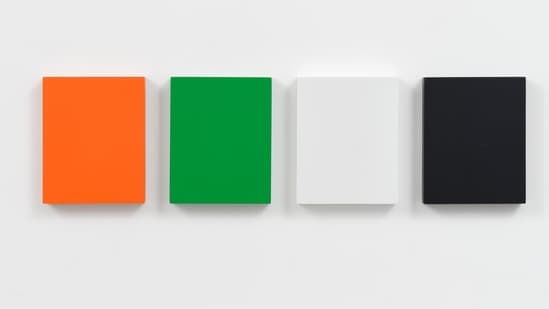
One of them is titled Suryakant. It is a set of four 8x10-inch panels painted in saffron, white, green and black, which carry the words uttered by CJI Suryakant in May while hearing a plea seeking the implementation of SC guidelines on designating senior advocates. “There are youngsters like cockroaches, who don’t get any employment or have any place in profession. Some of them become media, some of them become social media, RTI activists and other activists and they start attacking everyone,” the CJI had said. He further described such people as “parasites of society”. Nemeroff said that Mehra’s work reveals that “familiar forms and symbols can carry complex political meaning”.
Another work by Mehra, titled A Practical Guide, will be shown at the Sculpture Park. It renders the plastic bag into a large-scale, abstracted form and draws the viewer’s attention to its surrounding environment.
“A Practical Guide” implicates its surroundings, asking how institutions, economies, and cultural narratives determine what is acquired, what is displaced, and whose losses are rendered invisible,” Nemeroff said.
Mehra, whose family is from Mumbai, is the only Indian-Canadian artist on their roster. The gallery hopes to draw unexpected connections between Los Angeles and Mumbai. “We believe that, despite the distance, the two cities are more alike than different. These are both cities of extraordinary creativity and re-invention,” Nemeroff said.
The gallery with an international collector base is looking to build relationships with Indian collectors in its first presentation in Mumbai. “I am eager to connect to the art world there,” Nemeroff added.
Lisson Gallery, multiple global locations
Lisson Gallery, which made its debut at Art Mumbai last year, is bringing together a distinctly international group of artists including contemporary masters like Anish Kapoor, Tony Cragg, Ai Weiwei and Hiroshi Sugimoto. They will also be showing works by Christopher Le Brun, Mexico City-based artist Pedro Reyes, Swiss-Japanese artist Leiko Ikemura, and Julian Opie, whose exhibition opens at MAP in Bengaluru later this month. Accordingly, the price range is wide: from USD 30,000 ( ₹28.2 lakh) to GBP 1,200,000 ( ₹15 crore).
“The increasingly international outlook of India's collectors and institutions presents us the opportunity to platform artists working across a wide range of media and contexts, including those whose practices may be less familiar to local audiences,” said gallery director Ellie Harrison-Read.
“While artists such as Anish Kapoor have an established global presence, the fair also allows us to introduce collectors to artists across our programme whose work they may be discovering for the first time,” Harrison-Read said.
Rizq Gallery, UAE
The Rizq Art Gallery opened in November 2023 with 27 Indian artists and more than 60 works during Abu Dhabi Art week. Shafeena Yusuff Ali, founder and executive director calls this representation “deliberate”.
The gallery has shown prominent Indian artists such as Sudharshan Shetty, Gigi Scaria, G.R. Iranna and Jagannath Panda among others in both the gallery as well as other art fairs. Vivek Vilasini, one of the artists on their roster, was recently selected by Louvre Abu Dhabi for the sixth edition of its landmark annual exhibition and competition, Art Here.
“Three years on, approximately 130 artists have passed through the gallery, of whom roughly one in four is Indian,” she said. By value, Indian artists form about a third of their sales, she added. Emirati artists and artists from the wider region, including the Levant, and West Africa, make up the rest.
“So the gallery is not wholly Indian; however, it is a primary conversation that the Gulf had not had,” she said.
For Art Mumbai, Ali put the same question to each of the eight artists, four Emirati and four Indian, whose works she is presenting: “What makes Bombay a special conduit between the Gulf and India, both historically and today?” She asked them to answer in their own materials.
“With over three and a half million Indians in the UAE, and among them some of the most serious collectors in the region, Indian artists hold a lot of significance in the Gulf art market. For years, these collectors were offered prints and nostalgia. I believe the Indian collector in Abu Dhabi is the most under-served serious buyer in the art world, and the Indian artist is under-shown in Abu Dhabi. And this is where the Rizq Art Gallery tries to bridge the gap,” Ali said.
The artists on display include Nujoom Alghanem, who represented the UAE at the 2019 Venice Biennale. A poet, painter, filmmaker, and ceramist, her short film opened the Louvre Abu Dhabi’s exhibition on Indian Ocean trade this season.
Abdulla PA of Thrissur uses the hardware of a port for his installation, Cabinet of Drifting Histories, Amjum Rizve works with beads and Aari embroidery, to trace his own family’s route from Kerala to the Gulf through the old Bombay port, while Bhartti Verma, from Gurugram, paints the furniture of a household that lives in two cities: a rotary telephone whose dial holds a map of the UAE, and a dressing-table mirror with a Mumbai landmark in its glass.
“The four Indian artists have collectors in India, of course. The four Emirati artists have never been shown here. No one in Mumbai has ever stood in front of a Nujoom Alghanem. This is the opportunity we are creating this year for our visitors,” Ali said.
“Mumbai is a city where the modernists hang in family homes and collecting has been passed down through three generations. When a Mumbai collector acquires work by a young artist from Kerala or a painter from Abu Dhabi, it carries a weight that a quick sale elsewhere simply doesn’t,” she added.
Sundaram Tagore, multiple global locations
The artists we are bringing to Art Mumbai this year are predominantly Asian, representing countries such as Japan, South Korea, Vietnam, Singapore, and, of course, India. These are highly regarded and sought-after artists, many of whom have established significant international reputations. We will also be presenting a selection of Western artists, but the principal focus of our presentation is Asia, said Sundaram Tagore, founder of the eponymous gallery.
The range of works is US$10,000 ( ₹9.4 lakh) to US$600,000 ( ₹5.6 crore)
The reason for this emphasis is that we see a meaningful connection between these artists and their Indian counterparts. Despite their different cultural backgrounds, they often share similar ideals in their artistic explorations, philosophical approaches, and engagement with material and form. I am particularly interested in the hand of the artist—the physicality of the creative process, the materiality of the work, and its tactile qualities. For us, art is not simply about the finished image or object; it is also about the thought, labour, and sensibility that go into making it. We believe these shared concerns create opportunities for a deeper dialogue between Asian artists and Indian audiences. We have included the artists’ biographies to provide a more comprehensive understanding of their practices and backgrounds.
Sundaram Tagore’s participation in Art Mumbai last year went beyond physical presence, the gallerist said. “We also work closely with the fair’s organisers to bring our own international network of collectors to India. We had planned to bring a substantial group of international guests this year, but those plans had to be deferred because of the conflict in the Middle East and the resulting uncertainty around travel. Nevertheless, we are expecting a significant number of regional collectors, including people travelling from different parts of India and from neighbouring countries.”
With a presence in New York, London, Hong Kong, and Singapore developed over the past 26 years, Tagore said the gallery has built a global community of collectors. In Mumbai, their presentation will offer Indian collectors “a distinctive perspective—one that may be different from what they have traditionally encountered in the market.”
The Indian collector has changed in the past decade too, Tagore said. “We are seeing a younger, more vibrant, and increasingly cosmopolitan generation of buyers who are confident in their choices and curious about expanding their collections beyond familiar categories. They are interested in introducing new perspectives, taking intellectual risks, and adding different dimensions to their collections.” This has led to Indian collectors becoming an increasingly important part of the gallery’s clientele.
“Indian collectors have the means to acquire significant works when they find something that genuinely speaks to them. In my experience, the decisive factor is often not simply price, but the strength of the connection between a collector and a work of art,” Tagore said.
“I also find Mumbai particularly accessible in terms of the attitude of its people. There is a directness and a pragmatism among the collectors here, coupled with a deep interest in art and culture. They tend to know what they are looking for, and they often have limited time to explore a fair as extensive as Art Mumbai. This places a particular responsibility on us as exhibitors: we must communicate the quality and significance of our programme immediately,” Tagore added.