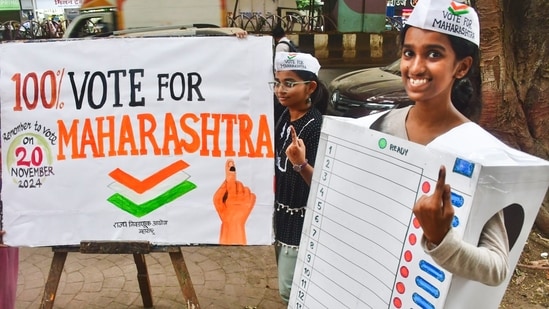
All 288 assembly constituencies in Maharashtra will vote today, November 20. Because this is the first assembly election after vertical splits in the Shiv Sena (SHS) and the Nationalist Congress Party (NCP), past results are not a good indicator of the strength or lack of it of the two major alliances in the state.
In the 2024 Lok Sabha elections the INDIA alliance comprising the Congress, NCP-Sharadchandra Pawar (NCP-SP) and the SHS- Uddhav Balasaheb Thackeray (SHS-UBT) won 30 out of
Do Lok Sabha polls give a true idea of the state of play in Maharashtra?The vote share gap between the two alliances was much smaller than the seat share gap in the Lok Sabha
INDIA alliance’s PC-wise seat share in the 2024 Lok Sabha elections in Maharashtra is 62.5% which is 27.1 percentage points more than the NDA’s 35.4% seat share. However, the vote share gap between the two alliances was almost negligible and the two groups polled a massive 87.5% of the total votes polled with INDIA and NDA blocs having a respective vote share of 43.9% and 43.5%. This shows that in terms of popular support, which is what the vote share number measures, the two alliances were almost neck and neck in the state.
When read at the AC level, even seat shares are pretty close in the 2024 Lok Sabha
This is the most important data point from the Lok Sabha elections which might matter in the assembly election. HT has collated AC-wise results published by the office of the Chief Electoral Officer, Maharashtra for each of the 48 PCs – the Election Commission of India has not published this consolidated data so far – to disaggregate PC-wise results at the AC level. The data presents a very different picture from the PC-wise results. The seat shares of INDIA and NDA alliances become significantly closer at the AC level than they are at the PC level. When read at the AC-wise level, the INDIA alliance’s seat share falls to 53.1% instead of 62.5% at the PC level and NDA’s seat share increases from 35.4% at the PC level to 43.75 % at the AC level.
And many ACs were decided by very small margins
This is the most important thing to keep in mind. The median victory margin at the level of PCs in the 2024 Lok Sabha elections in Maharashtra was 7.9% of the total votes polled. This number becomes 11.9% if the results are analysed at the AC level. A quintile-wise look at the ACs shows that median victory margins for the bottom two quintiles were just 2.4% and 6.6% in the 2024 Lok Sabha elections. To be sure, this is largely the same as the 2019 assembly elections but significantly lower than the margins in the 2019 Lok Sabha elections. Because the BJP, Congress, SHS and NCP fought the 2014 assembly elections on their own, the political contest was different from 2019.
There is a significant variation in region-wise median victory margins
Maharashtra can be broadly divided into five major sub-regions: Khandesh, Konkan, Marathawada, West Maharashtra, and Vidarbha. Among these, Konkan is the largest sub-region, covering 75 Assembly Constituencies (ACs), followed by Vidarbha with 62 ACs and West Maharashtra with 58 ACs. Khandesh and Marathawada have 47 and 46 ACs, respectively. The overall median victory margin across ACs in the 2024 Lok Sabha was 11.9 percentage points. However, different sub-regions exhibit significant variation in terms of median victory margin. Khandesh and Konkan had the highest median victory margin at 16.6 and 15.22 percentage points. On the other hand, West Maharashtra and Vidarbha had a median victory margin of 8.82% and 9.16%. This also means that local factors will play an important role in the forthcoming elections which is anything but a done deal.
{{^htLoading}}{{/htLoading}}{{#usCountry}}{{/usCountry}}