India is a vastly diverse nation in terms of its culture and traditions and we have innumerable languages and dialects. Most Indians are bilingual by birth as they grow up listening and speaking in at least two languages, including English which is a compulsory subject in schools and Hindi, which is our mother tongue. After our independence from the British, we have given a lot of importance to the English language due to globalization and it being one of the most widely spoken languages in the world.
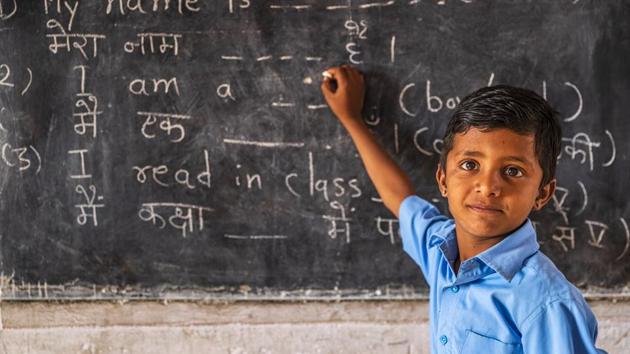
We can’t say the same for Hindi since it isn’t a mandatory subject in most of the schools. A discussion about Hindi also brings up the North and South divide in the country but it shouldn’t be looked at in that perspective. According to a survey by Lok Foundation, 528 million speak Hindi as a first language. It is both the most widely spoken first as well as a second language in India. According to a census report in 2001, approximately 258 million citizens across India spoke in Hindi as their native language, while 120 million used Hindi as a second language. Hindi is also one of the seven languages used to generate web addresses on the Internet.
But lately we have noticed that youngsters and even kids are losing touch of Hindi, mainly because parents as well as our education system does not give it equal importance. Hindi speakers are often looked down upon due to an inferiority complex associated with the language, people see English speaking as a class and stature definition.
A survey of 1,210 families with 2,464 children, conducted earlier by the Azim Premji Foundation in four states, shows that parents do not always make sound choices when it comes to educating their children. They often get spellbound to a school that focuses more on English than Hindi. The fact is that in some countries like India, today speaking English has become an ideogram of class and good education.
{{/usCountry}}A survey of 1,210 families with 2,464 children, conducted earlier by the Azim Premji Foundation in four states, shows that parents do not always make sound choices when it comes to educating their children. They often get spellbound to a school that focuses more on English than Hindi. The fact is that in some countries like India, today speaking English has become an ideogram of class and good education.
{{/usCountry}}However, according to the Lok Foundation survey, English is far more an urban than a rural phenomenon; just 3% of rural respondents said that they could speak English, as against 12% of urban respondents. There is a clear class element at work—41% of the rich could speak English as against less than 2% of the poor.
Therefore, learning both Hindi and English both can have some significant advantages for kids.
Importance of Multilingualism
Learning a second language is always a great way to improve your career opportunities, as well as broaden your travel and cultural horizons. There have been studies that suggest that being multilingual may help improve multitasking, make your memory better, and can also help improve your listening and hearing skills. And being in India, Hindi will always be our first language.
Good exercise for the brain
More parts of the brain are exercised when you learn Hindi instead of English. The way the Devanagari script is written, from its left to right direction with the vowel signs positioned on top, below or on both sides of consonants, both the left and right hemispheres of the brain are equally used when reading the syllabic script. When reading English text, which is alphabetic, only the left hemisphere is activated. In India, schoolchildren are taught to read both English and Hindi texts, making their brain more active than children from other parts of the world that only use alphabetic script.
Furthermore, a number of studies conducted all over the world by different expert groups have established the fact that teaching of mother tongue at the initial stages of education gives impetus to the growth of mind and thought and makes it more creative and logical.
Global reach of Hindi
Historians suggest that the language is part of the Indo-Aryan group of the Indo-Iranian branch that belongs to the Indo-European family of languages. It is not only the preferred language by the majority in India but speakers of Hindi can be found in Uganda, Yemen, Bangladesh, Mauritius and South Africa.
Importance of Regional Language
Hindi has had its own role in our country and is a widely spoken language that binds most Indians together. Most of us have grown up speaking it in our homes and still use it to communicate with our close friends and family. It is also used officially by the government for their paperwork and for diplomatic communications on the world-stage by the prime minister himself. Even our Bollywood fraternity enjoys worldwide popularity thanks to our Hindi blockbusters that have transcended all boundaries and presented the Indian culture on the world stage.
(The author is Founder of iChamp)