The Himachal Pradesh high court on Monday ordered the state government to stop operating two anti-hail guns at Deorighat and Bareonghat, apple-growing villages in the Jubbal-Kotkhai area of Shimla district, for at least a year.
The order came from a bench of chief justice GS Sandhawalia and justice Bipin C Negi. The state had told the court that Dr YS Parmar University of Horticulture and Forestry at Nauni, Solan, was studying whether the guns work and would need at least four more years to reach a definitive conclusion. The court made the university a party to the case, which it will hear next on December 8.
The guns fire shock waves at approaching storm clouds, and their makers say this stops hail from forming. Orchard owners near the two guns say they have worked. Growers farther away say the guns push storms on to their land. Meteorologists say there is still no scientific proof that the devices change hail at all.
Why did the court step in?
The court took up the matter on its own, as a public interest litigation. A resident of Bhamnoli village in Rohru had written to it seeking an immediate ban or suspension of anti-hail guns in the state, on environmental, ecological and public-safety grounds. A bench of the chief justice and justice Ranjan Sharma then issued notice to the state, returnable on July 20.
{{/usCountry}}The court took up the matter on its own, as a public interest litigation. A resident of Bhamnoli village in Rohru had written to it seeking an immediate ban or suspension of anti-hail guns in the state, on environmental, ecological and public-safety grounds. A bench of the chief justice and justice Ranjan Sharma then issued notice to the state, returnable on July 20.
{{/usCountry}}The director of horticulture filed an affidavit in response. According to the court, it showed that heavy rainfall was recorded while the hail-control system ran for more than an hour. The bench held that this bore out the complaint.
"Thus, it is apparent that the concerns raised in the representation that by using the anti-hail guns, the clouds are getting pushed into other portions of the orchards, leading to heavy downpour and hail at the cost of other adjacent areas, stand substantiated," the court said.
It ordered that the guns not be operated "till further orders". It also asked the state to report whether neighbouring areas had benefited once they fell silent.
Also read: Weather flux to continue as rains set to make brief return to Delhi next week: IMD
How does hail form?
Hail falls from cumulonimbus clouds, the tall, dark storm clouds that bring thunder and lightning. Strong updrafts inside them carry raindrops high into air that is well below freezing. Many of these drops stay liquid even there, a state known as supercooled. A hailstone grows by colliding with them and gathers a fresh layer of ice each time. The updraft keeps the stone aloft, or carries it back up through the cloud, until it is too heavy to hold and falls. The stronger the updraft, the bigger the stone. According to the US National Oceanic and Atmospheric Administration, rising air of about 39km/h can hold pea-sized hail, while softball-sized hail needs about 166km/h.
In India, hail is most frequent over the north and northwest of the country in April and May. In Himachal's hills the season begins around March. Most of these storms are brought by western disturbances, weather systems that form over the Mediterranean region and travel east, carrying rain, snow and hail to north India in winter and spring.
What does hail do to an apple crop?
Hail bruises and scars fruit, and the market marks down even small blemishes. "Even a dot on an apple can reduce the price by 20%," said Vardhan Chauhan, who grows apples about five kilometres from Deorighat. He spends more than ₹1 lakh each year putting anti-hail nets over his trees in March and April, at the start of the hail season, and takes them down for the monsoon.
What is an anti-hail gun?
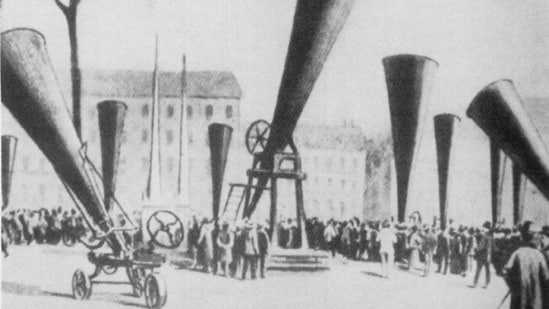
It is a gas chamber at ground level topped by a cone-shaped barrel several metres tall. A mixture of acetylene and air is ignited in the chamber, and the barrel directs the blast upward as a shock wave. The gun is fired repeatedly at an approaching storm, often in the short window between a hail warning, which may come only about 15 minutes ahead, and the storm's arrival.
Manufacturers say the shock waves travel faster than sound and disturb the cloud. In their account, the droplets fall as rain before updrafts can lift them high enough to freeze. They say timing is critical: the gun has to fire while droplets are being lifted, and firing late achieves nothing.
Farmers in Europe have fired cannons and rockets at storm clouds since the 19th century, mostly to protect vineyards.
In some parts of Himachal the guns were taken out of use after they failed to deliver, but the two at Deorighat and Bareonghat kept running.
Do they work?
Growers disagree, largely according to where their orchards are. Gobind Chauhan's orchard shares a boundary with the Deorighat gun. He said hailstorms had become far fewer since it was installed more than 15 years ago, and that any hail that did fall was light. Several farmers in the area still put up nets every year, because even light hail spoils the fruit.
Scientists are sceptical. The World Meteorological Organization, the UN's weather agency, says in its statement on weather modification that "scientific proof on the impact of hail cannons and ionization methods at the cloud scale is still lacking". A 2006 review by J Wieringa and I Holleman of the Royal Netherlands Meteorological Institute described the firing of explosives or sound blasts at hail clouds as a "useless but still quite popular practice". A 2024 study used four years of rainfall data from three farming regions of Mexico and found no link between the cannons and fewer heavy-rain episodes.
The complaint before the court rests on the opposite worry: that the guns move storms instead of dissolving them. That claim assumes the guns change the weather, which the evidence has yet to show. The guns are fired only as a storm approaches, so rain while they run would be expected either way.
In 2018, farmers near Volkswagen's plant in Puebla, Mexico, blamed the hail cannons the company used to shield new cars for a drought. They claimed losses of about 70 million pesos. The carmaker said it would stop using the cannons, except in emergencies, and cover the cars with nets instead.
What will the Himachal study show?
The state told the court the university has not yet collected enough data to reach any conclusion. Nauni and IIT Bombay began recording rain and hail after the guns were fired in June 2021, in the first long-term scientific study of the guns' efficacy. They need about four more years.