Gadi Eisenkot, the former Israeli military chief who led the campaign to replace Prime Minister Benjamin Netanyahu, has been given the first chance to form Israel’s next government, but his bloc is 13 seats short of a majority and he will need the support of parties his allies have opposed.
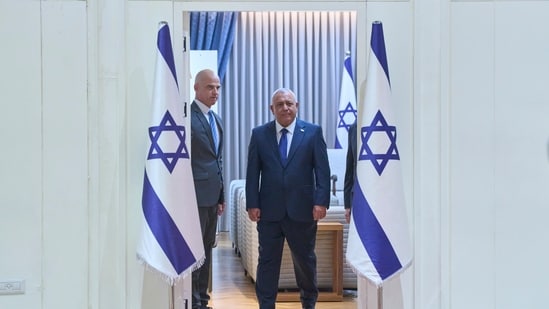
President Isaac Herzog formally handed Eisenkot the mandate on November 8, after consultations with representatives of the parties elected to the 120-member Knesset, Israel's parliament. The October 27 election had left neither Eisenkot’s bloc nor Netanyahu's alliance with enough seats to govern.
According to Herzog’s office, lawmakers representing 67 seats recommended Eisenkot, while representatives of 46 seats backed Netanyahu. A party from Netanyahu’s camp holding the remaining seven seats did not recommend either candidate.
The 67 include the two Arab-led parties.
Under Section 8 of Basic Law: The government, one of the laws that serve as Israel's constitution, Eisenkot has 28 days to form a government, and Herzog can extend the period by up to 14 days.
But securing the mandate does not guarantee that Eisenkot will become prime minister. His four-party bloc, which includes his own Yashar party, the second-largest in the Knesset with 21 seats, has 48 seats. Netanyahu’s Likud won 27, the most of any party, and his wider religious-nationalist bloc has 53. A majority in the 120-member Knesset is 61 seats, making negotiations with parties outside the two main camps crucial.
{{/usCountry}}But securing the mandate does not guarantee that Eisenkot will become prime minister. His four-party bloc, which includes his own Yashar party, the second-largest in the Knesset with 21 seats, has 48 seats. Netanyahu’s Likud won 27, the most of any party, and his wider religious-nationalist bloc has 53. A majority in the 120-member Knesset is 61 seats, making negotiations with parties outside the two main camps crucial.
{{/usCountry}}Eisenkot said on November 8 that he would work to form a “wide” government as quickly as possible, Reuters reported. "We must form a national emergency government. This will require creative and unconventional political steps," he said, according to AFP. Reuters reported that all three of his likely routes to power face formidable obstacles.
Here are the main scenarios.
1. Eisenkot forms minority govt with Arab parties’ support
One possibility is for Eisenkot to form a government with the four Jewish-led parties in his bloc, which together hold 48 seats, and seek support from the two Arab-led parties on important votes.
The two Arab parties, the United Arab List, known by its Hebrew acronym Ra’am, and the Joint List, hold a combined 19 seats. Their support could allow Eisenkot’s government to survive key parliamentary votes without either party formally joining the coalition or taking cabinet positions.
Ra’am has said it will support Eisenkot, and the Joint List has said it will back him from outside the coalition, AP reported.
Reuters has reported that a minority government relying on Arab party votes is among the options available to Eisenkot.
Eisenkot has appeared to suggest he is willing to start with such a government before bringing other lawmakers into his coalition, AFP reported. However, this route faces opposition from within his own camp. Avigdor Lieberman, a former defence minister who leads Yisrael Beiteinu, one of the parties in Eisenkot’s bloc, has ruled out supporting a minority government that depends on Arab parties, Reuters reported.
A more formal arrangement, in which the Arab-led parties join an Eisenkot-led coalition, could give the bloc 67 seats. But that would require parties with different political positions to agree to govern together. Ra’am is the only Arab-led party to have joined an Israeli governing coalition, in 2021, according to AP.
2. Ultra-Orthodox parties join an Eisenkot-led coalition
Another possibility is an agreement with the ultra-Orthodox parties Shas and United Torah Judaism (UTJ), which together hold 13 seats. If both joined Eisenkot’s 48-seat bloc, the resulting coalition would have 61 seats, the narrowest possible majority.
This option could avoid the need to bring Arab-led parties into the government. But it would put a contentious policy issue at the centre of negotiations: military service exemptions for ultra-Orthodox Jewish men, known as Haredim.
Eisenkot and his allies made equal military service central to their campaign, and Eisenkot has said any party that joins him must support mandatory military or civilian service, AP reported. The ultra-Orthodox parties want to preserve the exemptions for religious students. Many Israelis have grown resentful of the exemptions as reservists serve repeated tours of duty, AFP reported.
Reuters reported that Lieberman, who had previously opposed joining a government with ultra-Orthodox parties, has softened that stance, provided they support legislation requiring Haredi men to serve in the military. “Given the current reality, in order to prevent further elections and bring an end to the Netanyahu era, there is no choice but to make difficult decisions,” he said, according to Reuters.
Whether Shas and UTJ would accept those conditions remains a major obstacle to this route. UTJ has left the door open to cooperating with Eisenkot, AP reported.
3. A unity government with Netanyahu
Eisenkot could also explore a broad unity government that includes Netanyahu's Likud party and some or all of the parties in the opposition bloc.
Netanyahu has called for a unity government of “all Zionist parties”, and has ruled out a coalition with Arab-led parties. A combination of Likud’s 27 seats and Eisenkot’s four-party bloc of 48 would have 75 seats in the Knesset.
However, such an arrangement would require a major political compromise. Eisenkot and his allies campaigned against Netanyahu's continued leadership, while Netanyahu has not indicated whether he would be willing to serve under Eisenkot.
Eisenkot has invited Likud to join only with himself as prime minister, AFP reported. Lieberman has ruled out a unity government with Netanyahu, according to Reuters, which would take his party's seats out of that 75.
AP reported it was unclear whether the two men could agree on a power-sharing deal. The parties would have to settle who leads the government first, as well as agree on policy and ministerial positions. Israel has tried such a deal before: under the 2021 coalition, Naftali Bennett and Yair Lapid agreed to take turns as prime minister.
4. Netanyahu gets a chance to form government
If Eisenkot fails to form a government, Herzog can give another member of the Knesset the opportunity.
Under Section 9 of the Basic Law, the president must decide within three days of the first candidate’s failure whether to assign the task to another lawmaker who is willing to take it or inform the Knesset speaker that there is no possibility of forming a government. The second candidate gets 28 days, with no provision for an extension.
Netanyahu would be the likely choice. His Likud party won 27 seats, the largest tally for any single party, although his wider bloc has only 53, eight short of a majority, and only 46 lawmakers recommended him to Herzog.
He would have to win over parties that did not back him during Herzog’s consultations, or persuade lawmakers from the opposition to switch sides.
However, Netanyahu would still need to overcome the same divisions that have complicated the formation of a government so far.
5. A third candidate, or Israel heads towards elections
If both Eisenkot and a second candidate fail, the process does not necessarily lead immediately to another election.
Under Section 10 of the Basic Law, a majority of the Knesset, at least 61 members, can submit a written request within 21 days asking the president to assign the task to another lawmaker who has agreed to take it. The president must then give that candidate the mandate within two days, and the candidate has 14 days to form a government.
If no such request is submitted, or the third candidate also fails to form a government or win the Knesset's confidence, the Knesset is deemed to have decided to dissolve itself. New elections must then be held within 90 days, the law states. That would mean elections early next spring.
Until a new government is formed, Netanyahu and his cabinet remain in office in a caretaker capacity, with limited powers.