Americans will vote on Tuesday in midterm elections that will determine the control of the House of Representatives and the Senate. But the results will extend well beyond Congress. For President Donald Trump, the vote is a referendum on his second term. For the Republicans and the Democrats, and for those hoping to succeed Trump, it will shape the race for the 2028 presidential nomination and the direction each party takes after his term.
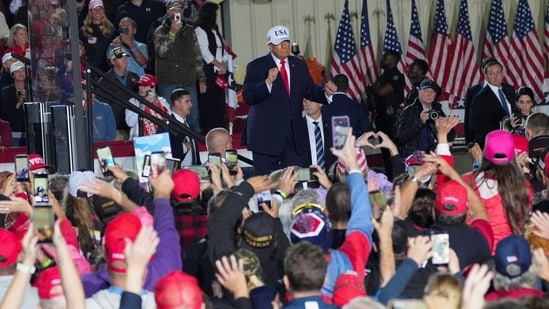
Here is what is at stake for the key players.
Donald Trump
For President Trump, the election will be a major referendum on his performance in office. Most indicators suggest an electoral setback is in the works for the 80-year-old commander-in-chief, amid the US’s ongoing war with Iran that has led to higher fuel prices and sparked a global crisis. His approval rating has even dropped to an average of around 37%, which is among the lowest in recent memory for a President leading his party into a major election.
Trump has to defy the odds and political gravity in order to hold on to both the House of Representatives and the Senate. If he does, his standing as one of the most consequential and powerful American politicians of the last 50 years will be greatly strengthened.
Besides, control over both chambers would shield Trump’s signature policies, including global tariffs and the war on Iran, from congressional challenges over funding and oversight. Presidents in the last year or two of their terms are often referred to as “lame ducks” – capable of doing little of consequence while the country looks beyond them towards their successor. A victory for the Republicans may help Trump in shaping the race for the party’s 2028 presidential nomination.
{{/usCountry}}Besides, control over both chambers would shield Trump’s signature policies, including global tariffs and the war on Iran, from congressional challenges over funding and oversight. Presidents in the last year or two of their terms are often referred to as “lame ducks” – capable of doing little of consequence while the country looks beyond them towards their successor. A victory for the Republicans may help Trump in shaping the race for the party’s 2028 presidential nomination.
{{/usCountry}}The House has the power to approve government spending and launch investigations into the administration. The Senate confirms the President’s nominees, including judges and cabinet officials, holds key powers on foreign policy matters and also approves spending bills once they pass the House.
Losing both the House and the Senate to the Democrats would deal the President a bruising defeat. This would give the opposition substantial power to frustrate Trump’s domestic agenda and embarrass his administration with corruption investigations. Even a split result, with Democrats winning only the House, would hand them subpoena power and leverage over spending, though a Republican Senate would continue to approve Trump’s nominees.
Republicans
For much of the last few years, the Republican party has been reduced to an instrument of Trump’s will. Few modern Presidents have dominated their parties the way he has, and that dominance will be tested on Tuesday.
A recent poll by Politico found that Trump’s hardline Make America Great Again (MAGA) voters are likely to back him even if he loses the midterms. In fact, 54% of them said losing both the House and the Senate would be a sign the party needed to align itself more closely with his policies.
Trump voters who do not identify as MAGA disagree. Some 44% of them said the loss of both chambers would be a sign that the party must distance itself from the President. More moderate voters have also expressed less support for the President’s hardline views on immigration.
A decisive Republican defeat at the polls on Tuesday could spark a battle within the party over its future.
Democrats
The party suffered a major setback in 2024, when it lost the White House and the Senate to the Republicans, and failed to regain the House of Representatives. For the last two years, the Democrats have been on a quest to redeem themselves, fighting off concerns that the party is too weak, out-of-touch and disorganised to beat Trump. Winning one or both chambers will do much toward restoring its confidence ahead of the 2028 presidential election. A bad result will only further spotlight its weaknesses.
The party’s moderate establishment is at odds with a new generation of progressive, left-wing politicians such as New York City Mayor Zohran Mamdani. A deeply embarrassing example of this division came to light on Sunday when US Representative Haley Stevens - a Democrat - broke with her party to endorse the Republican party’s candidate for US Senate in the state of Michigan. Stevens had narrowly lost her bid to become the Democratic candidate for the seat to progressive, left-wing candidate Abdul El-Sayed. The defection set off alarm bells within the party, as the seat is crucial to Democratic hopes of taking control of the Senate. More broadly, it reinforced the damaging perception that the party is too divided to get its house in order, even for must-win elections.
The battle for the 2028 presidential election will also begin in earnest within months of Tuesday’s midterms. Primary fights are divisive even in the best of times. If the Democratic Party cannot handle its divisions well enough to win a single Senate seat in Michigan, observers will ask, how will it cope when its top leaders jostle for the presidential nomination?
Republican 2028 hopefuls
Three Republican names stand out as potential candidates for the 2028 election: Vice President JD Vance, Texas Senator Ted Cruz and Secretary of State Marco Rubio. Rubio, however, has expressed a lack of interest in running for the polls and said he will support Vance’s candidacy.
The future of the other two will depend on Tuesday’s results. Vance is the frontrunner and the politician most closely tied to the President. A victory in the midterms will likely lead him to move ever closer to Trump’s policies in an effort to win support from the party’s base. A Republican defeat might signal that the country is tiring of President Trump and his policies. That may pose a problem for Vance, who will have to balance loyalty to the President with enough distance to avoid being tainted by his unpopularity, a balance that Kamala Harris tried and failed to strike in 2024.
Meanwhile, Cruz has been careful to carve out an independent position from the White House on key issues, including by speaking out against an increasingly troubling acceptance of racism and white supremacist influencers within the Republican party. A bad result in the midterms could bolster Cruz’s call for the party to return to its more traditionally conservative roots. He, however, remains a divisive figure even within his own party and likely lacks the backing to challenge Trump’s hold over the Republican base.
Democratic 2028 hopefuls
A long list of Democratic politicians are eyeing their party’s nomination for the Presidency. Former Vice President Kamala Harris, California Governor Gavin Newsom and Representative Alexandria Ocasio-Cortez are some of the key names in the mix. If Trump and the Republican party face severe setbacks during Tuesday’s elections, it could spark an intense competition within the Democratic party.
Whoever wins the Democratic party’s nomination could enter the race with an advantage, facing a Republican nominee saddled with an unpopular outgoing President, an unpopular war with Iran and high prices. Managing internal divisions and personal rivalries over the coming months could become crucial for the party.