India's relationship with electronics has changed faster than its ability to responsibly retire them. A country that leapfrogged straight to smartphones is now generating electronic waste at a pace few regulatory systems anticipated. According to the Central Pollution Control Board, India generated over 14 lakh metric tonnes of e-waste in 2025–26 alone, a figure that has more than doubled since 2017-18, when the country produced roughly 7 lakh tonnes. NITI Aayog projects this could climb to 14 million metric tonnes annually by 2030, growing at nearly 17% a year.
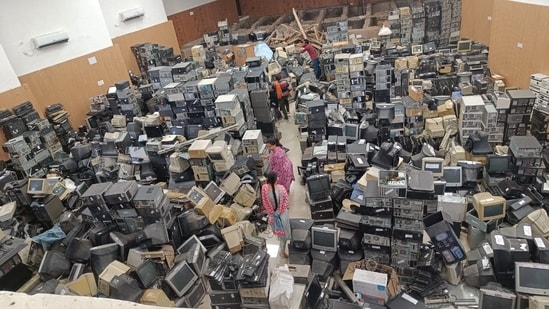
The instinct, understandably, has been to respond with recycling more collection points, more authorised dismantlers, more formalised scrap channels. And progress here is real: the share of generated e-waste that is formally collected and processed has risen from around 10% a decade ago to roughly 70% today. That is not a small achievement in a country where the informal sector has historically handled the overwhelming majority of discarded electronics, often through unsafe acid leaching and open burning.
But recycling, even at its best, is the last and least valuable step in managing a resource. If India's e-waste strategy stops at "collect it and shred it," the country will keep building bigger recycling infrastructure to process an ever-larger stream of waste without ever asking why that stream keeps growing in the first place, or whether most of what enters it needed to become waste at all.
Three forces are compounding simultaneously. First, digitisation itself: cheaper data, expanding 4G and 5G coverage, and government-led digital services have pushed smartphone and computing device penetration into every income bracket and geography. Second, consumption patterns have shifted from need-based to cycle-based purchasing device upgrades are now driven as much by marketing cycles, financing schemes, and social signalling as by functional failure. Third, and perhaps most underappreciated, product lifecycles have genuinely shortened. Devices are harder to repair, batteries are frequently non-removable, software support windows are shrinking, and replacement parts are often costlier than a new base-model device. Computer equipment alone accounts for roughly two-thirds of India's e-waste stream, a strong signal of how enterprise and personal computing refresh cycles are driving volumes.
{{/usCountry}}Three forces are compounding simultaneously. First, digitisation itself: cheaper data, expanding 4G and 5G coverage, and government-led digital services have pushed smartphone and computing device penetration into every income bracket and geography. Second, consumption patterns have shifted from need-based to cycle-based purchasing device upgrades are now driven as much by marketing cycles, financing schemes, and social signalling as by functional failure. Third, and perhaps most underappreciated, product lifecycles have genuinely shortened. Devices are harder to repair, batteries are frequently non-removable, software support windows are shrinking, and replacement parts are often costlier than a new base-model device. Computer equipment alone accounts for roughly two-thirds of India's e-waste stream, a strong signal of how enterprise and personal computing refresh cycles are driving volumes.
{{/usCountry}}Layer onto this the coming wave from India's electric vehicle and renewable energy push. Lithium-ion battery demand is expected to grow at 26 percent annually, from 16 GWh in 2023 to a projected 248 GWh by 2035. Battery waste brings a different order of complexity thermal risk, chemical hazard, and recovery economics that conventional e-waste dismantling was never designed for. Treating this as more of the same waste stream would be a significant miscalculation.
Recycling recovers materials copper, gold, aluminium, some rare earths but only after destroying everything else of value in a device: its embedded engineering, its remaining functional life, its components that could serve a second or third use. Global data consistently shows that reuse and refurbishment retain far more of a product's original value and avoid substantially more carbon and material footprint per unit than recycling does, because they avoid the energy- and chemical-intensive process of extracting virgin-equivalent materials from shredded scrap.
India's e-waste conversation has been almost entirely recycling-centric, in part because that is what the regulatory framework measures and rewards. This needs to widen along the full circularity hierarchy:
- Reuse--extending a device's life through direct resale or redeployment, particularly relevant for enterprise IT assets, government devices, and mid-life consumer electronics that are discarded functional.
- Repair--building accessible, affordable repair ecosystems, including support for India's vast informal repair economy, which already keeps millions of devices alive longer than formal channels acknowledge.
- Refurbishment--professionally restoring devices to warranty-backed, resale-ready condition, an area where India has an underdeveloped but commercially promising opportunity, especially for laptops, smartphones, and medical equipment.
- Remanufacturing--rebuilding components (batteries, motors, circuit boards) to original specification for reintroduction into new products, which is standard practice in mature electronics markets but nascent in India.
- Resource recovery--recycling as the genuine last resort, focused on maximising material yield and minimising hazardous release, once reuse and repair options have been exhausted.
Right now, India's Right to Repair framework, introduced in 2022, is a meaningful start. It pushes manufacturers toward publishing repair manuals, sharing spare parts pricing, and enabling third-party repair. But adoption is inconsistent across sectors, and there is no strong economic incentive structure pulling volumes toward reuse and refurbishment before they reach a shredder. Without deliberate market design, tax treatment, certification standards, warranty norms for refurbished goods, and consumer trust-building recycling will keep absorbing devices that had years of useful life left in them.
The E-Waste (Management) Rules, 2022 restructured India's Extended Producer Responsibility system, introducing an online portal, EPR certificate trading, and targets tied to the quantity of electronics a producer places on the market. This has driven real formalisation the jump in recycled tonnage over the past three years is partly a direct result of producers now needing certificates to demonstrate compliance.
But a system built primarily around certificate generation and target fulfilment creates a structural risk: compliance becomes the objective, rather than a proxy for genuine environmental outcomes. A tonne of e-waste processed on paper does not automatically mean hazardous substances were safely contained, that material recovery was maximised, or that the processing facility itself met environmental and labour standards. Reports of EPR certificate trading detached from verified physical processing, and continued leakage of e-waste into the informal and semi-formal sector, point to gaps between the compliance number and the on-ground reality.
Three shifts would move the system from paperwork to impact:
Traceability across the chain. India needs stronger digital tracking of e-waste from collection point to final material recovery not just aggregate tonnage reporting, but batch-level visibility into where devices go, who processes them, and what happens to hazardous fractions like leaded glass, mercury switches, and battery cells. Serialised tracking, QR-based chain-of-custody systems, and third-party audits of recycler facilities would close much of the verification gap.
Processing quality, not just processing quantity. Authorised recyclers vary widely in technical capability, from facilities with genuine hydrometallurgical or mechanical separation capacity to operations that do little more than basic dismantling before informal channels take over. Certification and inspection regimes need to differentiate and reward recyclers who invest in higher-recovery, lower-emission processing, rather than treating all authorised facilities as equivalent.
Outcome-linked targets. EPR targets are currently expressed largely in tonnage collected and processed. A more mature system would also track material recovery rates, informal sector displacement, hazardous substance containment, and critically how much e-waste was diverted upstream into reuse and repair before ever entering the recycling stream. Some of this data already exists within CPCB reporting; the opportunity is to make it central to how compliance is judged, not a secondary statistic.
Building this ecosystem requires coordinated movement from multiple actors, not a single policy lever:
- Producers need to design for disassembly, repairability, and material recovery from the outset, rather than treating end-of-life management as someone else's downstream problem.
- Retailers and platforms are well positioned to run structured buy-back and trade-in programmes that feed directly into refurbishment pipelines rather than storage or informal disposal.
- State governments can formalise and support the informal repair and collection workforce that already handles a large share of e-waste, rather than treating it purely as a compliance risk to be displaced.
- Recyclers need investment support and technology upgrades to move beyond basic dismantling toward higher-value material recovery.
- Regulators should evolve EPR from a certificate-generation exercise into a verified, outcome-linked accountability system.
- Consumers need visible, trustworthy channels for repair, resale, and responsible disposal — most e-waste today is lost not to indifference but to the absence of an easy, credible alternative to simply keeping a broken device in a drawer.
India does not lack the volume of e-waste to build a serious circular economy around quite the opposite. What it lacks is a system that treats each device as a sequence of value-recovery opportunities rather than a single event called recycling. The next phase of India's e-waste strategy will be judged not by how many tonnes get collected, but by how much of that value is captured before the shredder and how honestly the numbers reflect what actually happens to a device once it leaves a consumer's hands.
(The views expressed are personal)
This article is authored by Prashant Singh, founder and CEO, Blue Planet environmental solutions.