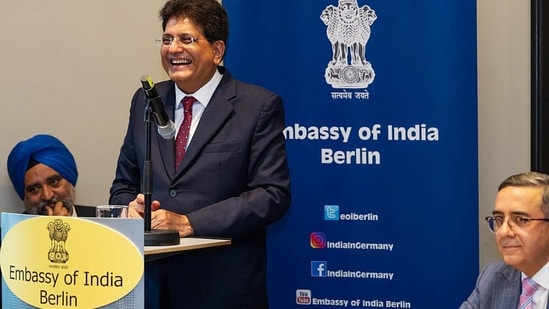
For decades, German companies came to India for one reason. There were many customers, and they wanted to sell them cars, machines and medicines. That is changing. After two days of meetings in Berlin recently, commerce minister Piyush Goyal said the chief executives he met had one message: German firms no longer see India only as a market, but as their partner.
The numbers show why. About 2,000 German companies already work in India and Goyal says most plan to double or triple their operations in the next two to five years. Many run global capability centres here, where young Indian engineers and analysts do design, software and research work for their head offices. India now hosts more than 2,100 such centres. Sentiment has little to do with it. Goyal was frank that the biggest task before German industry today is to cut costs and stay competitive in world markets. That is why German firms are looking to manufacture far more in India. India offers what they need most: scale, lower costs and a large pool of young people.
The question for India is not whether German money will come. It is what kind of partnership we want, and who in India gets a share of the gains. Start with the obvious. Germany is not buying land or tax breaks. It is buying people. Goyal himself spoke of lakhs of young men and women working in these centres. If talent is the real currency of this relationship, India has to invest in it seriously. The best-known centres hire from a thin top layer of graduates in a few big cities. Many more young people finish college without the practical skills such employers look for.
Germany has a tested answer to this problem. Under its dual system of vocational training, students spend part of the week in a classroom and part on the shop floor, paid by the company. The coming expansion of German business in India is the moment to make such training a condition, not a favour. Any new German plant or centre that gets state support could commit to training a fixed number of apprentices from nearby districts, instead of only hiring finished graduates from the metros. Second, the gains must reach women. Technical and factory jobs can give young women from small towns steady income, independence and a career. But women will take up these jobs only if the conditions are right: Safe transport, decent housing near the workplace and fair shifts. German companies opening new units should be asked to report how many women they hire and train, and state governments should build the support around these units. What gets counted gets done. Third, India must ask for laboratories, not only back offices. Goyal says co-creation and co-innovation will come step by step, and he has invited German research institutes to come and work in India. That is the right instinct, but it needs a timetable. The semiconductor partnership that India and Germany agreed during Chancellor Friedrich Merz’s visit in January offers an early test. If India only assembles and tests what is designed elsewhere, the relationship stays lopsided. Joint patents, shared research funds and Indian scientists in senior roles say more about partnership than the number of centres opened. Fourth, the terms must be fair both ways. In 2025-26, India sold Germany goods worth about $ 11.5 billion and bought nearly $ 19.5 billion. Germany ranks only tenth among India’s foreign investors. The free trade agreement with the European Union, concluded in January and likely to take effect next year, should help narrow that gap. Goyal himself has said its success will be judged by new business, new orders, more investment and technology partnerships. But trade is also about people who move. Indian engineers, nurses and students who go to Germany need quick visas, fair recognition of their degrees and protection from dishonest agents. Goyal’s sharp words in Berlin on Europe’s carbon border tax were a reminder that European rules can hurt Indian exporters even as European companies court Indian talent. A partner cannot welcome the workers and tax the products. There is one more gap, and it is easy to miss. Trade has grown, but mutual understanding needs the same attention. Business that lasts for decades depends on people who know each other’s languages, history and ways of working. Goyal opened an India Centre at a Berlin think tank and met Indian researchers and students during his visit. That is a good start. Companies planning to stay for the long-run need people who can read each other’s newspapers, not just each other’s balance sheets.
{{/usCountry}}Germany has a tested answer to this problem. Under its dual system of vocational training, students spend part of the week in a classroom and part on the shop floor, paid by the company. The coming expansion of German business in India is the moment to make such training a condition, not a favour. Any new German plant or centre that gets state support could commit to training a fixed number of apprentices from nearby districts, instead of only hiring finished graduates from the metros. Second, the gains must reach women. Technical and factory jobs can give young women from small towns steady income, independence and a career. But women will take up these jobs only if the conditions are right: Safe transport, decent housing near the workplace and fair shifts. German companies opening new units should be asked to report how many women they hire and train, and state governments should build the support around these units. What gets counted gets done. Third, India must ask for laboratories, not only back offices. Goyal says co-creation and co-innovation will come step by step, and he has invited German research institutes to come and work in India. That is the right instinct, but it needs a timetable. The semiconductor partnership that India and Germany agreed during Chancellor Friedrich Merz’s visit in January offers an early test. If India only assembles and tests what is designed elsewhere, the relationship stays lopsided. Joint patents, shared research funds and Indian scientists in senior roles say more about partnership than the number of centres opened. Fourth, the terms must be fair both ways. In 2025-26, India sold Germany goods worth about $ 11.5 billion and bought nearly $ 19.5 billion. Germany ranks only tenth among India’s foreign investors. The free trade agreement with the European Union, concluded in January and likely to take effect next year, should help narrow that gap. Goyal himself has said its success will be judged by new business, new orders, more investment and technology partnerships. But trade is also about people who move. Indian engineers, nurses and students who go to Germany need quick visas, fair recognition of their degrees and protection from dishonest agents. Goyal’s sharp words in Berlin on Europe’s carbon border tax were a reminder that European rules can hurt Indian exporters even as European companies court Indian talent. A partner cannot welcome the workers and tax the products. There is one more gap, and it is easy to miss. Trade has grown, but mutual understanding needs the same attention. Business that lasts for decades depends on people who know each other’s languages, history and ways of working. Goyal opened an India Centre at a Berlin think tank and met Indian researchers and students during his visit. That is a good start. Companies planning to stay for the long-run need people who can read each other’s newspapers, not just each other’s balance sheets.
{{/usCountry}}Germany has decided India is more than a market. India’s task now is to make sure it becomes more than a workshop. That means training the young people German firms want, opening doors for women and small-town graduates, insisting on shared research and keeping trade fair. If India gets this right, the next chapter of this relationship will be written in classrooms and laboratories as much as in boardrooms.
(The views expressed are personal)
This article is authored by Amit Kumar Sharma, doctoral scholar, Centre of German Studies, Jawaharlal Nehru University, New Delhi.